



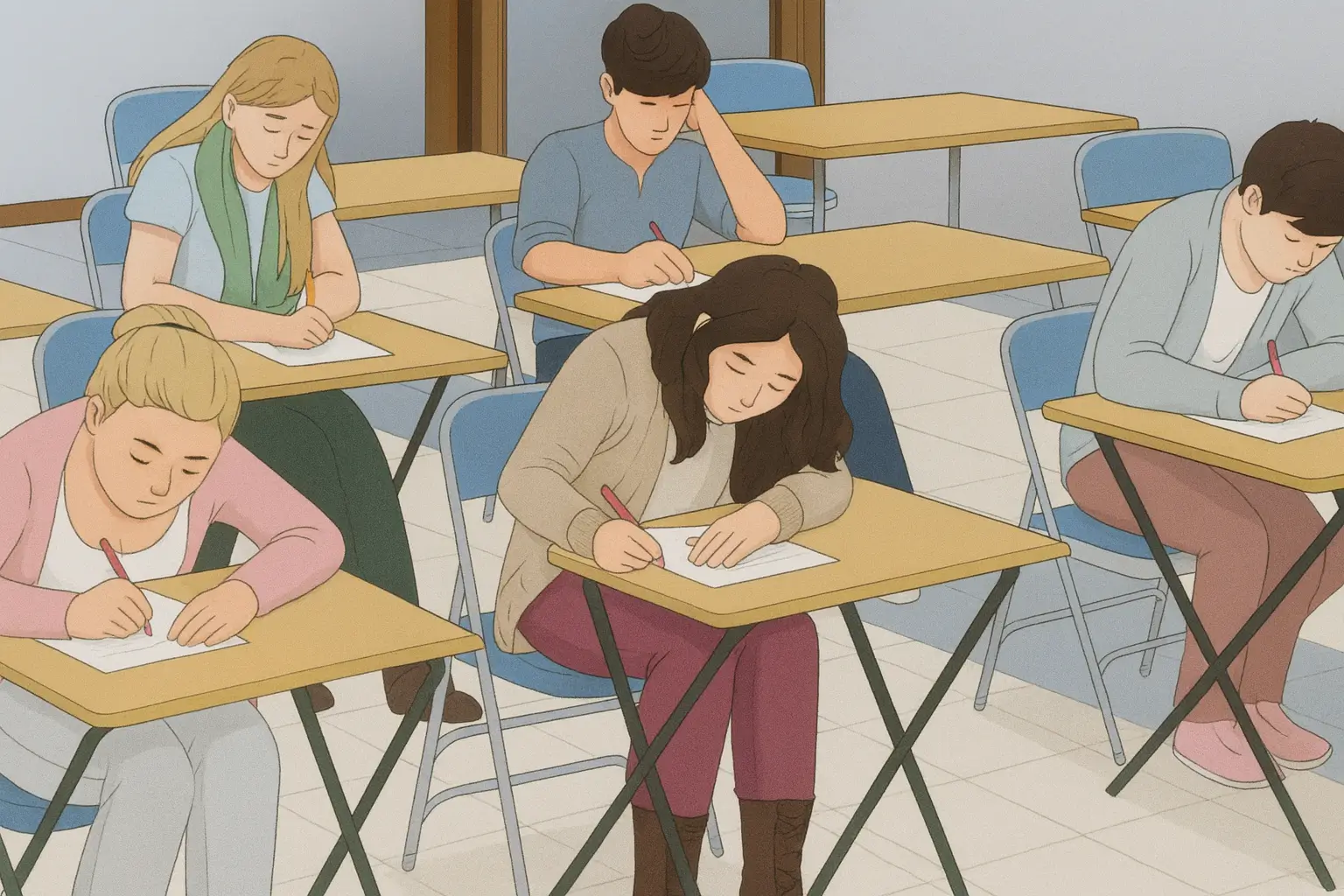
Class 6 Science Question Paper
100 Marks • Full-Length Practice & Examination Paper
Class 6 Science Question Paper – Practice & Revision
This Class 6 Science question paper is designed for students who want to revise important science concepts and practise different examination-style questions. The paper covers topics such as air, plants, materials, separation of substances, food and nutrients, magnets, measurement, temperature, motion, water, living organisms, space and natural resources.
It includes MCQs, Assertion–Reason questions, very short answer questions, short answer questions, long answer questions and a case-study/application-based question. Use it as a mock test, revision worksheet, classroom practice paper or examination-preparation resource.
Maximum Marks: 100
SCIENCE – CLASS VI
Time: 3 Hours
Maximum Marks: 100
General Instructions
- The question paper consists of five sections – A, B, C, D and E.
- All questions are compulsory.
- Read the questions carefully and write your answers neatly.
- Draw labelled diagrams wherever necessary.
- Marks are indicated against each question.
SECTION – A (Objective Type)
Q1–Q15: Choose the correct option. (1 × 15 = 15)
Q1. The gas that forms the major part of the air around us is –
(a) Oxygen (b) Carbon dioxide (c) Nitrogen (d) Water vapour
Q2. Plants with soft, green and tender stems are generally called –
(a) Trees (b) Herbs (c) Shrubs (d) Climbers
Q3. Materials that allow light to pass through them clearly are called –
(a) Opaque (b) Translucent (c) Transparent (d) Shiny
Q4. Which of the following mixtures is best separated by filtration?
(a) Salt in water (b) Sugar in water (c) Cornflakes in milk (d) Ink in water
Q5. Which food item is not mainly a source of carbohydrates?
(a) Rice (b) Bread (c) Potato (d) Fish
Q6. Which of these will be strongly attracted by a bar magnet?
(a) Copper coin (b) Plastic scale (c) Iron nail (d) Wooden block
Q7. The vitamin important for good vision, especially in dim light, is –
(a) Vitamin A (b) Vitamin B₁₂ (c) Vitamin C (d) Vitamin D
Q8. The SI unit of length is –
(a) Centimetre (b) Metre (c) Kilometre (d) Millimetre
Q9. A string is 2.5 m long. Its length in centimetres is –
(a) 25 cm (b) 250 cm (c) 2500 cm (d) 2.5 cm
Q10. Which of these substances will dissolve most readily in water?
(a) Sand (b) Sugar (c) Sawdust (d) Cooking oil
Q11. The Kelvin temperature equal to 30 °C is approximately –
(a) 273 K (b) 300 K (c) 303 K (d) 330 K
Q12. The hands of a clock show –
(a) Rectilinear motion (b) Circular motion (c) Oscillatory motion (d) Random motion
Q13. A clinical thermometer is specially designed to measure –
(a) Air temperature (b) Water temperature (c) Body temperature (d) Soil temperature
Q14. Change of liquid water into water vapour on heating is called –
(a) Condensation (b) Evaporation (c) Freezing (d) Melting
Q15. The process by which living organisms give rise to more individuals of their own kind is –
(a) Respiration (b) Reproduction (c) Excretion (d) Circulation
Q16–Q20: Assertion–Reason type. (1 × 5 = 5)
For each question, choose the correct option:
(a) Both A and R are true and R is the correct explanation of A
(b) Both A and R are true but R is not the correct explanation of A
(c) A is true but R is false
(d) A is false but R is true
Q16.
Assertion (A): A freely suspended bar magnet always comes to rest roughly in the north–south direction.
Reason (R): The Earth itself behaves like a giant magnet.
Q17.
Assertion (A): Some diseases occur when our body does not get enough of a particular nutrient.
Reason (R): Vitamins and minerals are unnecessary for maintaining good health.
Q18.
Assertion (A): Coal is called a non-renewable source of energy.
Reason (R): Coal takes millions of years to form and cannot be quickly replaced once used.
Q19.
Assertion (A): Magnetic separation is not useful for separating iron filings from sand.
Reason (R): Iron filings are attracted towards a magnet whereas sand is not.
Q20.
Assertion (A): Every seed must receive sunlight directly to begin germination.
Reason (R): Sunlight is needed later for the growth of the young plant during photosynthesis.
SECTION – B (Very Short Answer Type)
(Answer each question in 2–3 sentences. 2 × 6 = 12)
Q21. Why is our planet Earth often called the “blue planet”?
Q22. Where are the poles of a bar magnet situated?
OR In which direction does a magnet suspended freely with a string finally settle?
Q23. Why are thermometers using mercury gradually being replaced by other types?
Q24. What happens when hot steam touches a metal plate kept cold with ice?
OR “Condensation is the reverse of evaporation.” Explain briefly.
Q25. State the main function of proteins in our body.
Q26. Which characteristic of living organisms helps to maintain the continuity of life on Earth? Explain in one or two lines.
SECTION – C (Short Answer Type)
(Answer in about 40–60 words. 3 × 9 = 27)
Q27. A beaker contains a mixture of iron nails, common salt, cooking oil and water. Describe, in steps, how you would separate each component from the mixture.
Q28. How do different organisms vary in their habitats? Give examples of one terrestrial and one aquatic habitat and mention how animals are suited to each.
Q29. (a) What is meant by a comet?
(b) Why does a comet appear to have a long tail?
(c) Name any one famous comet.
OR
Name the heavenly body closest to the Earth. Why do we observe dark patches or spots on its surface?
Q30. Neha tested a sample of paneer by adding copper sulphate solution and caustic soda solution, but no violet colour appeared. What conclusion can she draw about the presence of protein in that paneer sample?
Q31. Is it possible to separate sugar crystals mixed with wheat flour? Give reason for your answer and suggest a suitable method, if any.
OR
Why is it sometimes necessary to separate the different components of a mixture? Give two practical examples.
Q32. Compare the motion of:
(a) a stone dropped from a height, and
(b) a stone tied to a string and whirled in a horizontal circle.
OR
Name the system of units used all over the world. What is its basic unit of length? Convert 1.5 m into centimetres.
Q33. Why are fresh fruits and vegetables considered essential for a balanced diet? Mention any three reasons.
Q34. What is the significance of dissolved oxygen for organisms living in water?
OR
What may happen if the amount of carbon dioxide in the atmosphere keeps increasing for a long time? State two effects.
Q35. Why are millets often referred to as “nutri-cereals”?
SECTION – D (Long Answer Type)
(Answer in about 70–90 words. 4 × 5 = 20)
Q36. Ramesh has three glass window panes in his study room. One is left clear, the second is painted yellow and the third is painted black.
(i) Through which pane will he see outside most clearly?
(ii) Through which pane will he not be able to see anything?
(iii) What kind of image will he see through the yellow pane and why?
Relate your answers with transparent, translucent and opaque materials.
Q37. “Air is a mixture and not a pure substance.” Justify this statement with at least four points.
Q38. Why is it important to include a variety of food items in our daily meals?
OR
What can be the harmful effects of eating an unbalanced diet for a long time? Explain with suitable examples.
Q39. Describe the major celestial bodies of our solar system.
OR
What are natural resources? Classify them into renewable and non-renewable resources, giving two examples of each and stating their importance in our daily life.
SECTION – E (Case Study / Application Based)
(1 × 6 = 6)
Q40. Read the passage and answer the questions that follow:
Ruby was studying the characteristics of living beings. She learnt that all living organisms excrete their waste materials. She became curious about how plants, which do not have special excretory organs like animals, remove their wastes.
Based on this, answer the following:
(i) Mention two ways by which plants get rid of their waste products.
(ii) List any four characteristics common to all living organisms.
(iii) Why is excretion important for the survival of living organisms?
Need More Class 6 Science Practice?
Subscribe to The Busy Brains for Science explanations, worksheets, practice questions and exam preparation videos.