
Number System Worksheet – Class 9 Maths Question Paper

number system worksheet
Before attempting the worksheet, watch this complete tutorial on the Number System for Class 9. It will help you understand concepts clearly and solve questions confidently.

πŸ‘‰ Watch first. Practice next. Score better!
Complete Number System tutorial for Class 9 below ⬇️


Section A: Multiple Choice Questions

(1 Γ— 10 = 10 Marks)

 \textbf{1. The decimal expansion of } \boldsymbol{\frac{7}{125}} \textbf{ is:}

 \textbf{(a)}\ \text{terminating}

 \textbf{(b)}\ \text{non-terminating repeating}

 \textbf{(c)}\ \text{non-terminating non-repeating}

 \textbf{(d)}\ \text{irrational}

2. Which of the following is an irrational number?

 (a) $\sqrt{49}$ \quad (b) $\dfrac{22}{7}$ \quad (c) $\sqrt{5}$ \quad (d) $0.375$

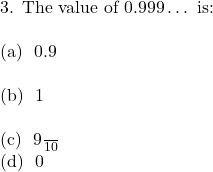
\text{3. The value of } 0.999\ldots \text{ is:} \\  \text{(a) } 0.9 \\  \text{(b) } 1 \\  \text{(c) } \frac{9}{10}  \text{(d) } 0

4. The product of a rational number and an irrational number is always

(a) rational
(b) integer
(c) irrational
(d) whole number

5. Which of the following has a terminating decimal expansion?

 (a)\ 3\frac{3}{7}

 (b)\ 5\frac{5}{8}

 (c)\ 11\frac{11}{15}

 (d)\ 7\frac{7}{12}

6. The square root of 0.09 is

(a) 0.9
(b) 0.03
(c) 0.3
(d) 3

7. How many rational numbers lie between 2 and 3?

(a) 1
(b) 10
(c) 100
(d) infinitely many

 \textbf{8. } \sqrt{12} \times \sqrt{3}

 \textbf{(a)}\ 6 \\[6pt] \textbf{(b)}\ \sqrt{36} \\[6pt] \textbf{(c)}\ 12 \\[6pt] \textbf{(d)}\ \sqrt{15}

9. Which number is NOT a whole number?

(a) 0
(b) 1
(c) –1
(d) 5

10. The decimal expansion of an irrational number is

(a) terminating
(b) repeating
(c) non-terminating non-repeating
(d) non-terminating repeating


Section B: Very Short Answer Questions

(2 Γ— 10 = 20 Marks)

11.  \text{Find three rational numbers between } 2\frac{2}{5} \text{ and } 3\frac{3}{5}.

12.  \text{Express } 0.125 \text{ in the form } \frac{p}{q}.

13.  \text{Is } \sqrt{18} \text{ a rational number? Justify your answer.}

14. Find the value of

15. Write whether the following are rational or irrational:

 (i)\ \sqrt{7}  (ii)\ 0.4  (iii)\ \frac{5}{11}

16.  \text{Find the value of } (3 + 2\sqrt{5})^2.

17. Write any two irrational numbers between 3 and 4.

 \textbf{18. } \text{Simplify: } \sqrt{50} - \sqrt{8}

 \textbf{19. } \text{If } a = \sqrt{3} \text{ and } b = \sqrt{12}, \text{ find } ab.

 \textbf{20. } \text{State whether } 0 \text{ is a natural number. Give reason.}


Section C: Short Answer Questions

(3 Γ— 10 = 30 Marks)

 \text{21. Find five rational numbers between } \frac{1}{3} \text{ and } \frac{2}{3}.

 \textbf{22. }\ \text{Represent } \sqrt{6} \text{ on the number line using geometrical construction.}  \textbf{23. }\ \text{Prove that } \sqrt{5} \text{ is an irrational number.}

 \textbf{24. Simplify and rationalise the denominator: } \ \frac{5}{\sqrt{3} + \sqrt{2}}

 \textbf{25. Find the value of: } \ (2 + \sqrt{3})^2 - (2 - \sqrt{3})^2

 \textbf{26. Write the smallest irrational number greater than } 4.

 \textbf{27. Express } 0.6\overline{3} \textbf{ in the form } \frac{p}{q}.

\textbf{28. Find the number of decimal places in } \dfrac{13}{2^{3} \times 5^{2}}.

\textbf{29. Write two irrational numbers whose product is } 12.

\textbf{30. Find the additive inverse of } \sqrt{7} - 3.


Section D: Long Answer Questions

(5 Γ— 3 = 15 Marks)

 \textbf{31. Find four rational numbers between } \frac{3}{7} \textbf{ and } \frac{4}{7}.

 \textbf{32. Simplify: } \sqrt{72} + \sqrt{18} - \sqrt{8}.

 \textbf{33. Show that the square of an irrational number can be rational using a suitable example.}

 \textbf{34. Find the decimal expansion of } \frac{17}{8} \textbf{ and state its nature.}

 \textbf{35. Write the smallest number by which } 450 \textbf{ must be multiplied to make it a perfect square.}

 \textbf{36. If } x = \sqrt{3} + \sqrt{2}, \textbf{ find } x^2.

 \textbf{37. Simplify: } \quad \frac{\sqrt{12}}{\sqrt{3}}

 \textbf{38. Represent } \sqrt{7} \textbf{ on the number line.}

 \textbf{39. Prove that the sum of a rational number and an irrational number is irrational.}

 \textbf{40. Find the reciprocal of } -\frac{7}{9}.

 \textbf{41. Determine whether } \frac{7}{2^{2} \times 5} \textbf{ is terminating or non-terminating.}


Section E: Case / Higher Order Questions

(4 Γ— 3 = 12 Marks)

 \textbf{42. Prove that } \sqrt{11} \textbf{ is an irrational number.}

 \textbf{43. Find six rational numbers between } \frac{5}{6} \textbf{ and } \frac{7}{6}.

 \textbf{44. Rationalise the denominator and simplify: } \frac{7}{\sqrt{5} - \sqrt{2}}.

 \textbf{45. If } x = \sqrt{5} + 2, \textbf{ find } x^2.

 \textbf{46. Using a suitable example, explain why an irrational number has a non-terminating, non-repeating decimal expansion.}

 \textbf{47. Find the value of } (\sqrt{5} + 2)^2.

 \textbf{48. Explain with reason whether the decimal expansion of an irrational number can ever terminate.}

Leave A Comment

Your email address will not be published. Required fields are marked *

error: Content is protected !!