

Introduction to Geometric Twins
Have you ever noticed two objects that look exactly alike, even when we turn or flip one of them? In geometry, we study such figures through the concept of congruence.
In this chapter, we will explore how to identify congruent figures and understand when two triangles have exactly the same shape and size. We will learn five important triangle congruence criteria: SSS, SAS, ASA, AAS and RHS.
We will also find out why AAA and SSA do not always prove that two triangles are congruent. Along the way, we will solve examples, study triangle properties and explore how we use triangular patterns in everyday structures.
Read each concept carefully, observe the diagrams and try the practice questions at the end. By the end of this chapter, you should be able to identify corresponding sides and angles and use the correct congruence rule to solve geometry problems.
Watch the Complete Video Lesson
Understand Geometric Twins through step-by-step explanations, triangle diagrams and examples.
Class 7 Maths | Ganita Prakash | Geometric Twins | The Busy Brains
📚 In This Chapter
- Meaning of Congruent Figures
- Congruence of Triangles
- Corresponding Parts of Triangles
- SSS Congruence Criterion
- SAS Congruence Criterion
- ASA Congruence Criterion
- AAS Congruence Criterion
- RHS Congruence Criterion
- Why AAA Is Not a Congruence Criterion
- Why SSA Does Not Always Prove Congruence
- Congruence vs Similarity
- Isosceles and Equilateral Triangles
- Congruence in Real Life
- Important Points for Revision
- Important Questions
What Are Congruent Figures?
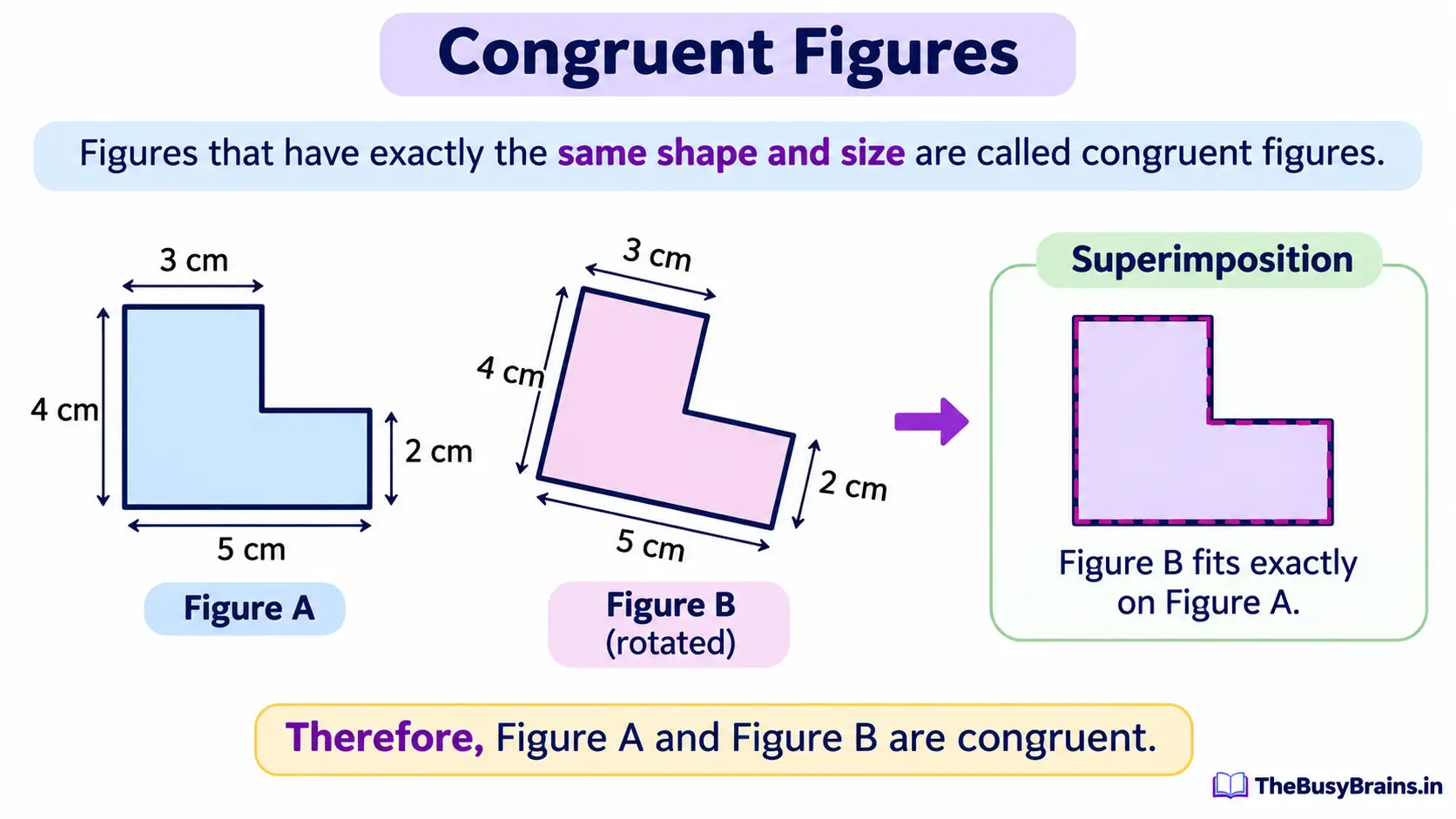
Figures that have exactly the same shape and size are called congruent figures.
Two congruent figures can be placed one over the other so that they fit exactly. This process is called superimposition.
Important Properties
- Congruent figures have the same shape and size.
- Their corresponding sides are equal.
- Their corresponding angles are equal.
- They can be rotated or flipped and still remain congruent.
- They can be superimposed exactly.
Congruence of Triangles
Two triangles are congruent when they have exactly the same shape and size. If we place one triangle over the other, their sides and angles match exactly.
The symbol ≅ means “is congruent to”. The order of the letters tells us which vertices correspond: A matches X, B matches Y and C matches Z.
In many questions, we do not need to measure all three sides and all three angles. We can use a few given measurements to establish that the triangles must be exactly the same size and shape. These reliable tests are called congruence criteria.
Each criterion tells us which combination of equal sides and angles is enough to prove congruence. Let us look at them one by one.
Corresponding Parts of Congruent Triangles
When two triangles are congruent, each vertex, side and angle in one triangle has a matching part in the other. These matching parts are called corresponding parts.
Look at the triangles below. The matching colours show which vertices belong together.
Corresponding vertices
A ↔ P, B ↔ Q and C ↔ R
Corresponding sides
- AB = PQ
- BC = QR
- AC = PR
Corresponding angles
- ∠A = ∠P
- ∠B = ∠Q
- ∠C = ∠R
Once we know which parts correspond, we can use the congruence criteria to prove that two triangles are congruent.
SSS – Side Side Side
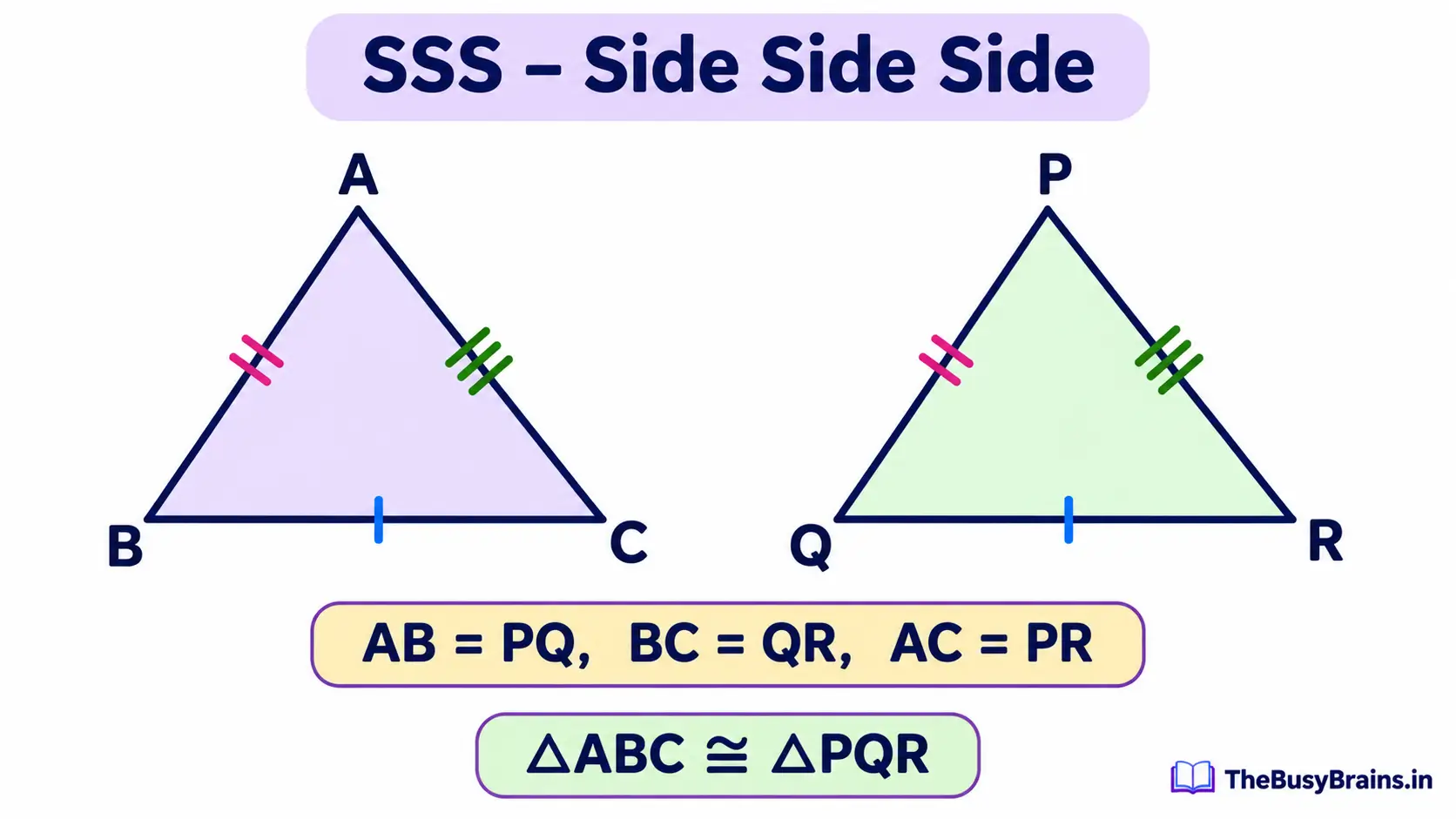
If the three sides of one triangle are equal to the three corresponding sides of another triangle, the two triangles are congruent.
Example
In △ABC and △PQR:
- AB = PQ = 4 cm
- BC = QR = 5 cm
- AC = PR = 6 cm
SAS – Side Angle Side
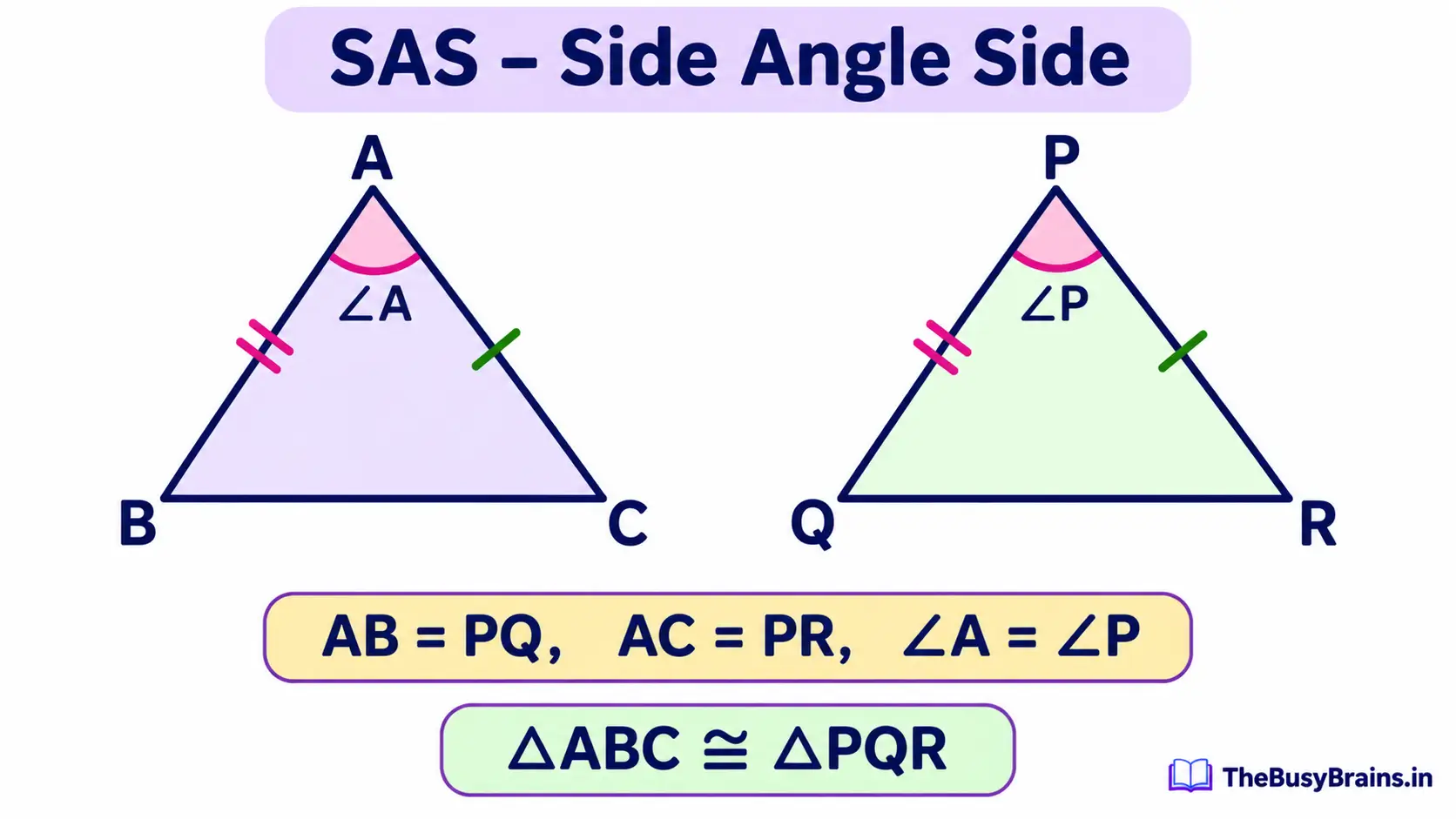
If two sides and the included angle between them of one triangle are equal to the corresponding two sides and included angle of another triangle, the triangles are congruent.
Example
In △ABC and △PQR:
- AB = PQ = 6 cm
- AC = PR = 5 cm
- ∠A = ∠P = 30°
ASA – Angle Side Angle
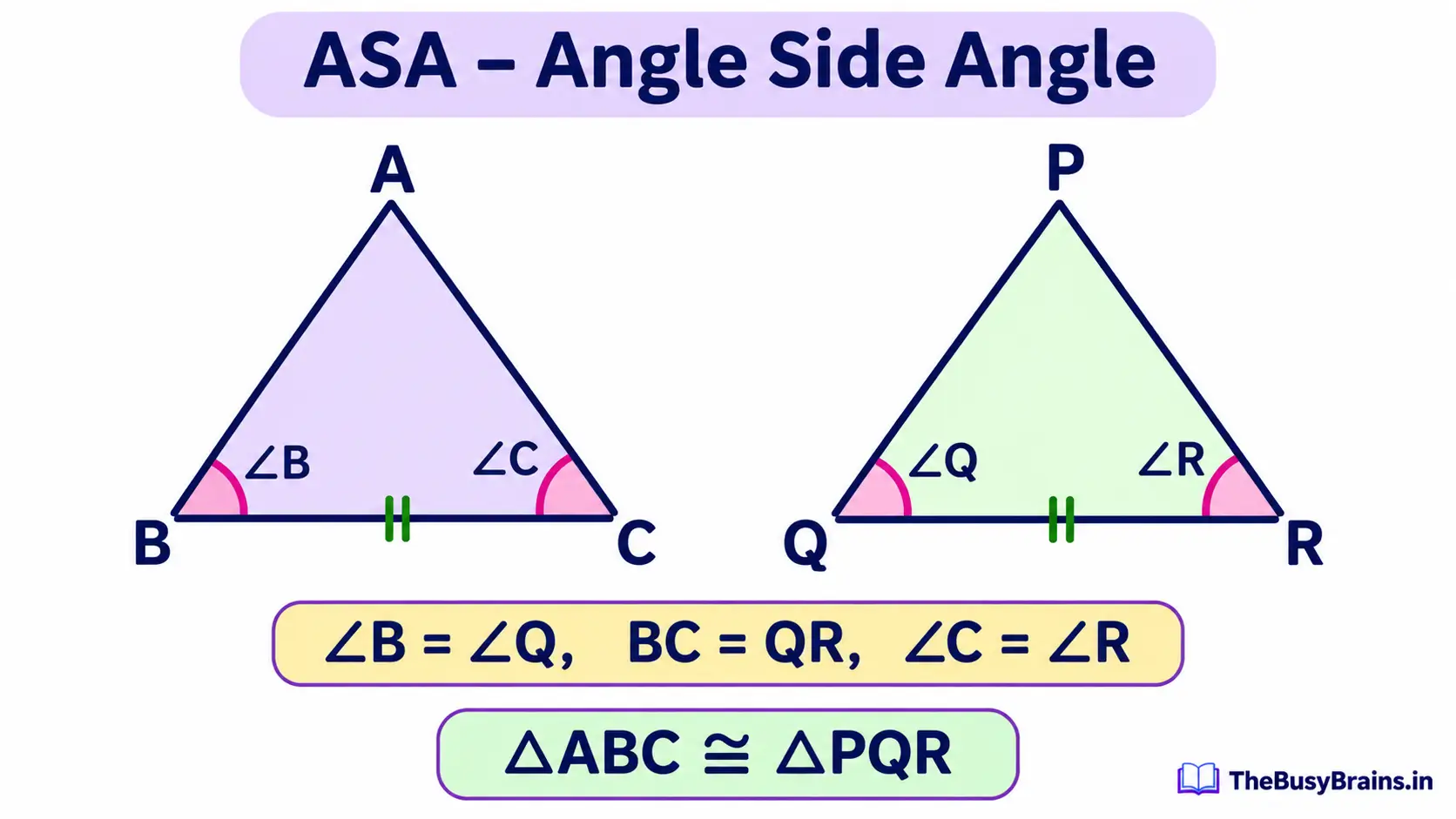
If two angles and the included side between them of one triangle are equal to the corresponding two angles and included side of another triangle, the triangles are congruent.
Example
- ∠B = ∠Q = 50°
- BC = QR = 5 cm
- ∠C = ∠R = 30°
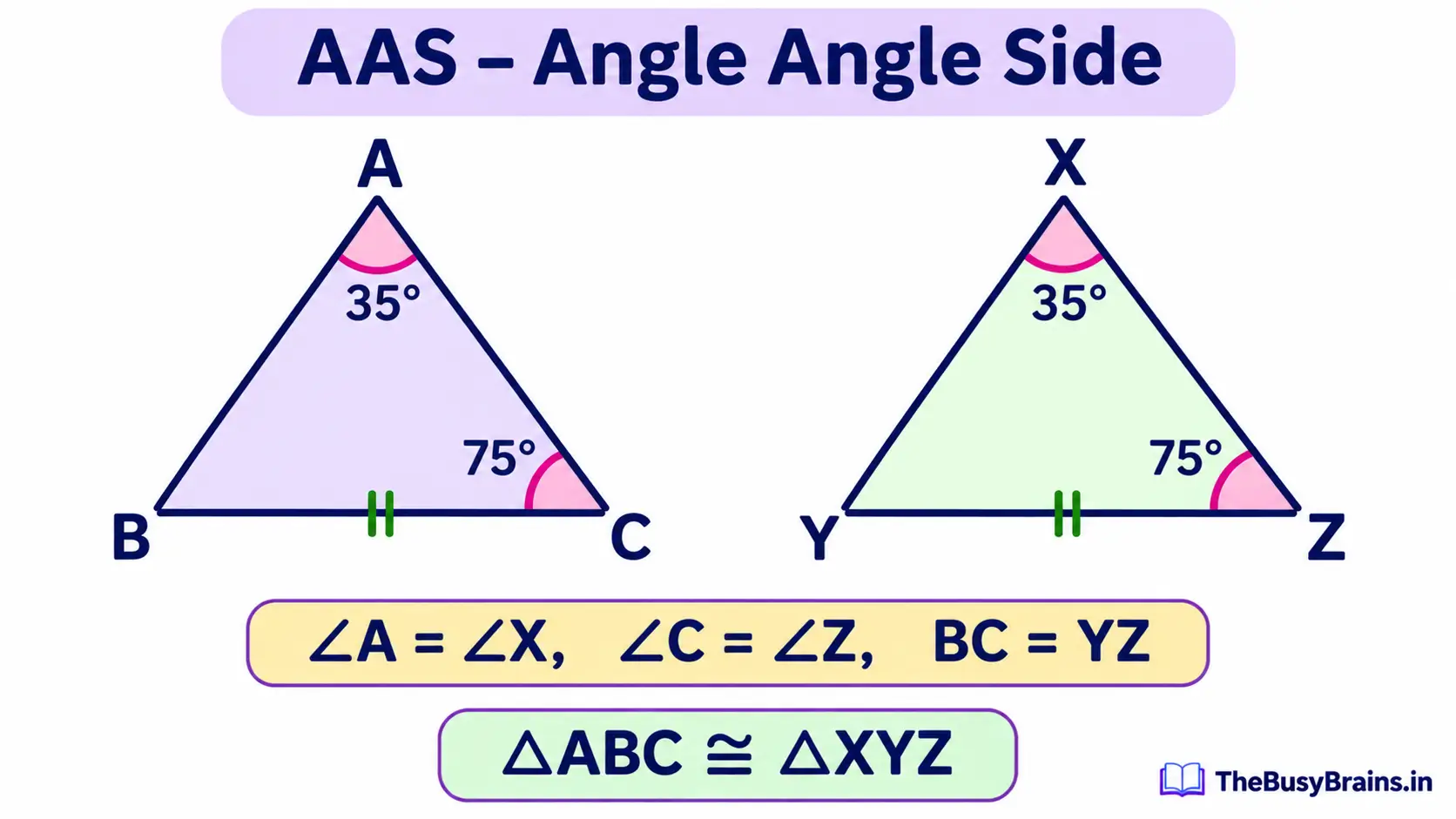
AAS – Angle Angle Side
If two angles and a corresponding non-included side of one triangle are equal to those of another triangle, the triangles are congruent.
NCERT Example
In △ABC and △XYZ:
- ∠A = ∠X = 35°
- ∠C = ∠Z = 75°
- BC = YZ = 4 cm
Using the angle sum property of a triangle:
Similarly, ∠Y = 70°.
Now, ∠B = ∠Y, ∠C = ∠Z and the included side BC = YZ. Therefore, the triangles are congruent by ASA. This also shows why two angles and a corresponding non-included side are sufficient: the third pair of angles must also be equal.
RHS – Right Hypotenuse Side
This criterion applies to right-angled triangles.
If the hypotenuse and one corresponding side of two right-angled triangles are equal, the triangles are congruent.
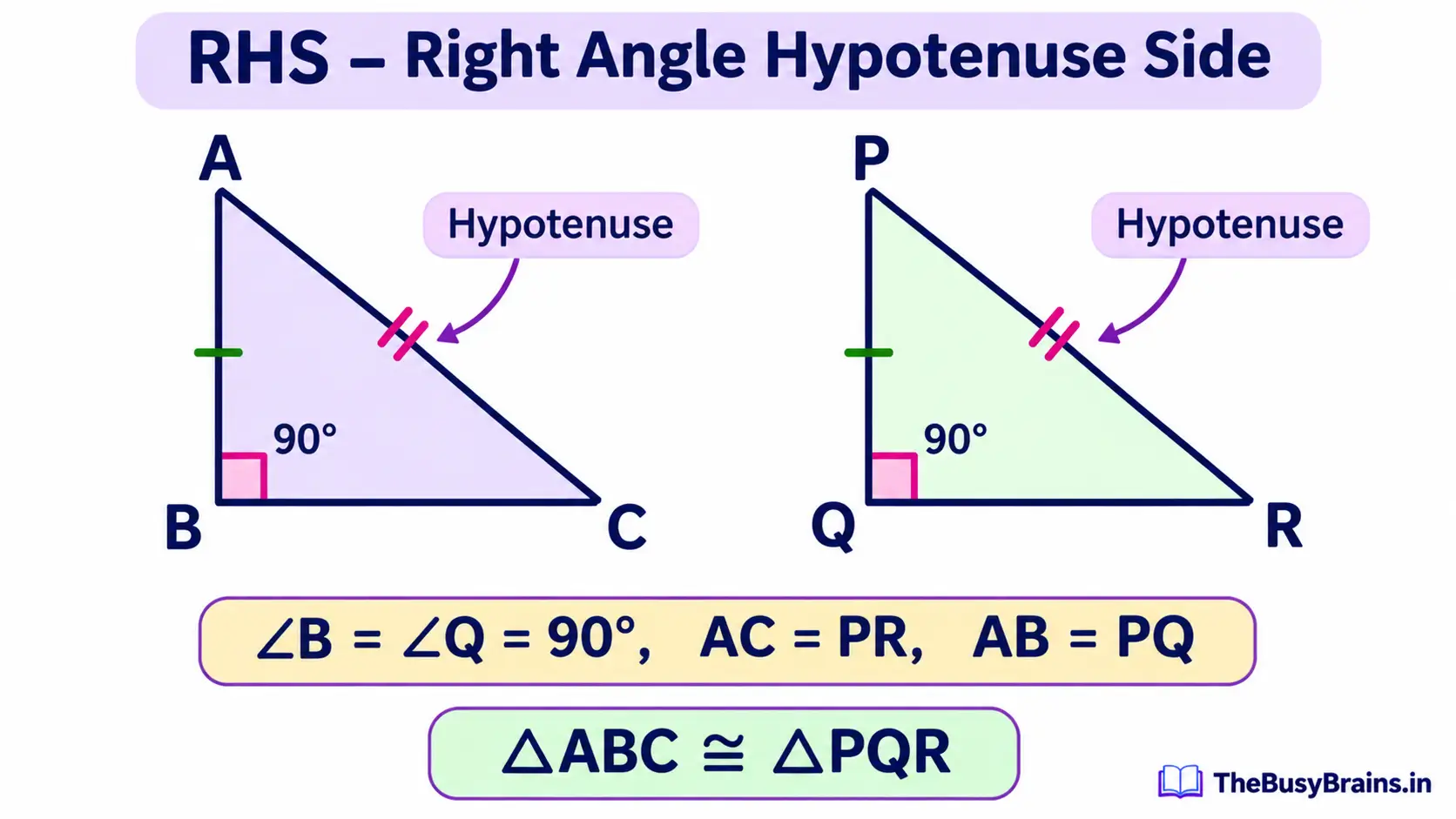
What Is a Hypotenuse?
The side opposite the right angle in a right-angled triangle is called the hypotenuse. It is the longest side of the triangle.
Why Is AAA Not a Congruence Criterion?
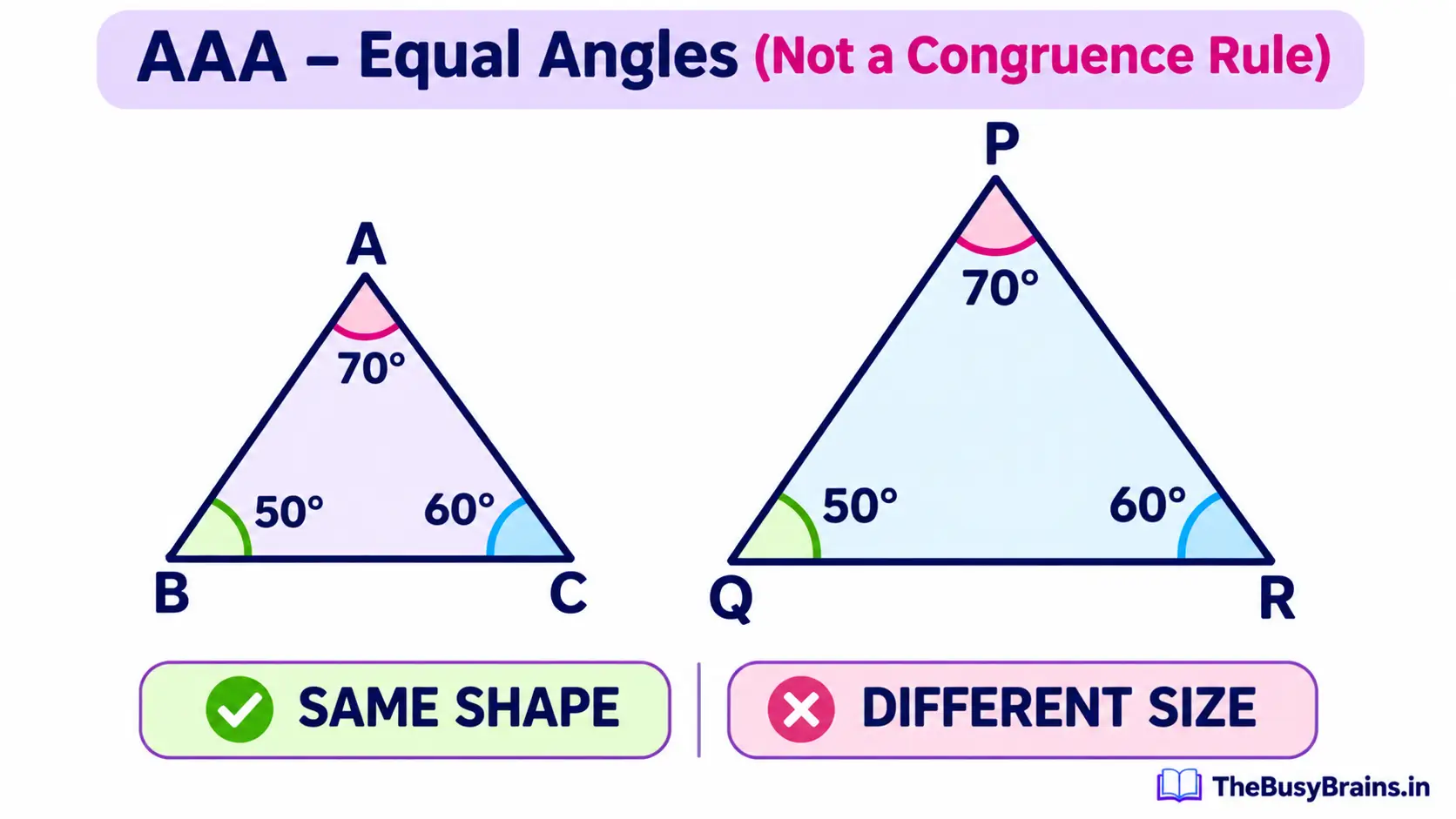
AAA stands for Angle-Angle-Angle.
AAA is not a congruence criterion because it only proves that two triangles have the same shape, not necessarily the same size.
Example
Triangle ABC has angles 50°, 60° and 70°.
Triangle PQR also has angles 50°, 60° and 70°.
However, their corresponding side lengths may be different.
Why Does SSA Not Always Prove Congruence?
SSA stands for Side-Side-Angle. It means that two sides and a non-included angle are equal.
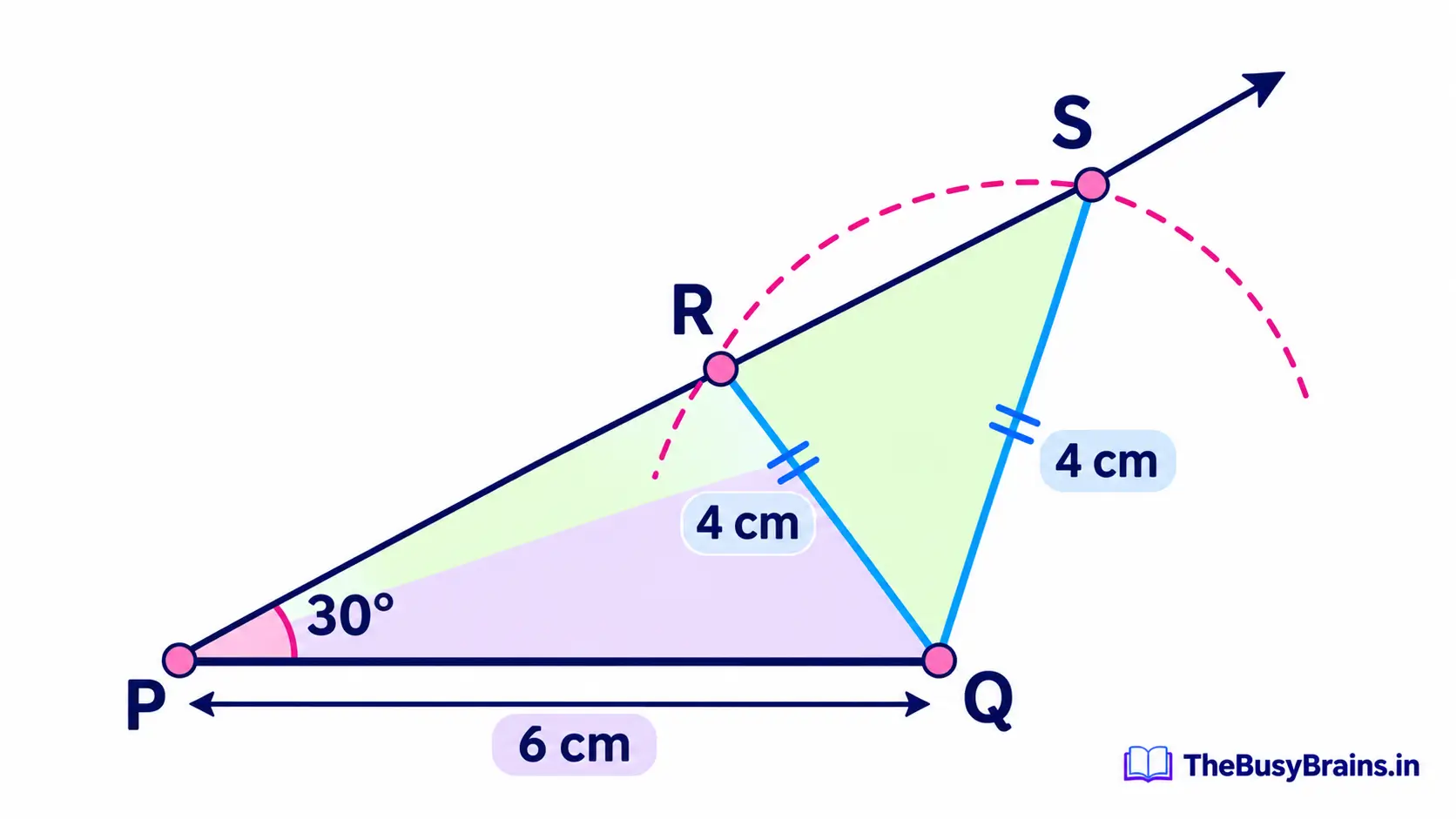
This condition does not always guarantee congruence because two different triangles can be constructed using the same measurements.
Construction Example
- Draw a line segment PQ of length 6 cm.
- Construct an angle of 30° at P.
- Draw an arc from Q with radius 4 cm.
- The arc can intersect the ray at two different points, R and S.
Difference Between Congruence and Similarity
| Congruent Figures | Similar Figures |
|---|---|
| Same shape and size. | Same shape, but size may differ. |
| Corresponding sides are equal. | Corresponding sides are proportional. |
| Corresponding angles are equal. | Corresponding angles are equal. |
| Can be superimposed exactly. | May not fit exactly. |
Angles of Isosceles and Equilateral Triangles
A. Isosceles Triangle
A triangle having two equal sides is called an isosceles triangle.
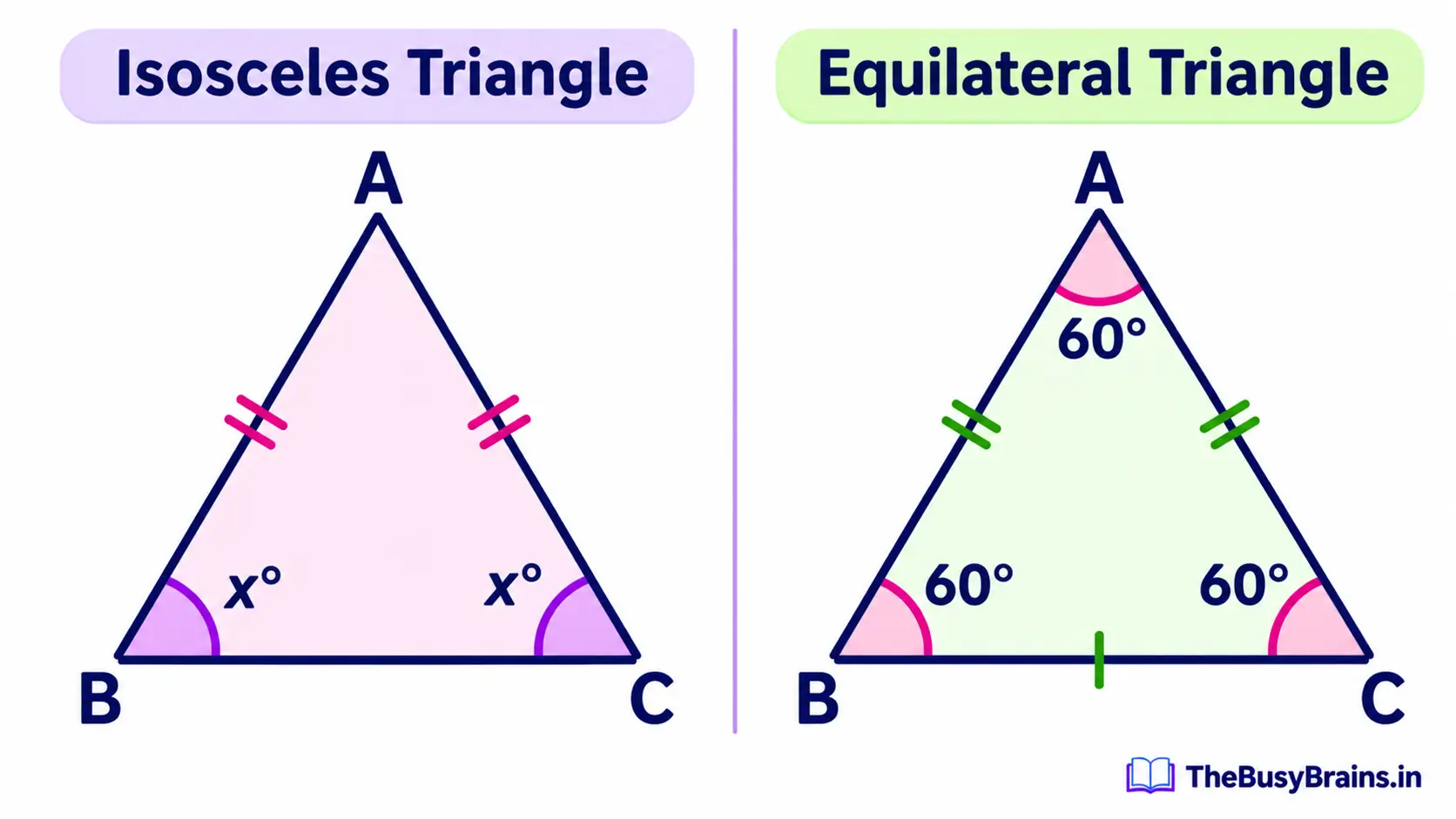
Important Property: Angles opposite to equal sides of a triangle are equal.
Solved Example
In an isosceles triangle ABC:
- AB = AC
- ∠A = 80°
Since AB = AC, the angles opposite these sides are equal.
Using the angle sum property:
∠A + ∠B + ∠C = 180°
80° + ∠B + ∠B = 180°
2∠B = 100°
B. Equilateral Triangle
A triangle having all three sides equal is called an equilateral triangle.
Important Properties
- All three sides are equal.
- All three angles are equal.
- Each interior angle measures 60°.
Congruence in Real Life
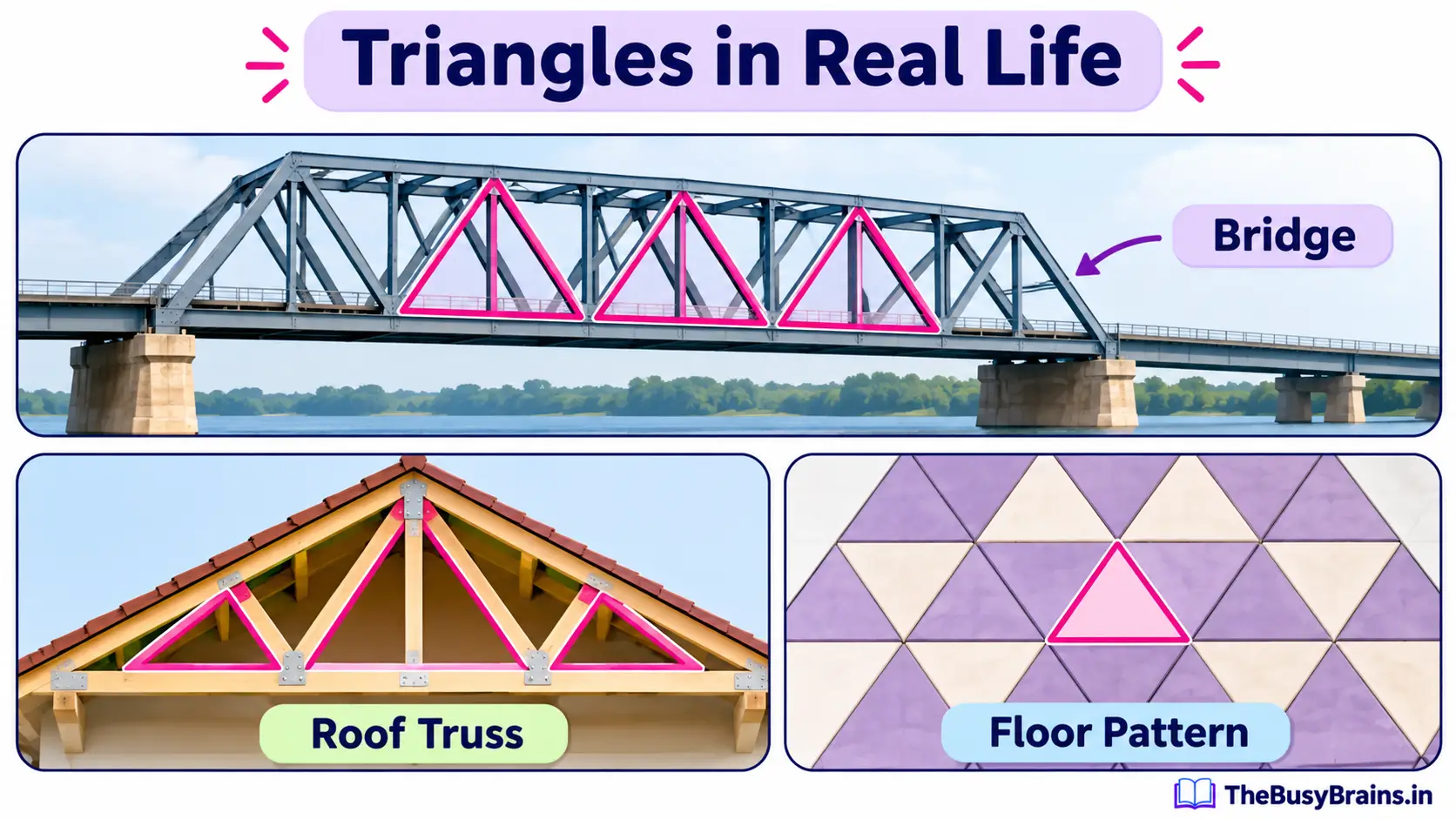
Congruent triangles can be seen in various constructions, buildings and designs.
- Triangular patterns in bridges.
- Roof structures and supporting frames.
- Rangoli and geometric designs.
- Domes and architectural structures.
- Pyramids and engineering designs.
⭐ Important Points for Quick Revision
- Congruent figures have the same shape and size.
- Congruent figures can be superimposed exactly.
- Corresponding sides and angles of congruent triangles are equal.
- SSS means Side-Side-Side.
- SAS means Side-Angle-Side.
- ASA means Angle-Side-Angle.
- AAS means Angle-Angle-Side.
- RHS means Right-Hypotenuse-Side.
- AAA does not guarantee congruence.
- SSA does not always guarantee congruence.
- Angles opposite to equal sides of a triangle are equal.
- Each angle of an equilateral triangle is 60°.
All Triangle Congruence Criteria at a Glance
| Criterion | Meaning | Guarantees Congruence? |
|---|---|---|
| SSS | Three corresponding sides equal | Yes |
| SAS | Two sides and included angle equal | Yes |
| ASA | Two angles and included side equal | Yes |
| AAS | Two angles and non-included side equal | Yes |
| RHS | Right angle, hypotenuse and one side equal | Yes |
| AAA | Three corresponding angles equal | No |
| SSA | Two sides and non-included angle equal | Not always |
Important Questions for Practice
Test your understanding of Geometric Twins with these NCERT-based practice questions.
A. Very Short Answer Questions
B. Short Answer Questions
C. Application-Based Questions
D. Answers / Hints
Click here to reveal answers
- Figures having exactly the same shape and size.
- Placing one figure over another to check if they fit exactly.
- Side-Side-Side.
- The side opposite the right angle.
- 60°.
- No, not necessarily.
- Three corresponding sides equal.
- Congruent figures have the same shape and size; similar figures may have different sizes.
- AAA proves similarity, not necessarily congruence.
- SSA can produce two different triangles.
- Equal hypotenuse and one corresponding side in right-angled triangles.
- Angles opposite equal sides are equal.
- Yes, by SSS.
- RHS.
- 50° and 50°.
- 60°.
- AAS.
Need Class 7 Ganita Prakash Help?
Visit our YouTube channel for chapter notes and step-by-step solutions to the Figure It Out problems of Ganita Prakash Class 7.
Visit The Busy Brains on YouTube