

Wastewater Story
Every time we wash our hands, take a bath, clean vegetables or flush a toilet, water goes down a drain. It may disappear from our sight, but it does not simply vanish. It becomes wastewater and has to be carried away and treated safely.
In this chapter, we follow the journey of wastewater from our homes to a treatment plant. We will see what sewage contains, how treatment plants clean it, why poor sanitation spreads disease and what each of us can do to keep drains and water sources clean.
Chapter contents
- Water – Our Lifeline
- What Is Sewage?
- The Journey of Wastewater
- Wastewater Treatment Plant
- Better Housekeeping Practices
- Sanitation and Disease
- Alternative Arrangements for Sewage Disposal
- Sanitation at Public Places
- An Early Engineering Feat: Indus Valley Civilisation
- Quick Revision for Exams
- Chapter Practice Questions
Water – Our Lifeline
Clean water is essential for life. We need it for drinking, cooking, bathing, washing clothes, cleaning, growing crops and many other activities. It is also needed by plants and animals. Yet clean water that is safe to use is not available to everyone.
Fresh water is becoming scarce in many places. Population growth increases the demand for water. Pollution makes rivers, lakes and groundwater unsafe. Industrial development, careless use and poor management add to the problem.
Why is clean water called a basic need?
Our bodies need safe water to function. We also depend on it for food production, hygiene and sanitation. Without clean water, daily life becomes difficult and the risk of disease increases.
Why should wastewater be cleaned before it is released?
Used water may contain human waste, detergents, oils, chemicals and disease-causing microorganisms. If it enters rivers, lakes or the ground without treatment, it can pollute water sources and harm living organisms. Treatment removes many pollutants and makes the water safer for discharge or further use where appropriate.
What is wastewater treatment?
Wastewater treatment is the process of removing pollutants from used water before it is released into a water body or reused. It is commonly called sewage treatment.
Water is shared by people, animals and plants. Polluting a water source can affect communities far beyond the place where the wastewater was produced. Treating wastewater helps protect public health and the environment.
Check your understanding
- Why is clean water considered a basic need?
- Name four activities for which we use clean water.
- What is wastewater treatment?
- Give two reasons why fresh water is becoming scarce.
- Why should used water not be allowed to flow untreated into rivers?
What Is Sewage?
Sewage is wastewater released by homes, industries, hospitals, offices and other users. It can also include rainwater that flows over roads and rooftops during heavy rain. As this water moves, it picks up dirt and harmful substances.
Sewage is a liquid waste. Most of it is water, but it contains dissolved and suspended impurities. These impurities may be organic, inorganic or biological.
What does sewage contain?
| Type of impurity | Examples |
|---|---|
| Organic impurities | Human faeces, animal waste, oil, urea in urine, pesticides, herbicides, and fruit and vegetable waste. |
| Inorganic impurities | Nitrates, phosphates and metals. |
| Nutrients | Nitrogen and phosphorus compounds. |
| Disease-causing bacteria | Vibrio cholerae, which causes cholera, and Salmonella typhi, which causes typhoid. |
| Other microbes | Protozoans and other microorganisms that may cause diseases such as dysentery. |
What is the difference between dissolved and suspended impurities?
Dissolved impurities mix with water and are not easily seen. Suspended impurities remain as tiny particles floating in water and may settle if the water is left undisturbed.
Which kinds of wastewater are commonly identified by their source?
| Type | Common source |
|---|---|
| Sullage water | Kitchen and washing activities. |
| Foul waste | Toilets. |
| Trade waste | Industrial and commercial organisations. |
It contains many different materials at the same time: solid particles, dissolved substances, nutrients, organic waste and microorganisms. Its composition changes with the place and activity that produced it.
Check your understanding
- Define sewage.
- Why is sewage described as a liquid waste?
- Name any four organic impurities found in sewage.
- Which two nutrients are commonly present in sewage?
- Which bacteria cause cholera and typhoid?
- What is the difference between dissolved and suspended impurities?
- What is trade waste? Give its source.
The Journey of Wastewater
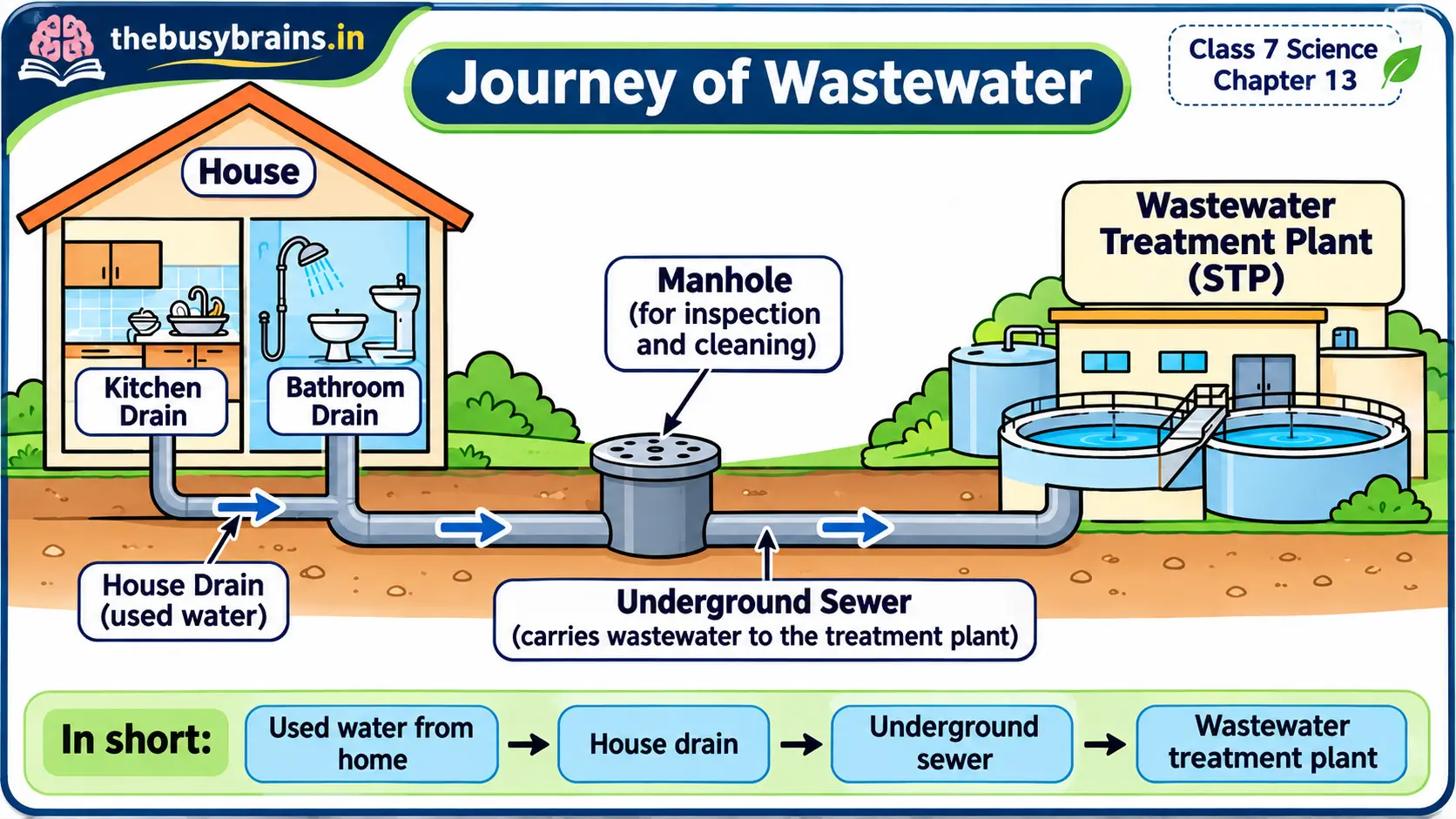
In a building, one set of pipes brings clean water in and another set carries wastewater away. Underground, many small and large pipes join to form a network called the sewerage. It transports sewage from homes and other buildings to a treatment plant.
What is a sewer?
A sewer is a pipe or channel that carries sewage. A network of sewers is called sewerage.
What is sewerage?
Sewerage is the system of pipes, drains and related arrangements that collect and carry sewage to the place where it is treated or disposed of safely.
What are manholes, and where are they provided?
Manholes are access points in the sewerage network. They allow workers to inspect, clean and maintain underground sewers. They are generally provided at intervals, at junctions where two or more sewers meet and where the direction of a sewer changes. The textbook describes intervals of about 50–60 metres.
Sewers are mostly underground and cannot be inspected from the surface along their entire length. Manholes provide access for checking blockages, carrying out repairs and maintaining the system.
What happens if a locality has no sewerage system?
Wastewater still needs safe disposal. In places without an underground sewer network, on-site arrangements such as septic tanks and other suitable sanitation systems may be used.
Check your understanding
- What is a sewer?
- What is the difference between a sewer and sewerage?
- Why are manholes provided in a sewerage system?
- At which places are manholes generally located?
- Where does the sewerage network carry wastewater?
Wastewater Treatment Plant (WWTP)
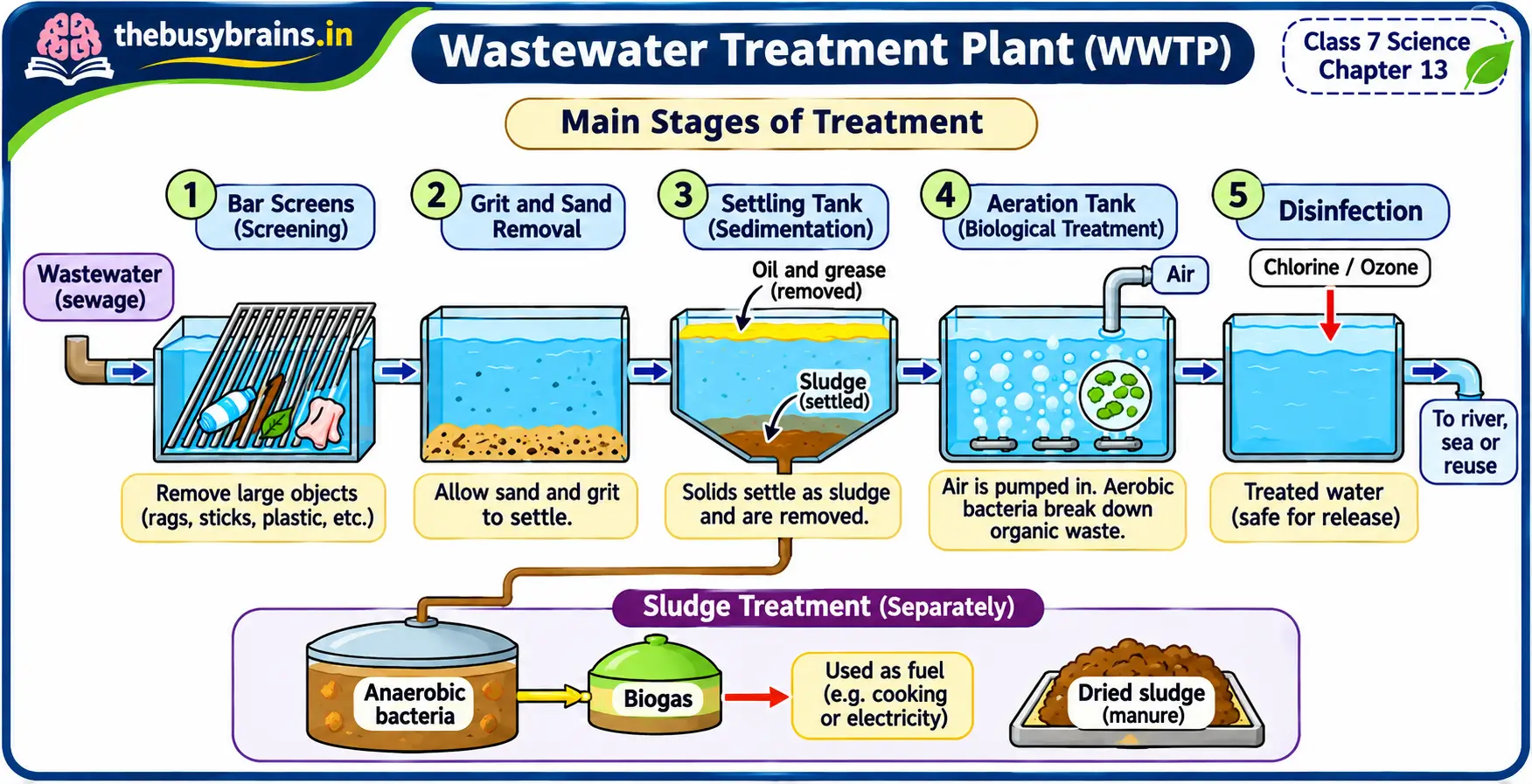
A wastewater treatment plant removes physical, chemical and biological impurities from sewage. The treatment takes place in stages. Some steps remove large or heavy solids, while others use microorganisms to break down organic waste.
How does a wastewater treatment plant work?
The following stages describe the main treatment process. The order matters because each stage prepares the water for the next one.
Screening – removing large objects
First, wastewater passes through bar screens. These screens trap large objects such as rags, sticks, cans, plastic packets and napkins.
Large objects can block pipes, damage pumps and interfere with later treatment. Removing them at the beginning protects the equipment and keeps the process running smoothly.
Grit and sand removal
Next, wastewater enters a grit and sand removal tank. The flow is slowed down so that sand, grit and small pebbles settle at the bottom.
Heavy particles need time to settle. When the water moves more slowly, sand and grit can sink instead of travelling further through the plant.
Primary settling – separating sludge and floating matter
Water then enters a large settling tank, which is sloped towards the middle. Heavier solids such as faecal matter settle at the bottom. A scraper collects this settled material, called sludge. A skimmer removes floating materials such as oil and grease. The water left after this step is called clarified water.
They remove different kinds of waste. The scraper collects solids that sink, while the skimmer removes lighter substances that float on the surface.
Aeration – using helpful bacteria
The clarified water still contains dissolved and fine organic waste. Air is pumped into it. This helps aerobic bacteria grow. These bacteria use oxygen and break down organic matter such as human waste, food waste and soap residues.
After several hours, the suspended microbes settle at the bottom as activated sludge. The water is then drawn off from the top.
Aerobic bacteria need oxygen to live and multiply. Supplying air helps them break down the remaining organic pollutants in the wastewater.
Sludge treatment and biogas
Some sludge is transferred to a separate tank. There, anaerobic bacteria decompose it in the absence of oxygen. This process produces biogas, which can be used as a fuel or to generate electricity.
Activated sludge is about 97% water. The water is removed using sand drying beds or machines. The dried sludge can be used as manure because it returns organic matter and nutrients to the soil.
Sludge contains settled organic matter and microorganisms. Treating it separately reduces the waste and allows useful products such as biogas and dried manure to be obtained.
Disinfection and release of treated water
After treatment, the water has a much lower level of organic matter and suspended solids. It may be released into a river, sea or the ground, where natural processes can further clean it. When required, it is disinfected using chemicals such as chlorine or ozone before being released into a distribution system.
Disinfection helps destroy disease-causing microorganisms that may remain after other treatment stages. It is an important safety step when the intended use requires it.
At a glance: stages of wastewater treatment
The sludge removed during settling and biological treatment is processed separately. The sequence above is a simplified learning summary of the water-treatment line.
What is the difference between sludge and clarified water?
| Sludge | Clarified water |
|---|---|
| Solid waste that settles at the bottom of the settling tank. | Water left after settled and floating solids have been removed. |
| Collected using a scraper. | Moves on to further treatment. |
| Can be treated by anaerobic bacteria; dried sludge may be used as manure. | Is aerated to help aerobic bacteria break down remaining organic matter. |
What can we learn from a simple filtration activity?
The chapter activity models some cleaning processes using a jar of dirty water, aeration, a sand-and-gravel filter and chlorine. The samples are compared before treatment, after aeration, after filtration and after chlorination. The activity helps students observe changes in smell and appearance. It is a classroom demonstration, not a method for making drinking water at home.
The samples contain dirty water and may contain harmful microorganisms or chemicals. They are for observation only.
Check your understanding
- What is the purpose of bar screens?
- Why is the speed of wastewater reduced in the grit and sand removal tank?
- What is sludge, and how is it removed?
- What is clarified water?
- Why is air pumped into the aeration tank?
- Differentiate between aerobic and anaerobic bacteria.
- How is biogas produced during sewage treatment?
- Why is dried sludge useful?
- Name two chemicals used to disinfect treated water.
- Why should the samples in the filtration activity never be tasted?
Better Housekeeping Practices
A treatment plant can work properly only when we do not send unnecessary waste into the drains. Many blockages and treatment problems begin inside homes. A little care while using sinks, toilets and drains can reduce the load on the wastewater system.
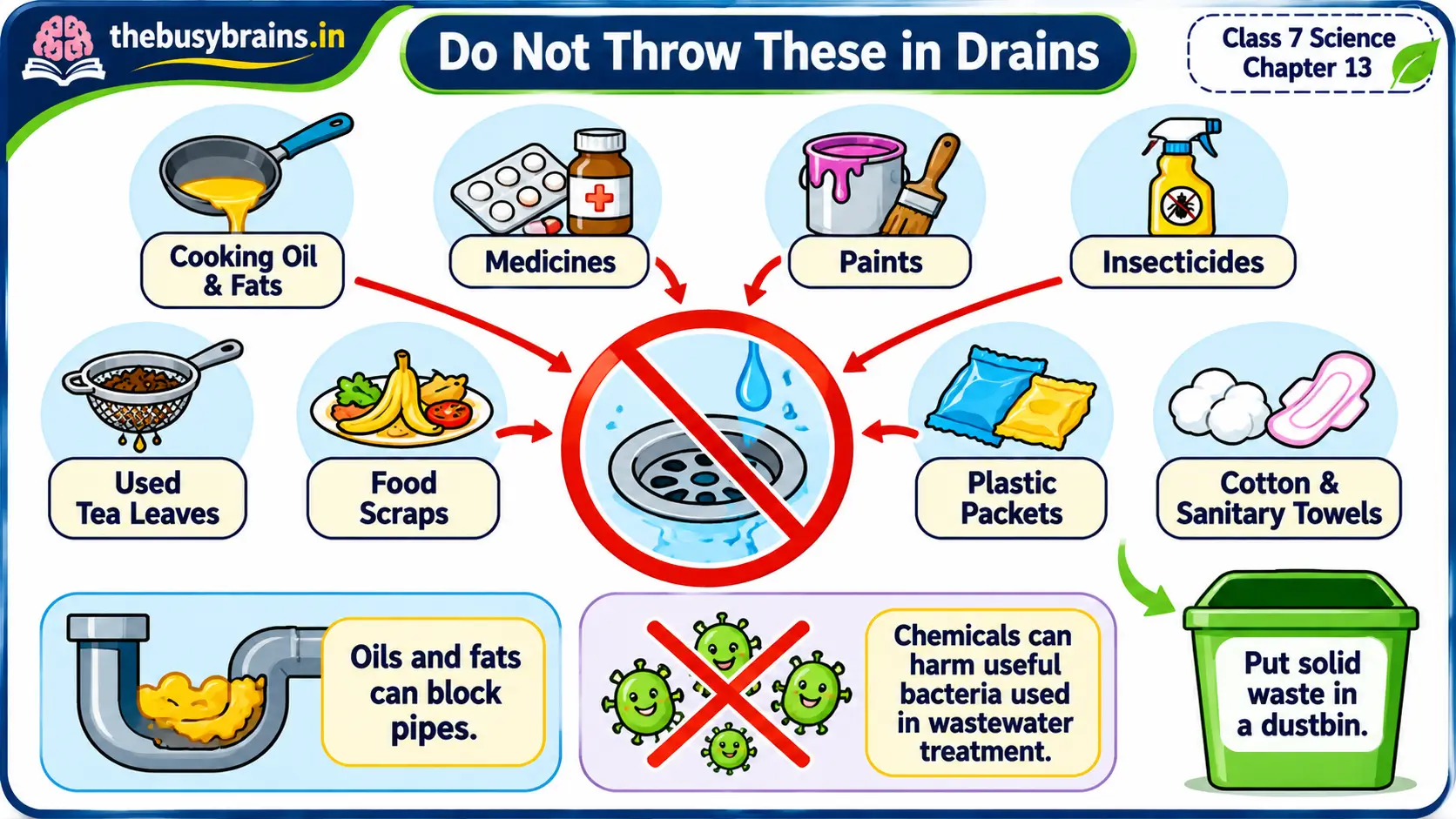
What should never be poured or thrown into a drain?
- Cooking oil and fats: They can cool, harden and block pipes. In open drains, they can clog soil pores and reduce the soil's ability to filter water.
- Paints, solvents, insecticides, motor oil and medicines: These chemicals may kill the microorganisms that help purify wastewater.
- Tea leaves and food scraps: They can collect in pipes and cause blockages.
- Soft toys, cotton, sanitary towels and other solid objects: They do not break down easily in drains and can obstruct the flow of wastewater.
Where should these wastes go?
Put solid household waste in the appropriate dustbin. Do not use the sink or toilet as a bin. Dispose of chemicals, medicines and oils according to local waste-collection guidance rather than pouring them into drains.
Wastewater treatment depends partly on helpful microorganisms. Certain chemicals can kill or damage these microbes, making it harder for the plant to break down organic waste.
Check your understanding
- Why should cooking oil and fats not be poured down the drain?
- Why should medicines, paints and insecticides not be thrown into sinks?
- Name four solid wastes that can choke drains.
- How can each household reduce the load on a wastewater treatment plant?
- What should we do with used tea leaves and food scraps?
Sanitation and Disease
Sanitation means maintaining clean and hygienic conditions through safe disposal of human waste and other wastewater, clean surroundings and access to proper toilets. Poor sanitation and contaminated drinking water can cause many diseases.
When human excreta is left in the open or discharged without treatment, it can pollute soil and water. Rainwater may carry the waste into ponds, rivers and other water sources. Pollutants can also seep into the ground and contaminate groundwater. Wells, tube wells and springs may then become unsafe.
Why is untreated human excreta a health hazard?
Human excreta may contain disease-causing microorganisms. If it contaminates drinking water or food, these organisms can enter the human body and spread infection.
Which diseases can spread through contaminated water?
The chapter names cholera, typhoid, polio, meningitis, hepatitis and dysentery among water-related diseases. The exact route of transmission differs by disease, but unsafe water and poor sanitation create conditions in which infections can spread.
How do open drains affect health?
Open drains may collect stagnant, polluted water. They can become breeding places for flies, mosquitoes and other organisms. They also create unpleasant and unhygienic surroundings, especially when they overflow during the rainy season.
Polluted water can seep through soil and reach underground water sources. This is why unsafe disposal of human waste can affect wells and tube wells as well as rivers and ponds.
Check your understanding
- What is sanitation?
- Why is untreated human excreta dangerous?
- How can groundwater become contaminated?
- Name four diseases associated with contaminated water and poor sanitation from the chapter.
- Why do open drains become a health risk?
- How can poor sanitation affect people who live far from the place where waste is produced?
Alternative Arrangements for Sewage Disposal
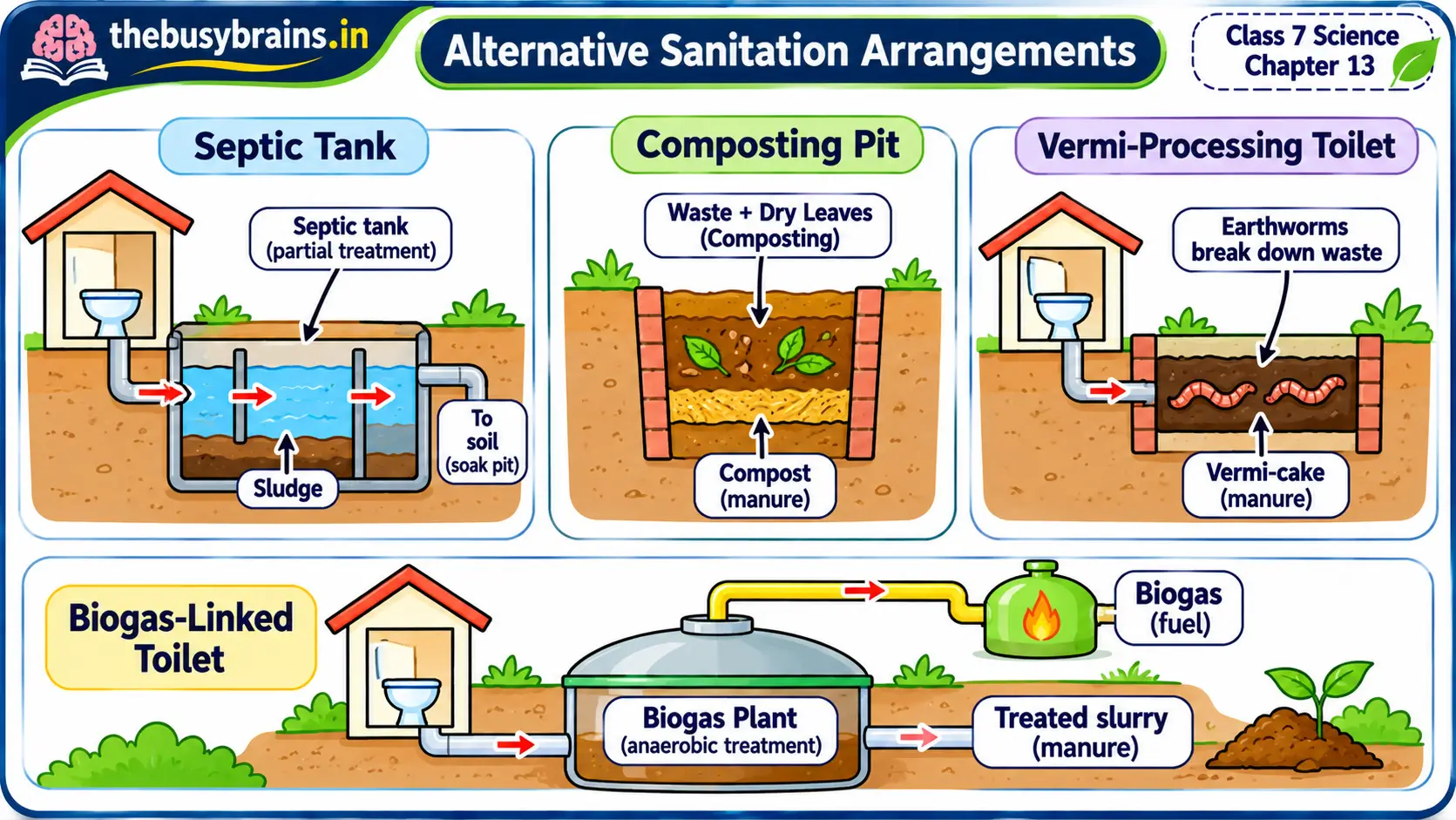
Not every place has an underground sewerage network. In such areas, low-cost on-site sanitation systems can provide a safer way to manage human waste. The chapter gives septic tanks, chemical toilets and composting pits as examples.
What is a septic tank?
A septic tank is an on-site system used to collect and partially treat household sewage. It is useful in places where a sewerage system is not available, such as isolated buildings, some hospitals or a small group of houses.
What are chemical toilets and composting pits?
They are alternative arrangements designed to manage human waste where conventional sewerage is unavailable. Their design and operation depend on the setting and the sanitation system being used.
How does a biogas-linked toilet work?
In the arrangement described in the chapter, excreta from toilet seats flows through covered drains to a biogas plant. The waste is treated there and the biogas produced can be used as a source of energy.
What is a vermi-processing toilet?
A vermi-processing toilet uses earthworms to process human excreta. The chapter describes a low-water-use design in which the waste is converted into vermi-cakes, a material useful for soil.
They provide a way to manage human waste safely in places where underground sewers and central treatment plants are not available. Without a suitable system, waste may be released into the surroundings and pollute water and soil.
Check your understanding
- Why are low-cost on-site sewage disposal systems encouraged?
- Name three on-site sanitation systems mentioned in the chapter.
- Where is a septic tank useful?
- How can biogas be obtained from human waste?
- What is a vermi-processing toilet, and what does it produce?
Sanitation at Public Places
Fairs, railway stations, bus depots, airports and hospitals are visited by large numbers of people. As a result, they generate large quantities of waste. If this waste is not collected and disposed of properly, the surroundings become dirty and diseases may spread.
Why is sanitation especially important at public places?
Many people use the same facilities and surroundings. Waste left in the open can attract insects, contaminate surfaces and water, and create conditions for disease outbreaks. Proper toilets, bins, cleaning and sewage disposal protect everyone.
What can an individual do to keep public places clean?
- Put litter in a dustbin.
- If no dustbin is available, carry the waste home and dispose of it properly.
- Use public toilets responsibly.
- Do not throw plastic, food waste or other rubbish into drains.
- Encourage others to follow hygienic practices.
- Report serious sanitation problems to the responsible local authority.
One person's litter can affect everyone who uses the same place. Public sanitation improves when residents, visitors, workers and local authorities all take responsibility.
Check your understanding
- Why do public places need proper sanitation arrangements?
- Name four public places where large amounts of waste may be generated.
- What should you do if there is no dustbin nearby?
- How can students help maintain sanitation in their school and neighbourhood?
An Early Engineering Feat: Indus Valley Civilisation
The chapter reminds us that planned sanitation is not a new idea. Harappa and Mohenjodaro, important cities of the Indus Valley Civilisation, had an advanced urban sanitation system for their time.
Many houses or groups of houses obtained water from wells. Houses had separate bathing areas, and wastewater flowed into covered drains along the major streets. The chapter also notes the use of brick-built toilets about 4,500 years ago.
Why is this an important example?
It shows that people in ancient cities understood the need to collect and remove wastewater in an organised way. Covered drains helped keep streets and living areas cleaner.
Check your understanding
- Which ancient civilisation is mentioned for its planned sanitation system?
- How was wastewater carried away in Harappa and Mohenjodaro?
- Why is the drainage system of these cities considered an engineering achievement?
Quick Revision – Exam Time
- Wastewater: Water that has been used and contains impurities.
- Sewage: Wastewater from homes, industries, hospitals, offices and other sources; it may also include rainwater runoff.
- Sewer: A pipe or channel that carries sewage.
- Sewerage: The network that carries sewage to a treatment or disposal point.
- Manhole: An access point used to inspect and maintain underground sewers.
- WWTP: A wastewater treatment plant that removes pollutants from sewage.
- Bar screens: Remove large objects such as rags, sticks and plastic packets.
- Grit tank: Allows sand, grit and pebbles to settle.
- Sludge: Solid matter that settles at the bottom of a settling tank.
- Clarified water: Water left after settled and floating solids have been removed.
- Aeration: Supplying air so aerobic bacteria can break down organic waste.
- Activated sludge: Microbes that settle after aeration.
- Anaerobic bacteria: Break down sludge in the absence of oxygen and produce biogas.
- Biogas: A useful fuel that can be produced during sludge treatment.
- Disinfection: Treatment using substances such as chlorine or ozone to destroy harmful microorganisms.
- Good drain habits: Keep oils, fats, chemicals and solid rubbish out of drains.
- Sanitation: Safe and hygienic management of human waste and surroundings.
- On-site systems: Septic tanks, chemical toilets and composting pits.
- Vermi-processing toilet: Uses earthworms to process human excreta.
Remember the treatment sequence
Screening → Grit and sand removal → Settling → Aeration → Further treatment/disinfection as required.
Important differences
| Terms | Difference to remember |
|---|---|
| Sewer / Sewerage | A sewer is a pipe; sewerage is the network of pipes and related arrangements. |
| Sludge / Clarified water | Sludge settles at the bottom; clarified water is the liquid left after settling and skimming. |
| Aerobic / Anaerobic bacteria | Aerobic bacteria need oxygen; anaerobic bacteria act in the absence of oxygen. |
| Screening / Grit removal | Screening traps large objects; grit removal lets heavy sand and small stones settle. |
Important Chapter Questions
Try answering these without looking at the notes. They cover definitions, reasons, processes and application-based questions from the chapter.
Very short answer questions
- What is wastewater?
- Define sewage.
- What is a sewer?
- What is sewerage?
- What are manholes?
- What is sludge?
- What is clarified water?
- What is aeration?
- Name two chemicals used to disinfect water.
- What is biogas?
Short answer questions
- Why should untreated sewage not be discharged into rivers or seas?
- Explain the difference between dissolved and suspended impurities with examples.
- Describe the work done by bar screens and grit removal tanks.
- How is clarified water obtained from wastewater?
- Explain how sludge is treated and state two useful products or outcomes of this treatment.
- Why should cooking oil, fats and chemicals not be poured into drains?
- How does poor sanitation lead to the spread of disease?
- Why are septic tanks useful in places without sewerage systems?
- Explain how a vermi-processing toilet works.
- What steps can students take to improve sanitation in public places?
Long answer and application-based questions
- Describe the stages of wastewater treatment in the correct order. Explain the purpose of each stage.
- “A wastewater treatment plant depends on microorganisms.” Explain this statement with reference to aerobic and anaerobic bacteria.
- A neighbourhood drain is blocked by plastic packets, food scraps and cooking oil. Explain how these materials cause problems and suggest ways to prevent them.
- Untreated human waste is dumped near a pond. Explain how this can affect soil, surface water, groundwater and human health.
- A village does not have an underground sewerage network. Suggest suitable sanitation arrangements and explain why safe disposal is necessary.
Answer key – quick checking
Open short answers and key points
For long answers, include the correct sequence, explain the purpose of each step and use the scientific terms from the chapter.
Ready to Test What You Have Learnt?
Attempt the chapter worksheet to practise important questions and check your understanding of Wastewater Story.
Attempt the Chapter Worksheet →Try the questions first, then check your answers.
Finished the Chapter Notes?
Now check your preparation with the Wastewater Story worksheet. Attempt the questions and revise the topics that need more practice.
Attempt Worksheet →