



-
Introduction: Why Institutions Matter
Democracy is not only about electing leaders. After elections, the rulers must follow rules, procedures, and work through institutions to run the country. Institutions such as the Legislature (Parliament), Executive (PM & Ministers), Judiciary (Courts) shape how decisions are made, implemented, and resolved. These institutions ensure that the government functions even when individuals in power change. Institutions bring rules, regular procedures, and transparency, which prevent misuse of authority and help maintain democratic values.
-
How Major Policy Decisions Are Taken
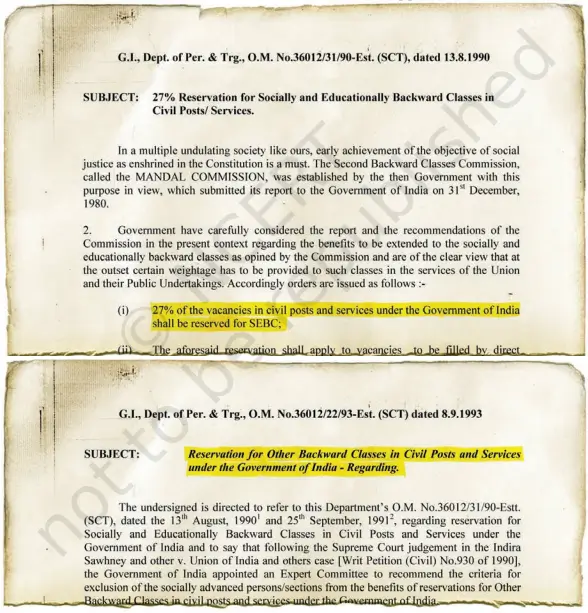
Decision-making in a democracy involves multiple steps and institutions. The chapter begins with the example of the 1990 Mandal Commission decision, in which the Government of India announced 27% reservation for Socially and Educationally Backward Classes (SEBC) in government jobs.
2.1 The Government Order (Office Memorandum)
On 13 August 1990, an Office Memorandum announced job reservation for SEBC. Although a Joint Secretary signed it, he did not make the decision himself. He simply executed the decision taken at higher levels.
2.2 Who Took the Decision?
The decision involved:
- Prime Minister – Led the decision and guided the Cabinet.
- Union Cabinet – Formally approved the implementation of the Mandal Commission report.
- President – Mentioned the government’s intent in his speech to Parliament.
- Parliament – Debated the Mandal Report for years, creating pressure for action.
- Officials – Drafted and issued the Office Memorandum.
The flow of the decision shows how different institutions connect and support each other while taking major policy decisions.
-
Need for Political Institutions
Running a country requires decision-making, administration, and dispute resolution. Institutions ensure that these processes are organized and predictable. They:
- Provide clarity on who is responsible for what.
- Ensure continuity even when leaders change.
- Include wider consultation through rules and procedures.
- Prevent hasty decision-making.
Essential institutions include:
- Political Executive (PM & Cabinet) – Takes major decisions.
- Civil Servants – Implement decisions.
- Judiciary – Settles disputes between citizens and government.
Although institutions may slow the process through meetings and discussions, they protect democracy by preventing misuse of power.
-
Parliament
Parliament is the central institution representing the people. It exercises supreme political authority and acts on behalf of the citizens.
4.1 Why Parliament is Needed
Parliament performs four major functions:
- Law-making – Creates, changes, or abolishes laws.
- Control over the Executive – Government remains in power only when it has support of Lok Sabha.
- Control over Finances – No money can be spent without Parliament’s approval.
- Forum for Debate – Discusses public issues, national policies, and government actions.
4.2 Two Houses of Parliament
India has a bicameral legislature:
Lok Sabha (House of the People)
- Members elected directly by people.
- More powerful, especially in money matters.
- Can remove the government through a No-Confidence Motion.
- Major decisions depend on its majority.
Rajya Sabha (Council of States)
- Members elected indirectly by State Legislatures.
- Represents the interests of states.
- Cannot reject money bills but can suggest changes.
Although often termed the “Upper House,” Rajya Sabha is not more powerful than Lok Sabha in India’s parliamentary system.
-
Political Executive
The executive implements laws and policies.
5.1 Political vs Permanent Executive
- Political Executive – Ministers elected for a fixed term; they take major decisions.
- Permanent Executive (Civil Services) – Officers appointed on a long-term basis; they provide expertise and run administration.
Even though civil servants may have more technical knowledge, the political executive holds final authority because they represent the will of the people.
-
Prime Minister and Council of Ministers
6.1 Appointment of the Prime Minister
The President appoints the leader who has majority support in Lok Sabha as the Prime Minister. If no party has clear majority, the President uses discretion to choose the leader capable of securing support.
6.2 Council of Ministers
It includes 3 categories:
- Cabinet Ministers – Head major ministries; part of the core decision-making group.
- Ministers of State (Independent Charge) – Handle smaller ministries independently.
- Ministers of State – Assist Cabinet Ministers.
All major decisions are taken in Cabinet meetings, making India a Cabinet form of government.
6.3 Powers of the Prime Minister
The Prime Minister:
- Leads the government.
- Chairs Cabinet meetings.
- Coordinates among ministries.
- Supervises administration.
- Allocates portfolios and can dismiss ministers.
In a coalition government, the PM must also consider allies’ views, limiting their independent power.
-
The President
The President is the head of the state and holds nominal powers.
7.1 Election of the President
- Elected indirectly by MPs and MLAs.
- Represents the entire country.
- Does not have direct mandate like the PM.
7.2 Powers of the President
All government actions are taken in the President’s name:
- Signs all bills into law.
- Appoints PM, Ministers, Judges, Governors, Election Commissioners, etc.
- Is the Supreme Commander of Armed Forces.
- Issues treaties and agreements.
However, she acts on the advice of the Council of Ministers. She can return a bill for reconsideration once, but must sign it if passed again.
7.3 Situations where President has discretion
- When no party has a clear majority.
- When appointing a Prime Minister in uncertain conditions.
-
Judiciary
The judiciary ensures justice and protects the Constitution.
8.1 Structure of the Indian Judiciary
India has an integrated judicial system:
- Supreme Court (national level)
- High Courts (state level)
- District and Subordinate Courts (local level)
Supreme Court decisions are binding on all courts.
8.2 Independence of Judiciary
Judiciary remains independent because:
- Judges are appointed through a consultative process involving senior judges.
- Judges have security of tenure and can be removed only through impeachment requiring two-thirds majority in both houses.
- Judiciary is free from interference of Executive and Legislature.
8.3 Powers of the Judiciary
- Acts as the highest court of appeal.
- Settles disputes between:
- citizens,
- citizens and government,
- states,
- Union and states.
- Exercises Judicial Review – can strike down laws violating the Constitution.
- Acts as guardian of Fundamental Rights.
- Allows Public Interest Litigation (PIL) to protect public welfare.
The people trust judiciary because it gives fair judgments and checks misuse of power.
The legislature, executive, and judiciary form the backbone of Indian democracy. They work together to ensure decisions are made democratically, implemented effectively, and judged fairly. Institutions may introduce delays, but they maintain accountability, limit concentration of power, and protect citizens’ rights—making democracy meaningful and stable.
✅ EXAM-ORIENTED Q&A – WORKING OF INSTITUTIONS
A. VERY SHORT ANSWERS (1 Mark)
1. What is an Office Memorandum?
An Office Memorandum is a government order or circular issued by an authorized department declaring a policy or decision.
2. Which institution is responsible for making laws in India?
Parliament.
3. Who is the real executive in India?
The Prime Minister and the Council of Ministers.
4. Who appoints the Prime Minister of India?
The President.
5. What is Judicial Review?
The power of courts to examine laws and actions of the government and strike them down if they violate the Constitution.
B. SHORT ANSWERS (2–3 Marks)
6. Why do we need political institutions?
We need political institutions to take decisions, implement them, and resolve disputes. Institutions create a clear rule-based system so that governance continues smoothly even when leaders change.
7. What is the difference between Lok Sabha and Rajya Sabha?
- Lok Sabha is directly elected by the people, more powerful, especially in money matters, and can remove the government.
- Rajya Sabha is indirectly elected, represents states, and cannot reject money bills.
8. Why is the Prime Minister more powerful than the President?
Because the Prime Minister is the head of the government, leads the Cabinet, controls ministries, and holds majority support in Lok Sabha. The President works on the Prime Minister’s advice.
9. What is the role of civil servants?
Civil servants implement the policies made by ministers, handle daily administration, give expert advice, and ensure continuity in governance even when political leadership changes.
10. Explain the independence of the judiciary.
Judiciary is independent because judges are appointed through a consultative process, have security of tenure, cannot be removed easily, and are free from interference by the executive or legislature.
C. LONG ANSWERS (4–5 Marks)
11. Describe how major policy decisions are taken with the example of the Mandal Commission.
- The Mandal Commission (1979) recommended 27% reservation for SEBC.
- Parliament discussed the report for years.
- In 1990, the Union Cabinet approved the recommendation.
- The Prime Minister announced the decision in Parliament.
- The Department of Personnel drafted the order and issued the Office Memorandum.
- Supreme Court examined the dispute and upheld the order with modifications.
This example shows how multiple institutions—Parliament, Cabinet, PM, Officials, and Judiciary—work together in the decision-making process.
12. Explain the powers and functions of Parliament.
Parliament performs four major functions:
- Law Making – It creates, amends, or abolishes laws.
- Control Over Executive – The government stays in power only as long as it enjoys Lok Sabha’s majority.
- Control Over Finance – No money can be spent without Parliament’s approval.
- Forum for Debate – It discusses national issues, policies, and public concerns.
Thus, Parliament is the supreme representative body in a democracy.
13. Describe the powers of the Prime Minister.
The Prime Minister:
- Heads the government and leads the Cabinet.
- Assigns work to ministers and supervises their functioning.
- Coordinates policies of different ministries.
- Resolves conflicts between ministries.
- Can dismiss ministers.
- Represents India in world affairs.
The PM is the most powerful political authority in India.
14. Explain the structure and functions of the Indian judiciary.
- India has an integrated judiciary consisting of the Supreme Court, High Courts, and District Courts.
- Judiciary settles disputes between citizens, between states, and between Union and states.
- It is the highest court of appeal.
- It exercises Judicial Review and can strike down unconstitutional laws.
- It protects Fundamental Rights and allows PILs to safeguard public interest.
- It acts independently from the government, ensuring fairness and justice.
D. HIGHER-ORDER / 5-Mark Questions
15. Why is Parliament considered the supreme law-making body? Explain with points.
Parliament is supreme because:
- It represents the people directly.
- It can make, amend, or cancel any law.
- Its laws are binding on all institutions.
- The government needs Parliament’s approval to spend money.
- Parliament controls the executive through debates, questions, and no-confidence motions.
This makes Parliament the most powerful institution in a democracy.
16. Differentiate between Political Executive and Permanent Executive.
| Political Executive | Permanent Executive |
|---|---|
| Elected leaders like PM and ministers | Appointed civil servants |
| Hold power for a fixed term | Remain in service for long periods |
| Take final policy decisions | Provide expert advice |
| Change with elections | Ensure administrative continuity |
Though less technically skilled, political executives are more powerful because they represent the people.
17. Why is an independent judiciary important in a democracy?
Independent judiciary is important because:
- It protects citizens’ rights.
- Checks misuse of power by government.
- Ensures rule of law.
- Resolves disputes impartially.
- Exercises judicial review.
- Maintains balance among institutions.
Without independence, courts cannot act fairly and democracy weakens.
Class 9 – Working of Institutions | SST Practice Paper & Worksheet