



SECTION A – OBJECTIVE TYPE QUESTIONS (1 mark each)
(Choose the correct option.)
- Which of the following is NOT a unit of speed?
a) m/s
b) km/h
c) m²/s
d) cm/s - A simple pendulum completes 50 oscillations in 40 seconds. Its time period is:
a) 0.8 s
b) 1 s
c) 1.2 s
d) 2 s - Which of the following describes non-uniform motion?
a) A car moving at 40 km/h constantly
b) A clock’s second hand
c) A child running and slowing down
d) Earth revolving around the sun - The device that measures the speed of a vehicle is called:
a) Thermometer
b) Speedometer
c) Odometer
d) Barometer - The formula to calculate speed is:
a) Distance × Time
b) Distance ÷ Time
c) Time ÷ Distance
d) (Distance × Time) ÷ 2 - Which is an example of periodic motion?
a) A car moving on a road
b) A moving train
c) Swinging of a pendulum
d) A rocket taking off
ASSERTION – REASON QUESTIONS
- Assertion (A): A pendulum stops swinging after some time.
Reason (R): Friction and air resistance slow down its motion.
Options: (i) A and R both true; R explains A
(ii) A and R both true; R does not explain A
(iii) A true; R false
(iv) A false; R true - Assertion (A): Speed is a scalar quantity.
Reason (R): Speed has magnitude and direction.
Options: Same as above.
SECTION B – VERY SHORT ANSWERS (2 marks each)
- What is meant by non-uniform motion? Give one example.
- Define speed. Give its SI unit.
- What is an oscillation?
- A cyclist covers 25 km in 1 hour and 50 minutes. Find his average speed in km/h.
- Write any two differences between distance and displacement.
SECTION C – SHORT ANSWERS (3 marks each)
- Distinguish between circular motion and rotational motion with examples.
- Explain why a simple pendulum takes the same time to complete each oscillation (under small swings).
- A bus travels 150 km in 3 hours and another 120 km in 2 hours.
a) Find the total distance.
b) Find the total time.
c) Calculate the average speed. - Describe any three types of motion with examples.
- Convert the following:
a) 54 km/h into m/s
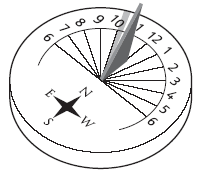
b) 20 m/s into km/h - a) Identify the time-measuring device shown in the figure . What is the principle behind its working?
SECTION D – LONG ANSWERS (5 marks each)
- Explain in detail the steps involved in constructing a Distance–Time graph.
Draw a rough Distance–Time graph for an object moving with uniform speed. - Describe the working of a simple pendulum.
Explain:- Time period
- Oscillation
- Factors affecting time period
- What is meant by uniform and non-uniform speed?
Explain with suitable examples and draw a neat labelled Distance–Time graph for both.
SECTION E – CASE STUDY QUESTIONS
1. Riya’s Bicycle Trip
Riya recorded the distance travelled by her bicycle at different times:
| Time (min) | 0 | 5 | 10 | 15 | 20 |
|---|---|---|---|---|---|
| Distance (m) | 0 | 60 | 130 | 130 | 200 |
Answer the following:
a) What was Riya’s speed during the first 5 minutes?
b) Was she at rest at any time?
c) Was her motion uniform or non-uniform? Why?
2. A Car Journey
A car’s odometer reading at the start of a journey is 10,520 km. After 2 hours, it reads 10,600 km.
The speedometer shows a nearly constant speed.
a) What is an odometer?
b) How much distance did the car travel?
c) Calculate the average speed of the car.
3. The graph below shows the change in distance covered by a student as he walks from home to the playground.
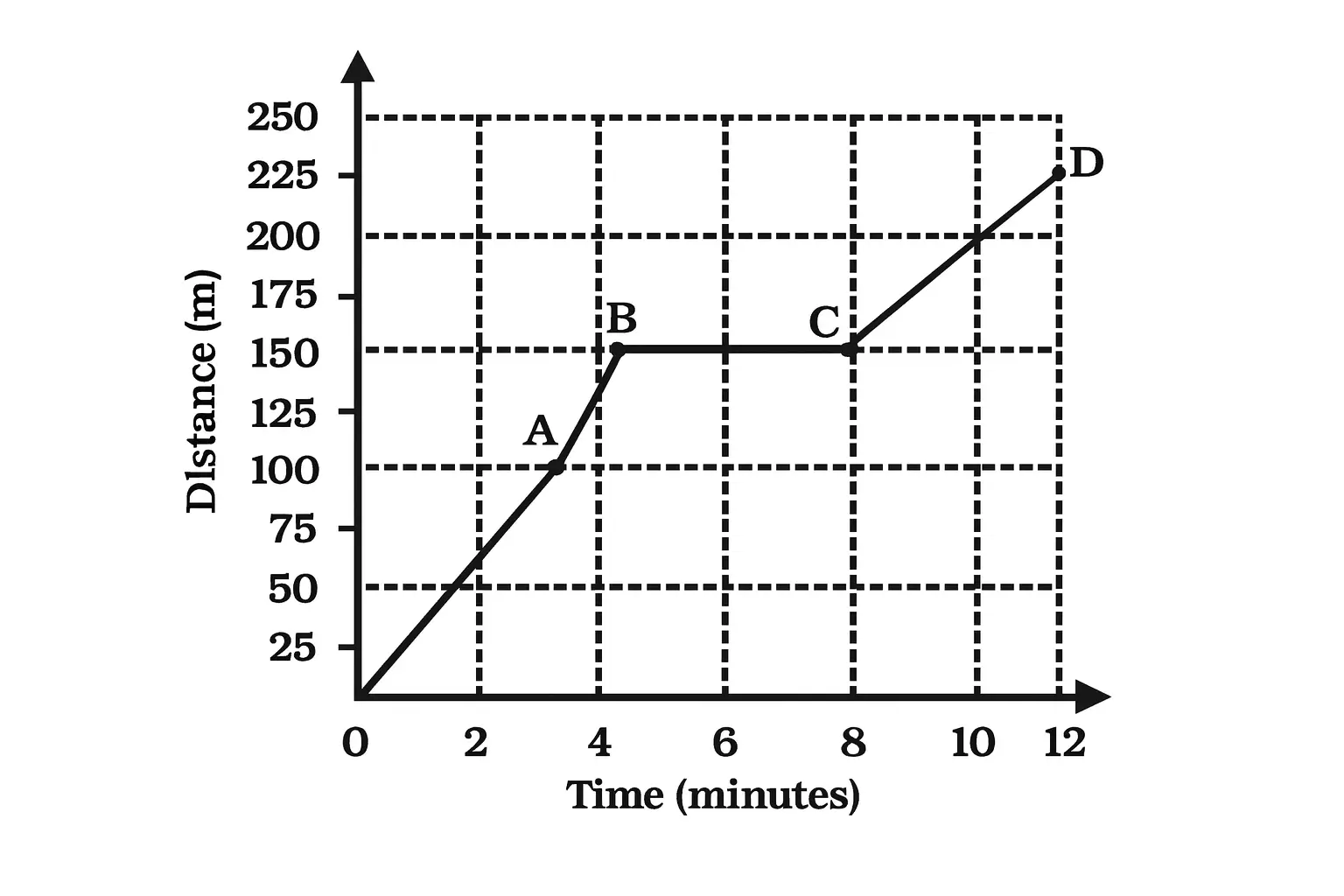
Study the distance–time graph carefully and answer the following questions:
a) What does the horizontal line between points B and C tell you about the student’s movement during that interval?
b) From 0 to 4 minutes, is the student moving with a constant speed? Explain your answer using the graph.
c) Calculate the speed of the student between 8 and 12 minutes, based on the information shown in the graph.