


SECTION–A: MULTIPLE CHOICE QUESTIONS (MCQs)
(10 questions × 1 mark = 10 marks)
- Exchange of gases in Amoeba takes place by:
a) gills b) lungs c) simple diffusion d) spiracles - The process of taking in air rich in oxygen is called:
a) Exhalation b) Inhalation c) Respiration d) Diffusion - Anaerobic respiration occurs:
a) In presence of oxygen
b) In absence of oxygen
c) In presence of carbon dioxide
d) Only in plants - End products of anaerobic respiration in yeast are:
a) Alcohol + CO₂
b) Lactic acid + CO₂
c) Water + CO₂
d) Only CO₂ - In plants, water and minerals are transported through:
a) Phloem b) Xylem c) Roots d) Veins - The human heart has:
a) 2 chambers b) 3 chambers c) 4 chambers d) 5 chambers - The component of blood that helps in clotting is:
a) RBC b) WBC c) Plasma d) Platelets - The relaxation phase of the heart is called:
a) Systole b) Diastole c) Pulse d) Contraction - Transpiration refers to:
a) Loss of CO₂
b) Loss of O₂
c) Evaporation of water from plant surface
d) Absorption of minerals - Urine is produced by the:
a) Heart b) Kidney c) Skin d) Liver
SECTION–B: ONE WORD / ONE LINE ANSWERS
(10 questions × 1 mark = 10 marks)
- Name the process that releases energy from food.
- What are the tiny openings on leaves for gaseous exchange called?
- Which pigment in blood carries oxygen?
- What is the contraction of the heart called?
- Name the vascular tissue that transports food.
- What is one breath?
- Name the network of air tubes in insects.
- Which waste material is excreted by human kidneys?
- Name the process of loss of water in plants.
- What connects arteries to veins?
SECTION–C: ASSERTION & REASONING
(5 questions × 2 marks = 10 marks)
Choose:
A – Both assertion and reason are true & reason is correct explanation
B – Both true but reason NOT explanation
C – Assertion true, reason false
D – Assertion false, reason true
- Assertion: Anaerobic respiration occurs in muscle cells during heavy exercise.
Reason: During intense activity, oxygen supply to muscles becomes insufficient. - Assertion: Plants respire day and night.
Reason: Photosynthesis takes place only in presence of sunlight. - Assertion: Capillaries have thin walls.
Reason: They allow exchange of substances between blood and tissues. - Assertion: Earthworms exchange gases through their moist skin.
Reason: Their skin contains blood vessels close to the surface. - Assertion: Transpiration helps in cooling the plant body.
Reason: Evaporation of water absorbs heat.
SECTION–D: SHORT ANSWER QUESTIONS
(8 questions × 3 marks = 24 marks)
- Differentiate between aerobic and anaerobic respiration (any 3 differences).
- Why do we get muscle cramps after heavy physical exercise?
- Write an activity to show that plants also respire.
- Explain why an athlete breathes faster and deeper after a sprint.
- State the functions of blood (any 3).
- What is transpiration? State any two benefits of transpiration.
- How does oxygen taken into the lungs get transported to different parts of the body?
- Why must waste materials be removed from the human body?
SECTION–E: LONG ANSWER QUESTIONS
(4 questions × 4 marks = 16 marks)
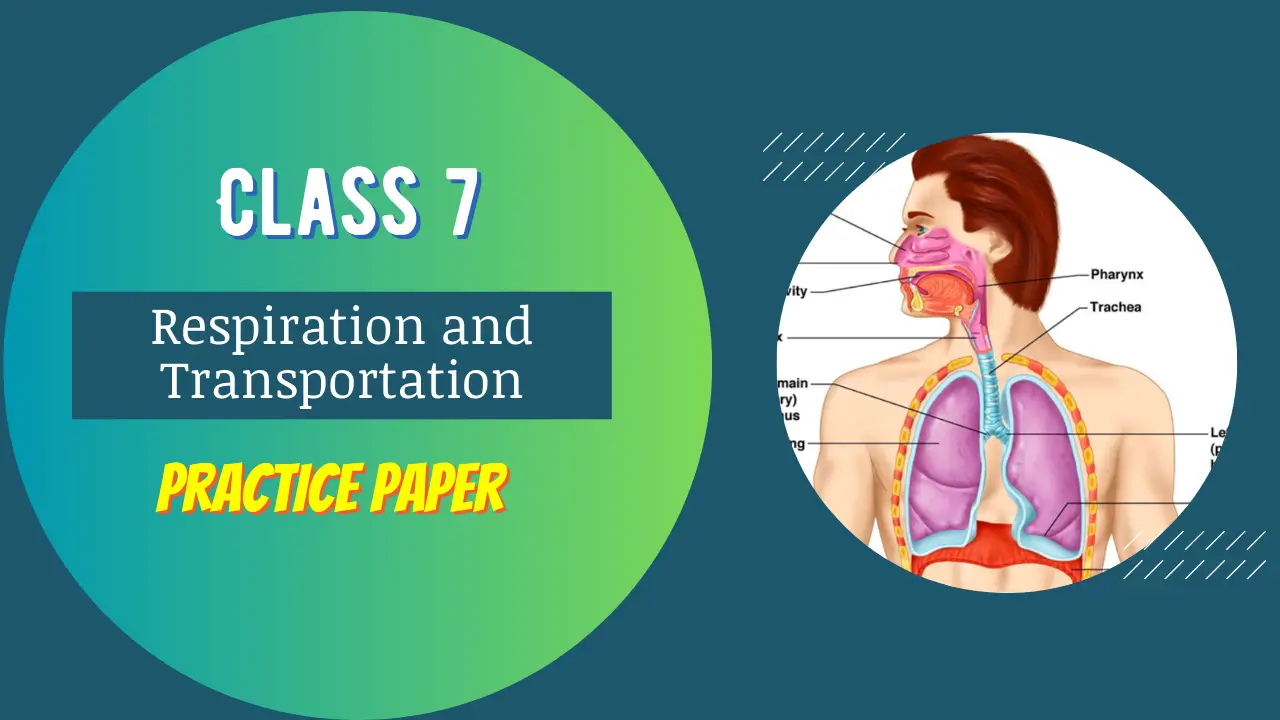
a) Draw a labelled diagram of the human respiratory system.
b) Describe inhalation and exhalation.
a) Explain the transportation of water in plants through xylem.
b) Write an activity to show that water is absorbed by roots.
a) Describe the structure of the human heart.
b) Where is oxygenated and deoxygenated blood found in the heart?
a) Explain why diffusion and osmosis are sufficient for unicellular organisms, but not for multicellular organisms.
b) List the differences between arteries and veins.