


Section A – Multiple Choice Questions (1×10 = 10 marks)
- The water present on, under and above the earth’s surface is known as
a) Atmosphere
b) Lithosphere
c) Hydrosphere
d) Biosphere - Which of the following is the gaseous form of water?
a) Ice
b) Snow
c) Water vapour
d) Glacier - The process by which water vapour changes into water droplets is called
a) Evaporation
b) Condensation
c) Precipitation
d) Transpiration - The continuous circulation of water in nature is called
a) Ocean cycle
b) Water balance
c) Hydrological cycle
d) Rain cycle - Tsunamis are mainly caused by
a) Cyclones
b) Heavy rainfall
c) Earthquakes on the ocean floor
d) Ocean currents - The highest point of a wave is known as
a) Trough
b) Crest
c) Frequency
d) Height - The rise of sea water twice a day is called
a) Ocean current
b) Wave
c) High tide
d) Low tide - Which of the following is a warm ocean current?
a) Labrador Current
b) Humboldt Current
c) Gulf Stream
d) Benguela Current - The average salinity of ocean water is about
a) 25 grams
b) 30 grams
c) 35 grams
d) 40 grams - World Water Day is celebrated on
a) March 5
b) March 22
c) April 22
d) June 5
Section B – Very Short Answer Questions (2×5 = 10 marks)
- What is hydrosphere?
- Name any two forms of water found on the earth.
- What is evaporation?
- What are tides?
- Name any two factors affecting the movement of ocean water.
Section C – Short Answer Questions (3×5 = 15 marks)
- Explain the distribution of water on the earth.
- Describe the process of condensation.
- What are ocean waves? How are they formed?
- Write any three effects of tsunamis.
- State any three importance of tides.
Section D – Long Answer Questions (5×1 = 5 marks)
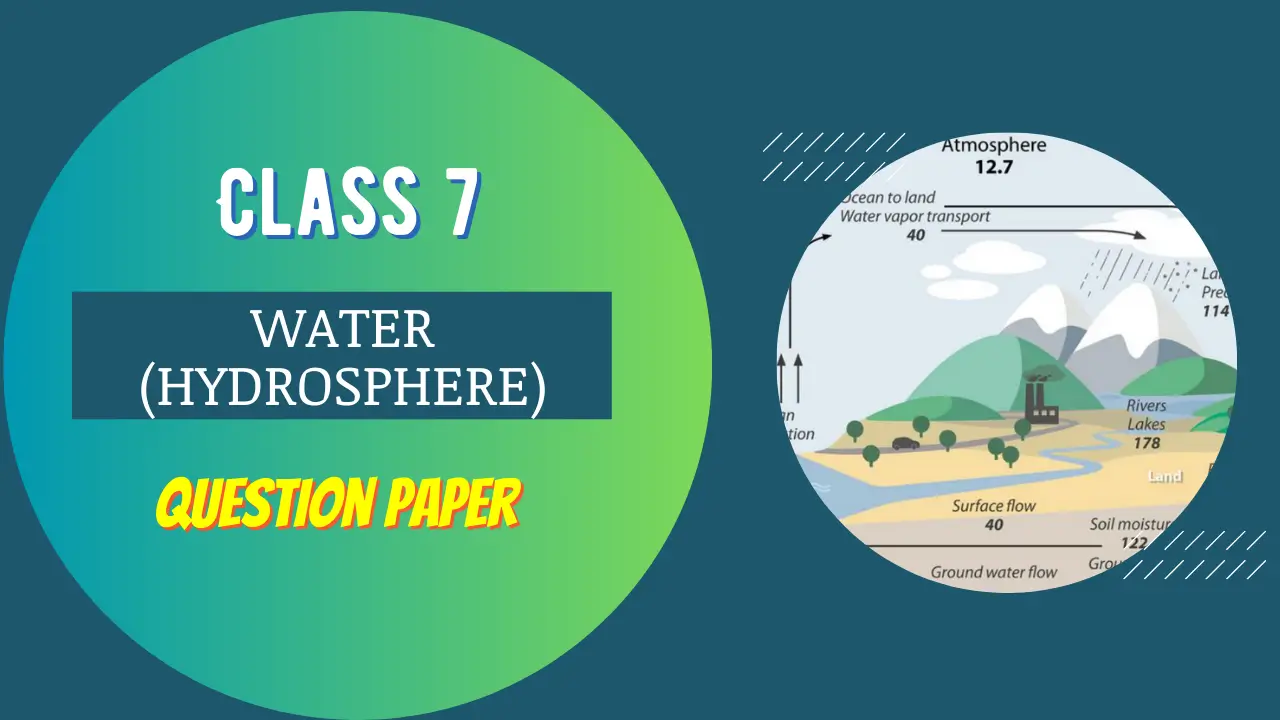
- Explain the hydrological cycle with the help of a neat diagram.