


SECTION A: MULTIPLE CHOICE QUESTIONS (MCQs)
(Choose the correct option.)
- Light travels in a:
a) Zig-zag path
b) Straight line
c) Curved path
d) Circular path - The natural source of light on Earth is:
a) Candle
b) Bulb
c) Sun
d) Fire - The bouncing back of light from a surface is called:
a) Refraction
b) Reflection
c) Dispersion
d) Transmission - An image formed by a plane mirror is:
a) Inverted
b) Magnified
c) Virtual and erect
d) Real - The mirror used by dentists is:
a) Plane mirror
b) Convex mirror
c) Concave mirror
d) Periscope mirror - The image formed by a convex mirror is always:
a) Real and inverted
b) Virtual and erect
c) Enlarged
d) Of the same size - Light can travel through:
a) Solid only
b) Liquid only
c) Air only
d) Vacuum - The lens used to correct short-sightedness is:
a) Convex lens
b) Concave lens
c) Cylindrical lens
d) Plano lens - The order of colours in a rainbow is known as:
a) ROYGBIV
b) RGB
c) CMYK
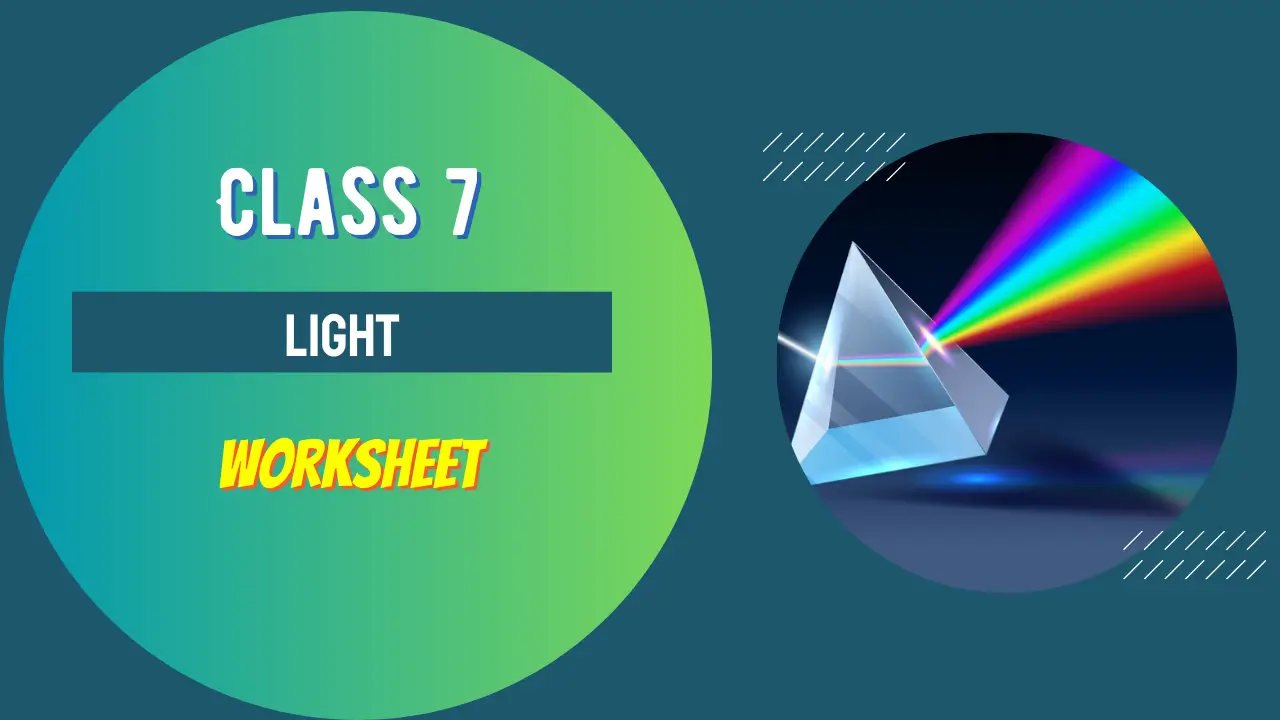
d) UVB - Splitting of white light into seven colours is called:
a) Reflection
b) Absorption
c) Dispersion
d) Scattering
SECTION B: ONE-WORD ANSWERS
- Name the phenomenon that shows left-right reversal in a mirror.
- What type of image can be formed on a screen?
- What is the inner curved mirror called?
- Name the lens that converges light rays.
- What is the main cause of rainbow formation?
SECTION C: VERY SHORT ANSWERS (1–2 sentences)
- What is meant by reflection of light?
- Why is a convex mirror used as a rear-view mirror in vehicles?
- Define a virtual image.
- How does a concave lens bend light rays?
- What happens to the image in a plane mirror when you move farther away from it?
SECTION D: ASSERTION–REASONING QUESTIONS
Choose the correct option:
A. Both A and R are true, and R is the correct explanation of A
B. Both A and R are true, but R is not the correct explanation
C. A is true, but R is false
D. A is false, but R is true
- Assertion (A): A plane mirror forms a laterally inverted image.
Reason (R): Light bends when it reflects from a mirror. - Assertion (A): A convex lens can form a real image.
Reason (R): Convex lenses converge light rays to a point. - Assertion (A): Concave mirrors are used in headlights.
Reason (R): They spread light in all directions. - Assertion (A): A rough surface causes irregular reflection.
Reason (R): The reflected rays do not travel in the same direction. - Assertion (A): Dispersion occurs when white light passes through a prism.
Reason (R): White light is a mixture of seven colours.
SECTION E: ANSWER IN BRIEF (3–4 sentences)
- What are the characteristics of an image formed by a plane mirror?
- Explain the difference between regular and irregular reflection with examples.
- Describe the uses of concave mirrors in daily life.
- Explain how a convex lens forms different types of images based on the distance of the object.
- What is dispersion of light? How does a rainbow form?