Complete solutions to all 10 questions with simple, step-by-step explanations.
▶ Watch the Complete Solution Video
In this post: We solve all 10 questions from Class 7 Computational Thinking Chapter 1, Large Numbers Around Us, including number formation, place value, logical reasoning,
digit arrangements and large-number puzzles.
Questions & Step-by-Step Solutions
Q1
Find the highest possible value of Y
‘X’ is a 6-digit number formed using exactly three different digits. One digit appears once,
another twice, and the third three times. When 2 lakhs are added to X, the resulting number Y
is still a 6-digit number. What is the highest possible value of Y?
A) 977889
B) 999999
C) 999988
D) 999887
Solution
Since 2 lakhs = 200000, to keep Y a 6-digit number, X must be less than 800000.
The largest possible X satisfying the digit-frequency condition is:
X = 799988
Here, 7 appears once, 9 appears three times and 8 appears twice.
Y = 799988 + 200000 = 999988
Answer: C) 999988
Q2
Product of the numbers on a telephone dial-pad
What is the product of all the numbers on a telephone dial-pad?
A) 12345
B) 32451
C) 362880
D) None of these
Solution
The product of the digits 1 through 9 is:
1 × 2 × 3 × 4 × 5 × 6 × 7 × 8 × 9 = 362880
Answer: C) 362880
Q3
Find the difference between X and Y
Sam forms two different 6-digit numbers X and Y using digits from 0 to 9 without repetition. Exactly two digits are common. The digit 9 is in the same position in both numbers. Y ends in 0, has only one even digit, and its digits are in descending order. 6 is present in X, and the number of even digits on its left equals the number on its right. If X is the largest possible number, find X − Y.
Y ends in 0 and has only one even digit, so its other five digits must be the five odd digits
9, 7, 5, 3 and 1. Since they are in descending order:
Y = 975310
For X, 9 must be in the first position. To make X as large as possible while keeping exactly
two common digits and balancing the even digits around 6, we get:
X = 984620
X − Y = 984620 − 975310 = 9310
Answer: A) 9310
Q4
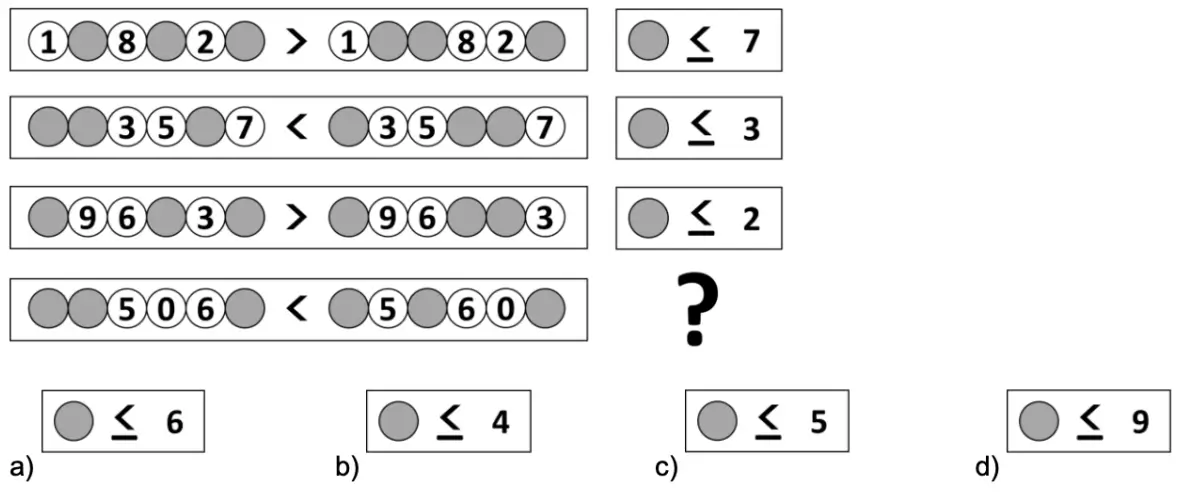
Find the value represented by the grey circle
If each of the rows follows the same theme, what will come in place of “?”?
Solution
Compare the first position where the two numbers differ in each row.
Row 1 gives grey digit ≤ 7.
Row 2 gives grey digit ≤ 3.
Row 3 gives grey digit ≤ 2.
For the last row, compare:
○○506○ < ○5○60○
The first difference is in the second position. Therefore the grey digit must be less than 5,
so its greatest possible value is 4.
Answer: B) ○ ≤ 4
Q5
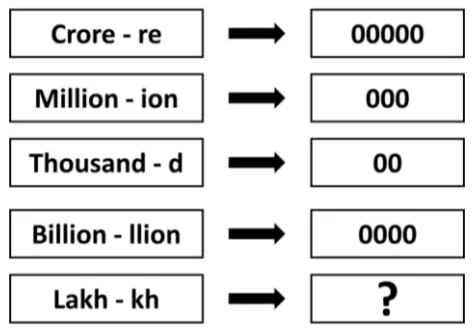
Complete the number-word pattern
What will come in place of “?”?
Solution
The pattern subtracts the number of letters removed from the number of zeros in the corresponding
large number.
Crore has 7 zeros; “re” has 2 letters → 5 zeros.
Million has 6 zeros; “ion” has 3 letters → 3 zeros.
Thousand has 3 zeros; “d” has 1 letter → 2 zeros.
Billion has 9 zeros; “llion” has 5 letters → 4 zeros.
For lakh: 1 lakh has 5 zeros. Remove “kh” (2 letters):
The six tokens are 2, 5, 8, 1, 4, 7. Rearrange them to form a 6-digit number such that:
● The difference between the first and last digits is as small as possible
● The hundreds digit is double the thousands digit
● No consecutive digits appear next to each other
● All given tokens must be used exactly once
How many different 6-digit numbers between 2 lakhs and 8 lakhs can be formed under these conditions?
A) 1
B) 2
C) 3
D) More than 3
Solution
The hundreds digit must be double the thousands digit. After checking the arrangements between 2 lakhs and 8 lakhs and applying the remaining conditions, the smallest possible difference between the first and last digits is 1.
The two valid numbers are:
274851 752418
Both use all six tokens, have hundreds digit double the thousands digit, contain no consecutive adjacent digits, and have a first-to-last digit difference of 1.
Therefore, there are exactly two valid numbers.
Answer: B) 2
Q7
Find the maximum possible difference
Two five-digit numbers are formed using different digits from 0 to 9:
Number 1: _ 1 _ 9 _
Number 2: _ 4 _ 6 _
No two consecutive digits of the number series are present in the same number. What is the maximum possible difference?
A) 47525
B) 52663
C) 52429
D) 46733
Solution
The maximum difference is obtained with the valid pair:
Number 1 = 31597 Number 2 = 84260
84260 − 31597 = 52663
Answer: B) 52663
Q8
Determine E’s number card
A, B, C, D and E each have a different card among one hundred, one thousand, ten thousand, one lakh and ten lakhs. Use the clues to determine which card E has.
C must have an even number of zeros. If C had 6 zeros, D would need 8 zeros, which is impossible. Therefore C has 4 zeros.
C = 10,000
A = 100
D = 10,00,000
B = 1,000
Therefore E = 1,00,000
Answer: C) One lakh
Q9
Find Calvin’s profession and salary
Alex, Bob, Calvin and David have different professions—Doctor, Lawyer, Cricketer and Engineer— and different salaries—₹40,000, ₹50,000, ₹60,000 and ₹70,000 per year. Use the clues to determine Calvin’s profession and salary.
Solution
Bob is the lawyer and David is the engineer. The cricketer earns ₹70,000.
Alex earns more than Bob, while the doctor earns more than David.
Testing the possible salary and profession combinations consistently with all clues gives:
Calvin = Doctor Calvin’s salary = ₹50,000
Answer: C) Doctor – ₹50,000
Q10
Find Nisha’s 6-digit password
The clues to the 6-digit password are: 35 tens, 31 thousands, 25 ones, 423 hundreds, 14 ten thousands.
What is Nisha’s password?