

Motion and Time Question Paper – Class 7 Worksheets

MOTION AND TIME

Class 7 Science Worksheet: Measurement of Time and Motion

Looking for a Class 7 Science Measurement of Time and Motion worksheet for practice and exam preparation? The Busy Brains brings you a comprehensive worksheet covering important questions on speed, time period, oscillations, uniform and non-uniform motion, distance, displacement and distance–time graphs.

This Class 7 Science worksheet with MCQs, assertion–reason questions, short answers, long answers and case studies helps students revise key concepts and practise numerical problems. It is useful for school tests, homework, classroom assessment and science revision.

Topics covered in this worksheet
  • Speed, average speed and SI units
  • Simple pendulum, oscillations and time period
  • Uniform and non-uniform motion
  • Circular motion and rotational motion
  • Distance, displacement and unit conversions
  • Distance–time graphs and case-based questions

How to use this worksheet: Read every question carefully, show all calculations for numerical problems, and draw neat, labelled graphs wherever required.

THE BUSY BRAINS • SCIENCE PRACTICE

Class 7 Science – Measurement of Time and Motion Worksheet

Important exam-style questions for concept revision and practice.

Class 7Science 5 SectionsMCQs & Numericals

Choose the correct option.

Q1. Which of the following is NOT a unit of speed?
  1. m/s
  2. km/h
  3. m²/s
  4. cm/s
Q2. A simple pendulum completes 50 oscillations in 40 seconds. Its time period is:
  1. 0.8 s
  2. 1 s
  3. 1.2 s
  4. 2 s
Q3. Which of the following describes non-uniform motion?
  1. A car moving at 40 km/h constantly
  2. A clock’s second hand
  3. A child running and slowing down
  4. Earth revolving around the Sun
Q4. The device that measures the speed of a vehicle is called:
  1. Thermometer
  2. Speedometer
  3. Odometer
  4. Barometer
See also  Class 7 Science Measurement of Time and Motion Worksheet with Answers
Q5. The formula to calculate speed is:
  1. Distance × Time
  2. Distance ÷ Time
  3. Time ÷ Distance
  4. (Distance × Time) ÷ 2
Q6. Which is an example of periodic motion?
  1. A car moving on a road
  2. A moving train
  3. Swinging of a pendulum
  4. A rocket taking off

Assertion–Reason Questions

For Q7–Q8, choose the correct option:

  1. A and R are both true; R explains A.
  2. A and R are both true; R does not explain A.
  3. A is true; R is false.
  4. A is false; R is true.
Q7.

Assertion (A): A pendulum stops swinging after some time.

Reason (R): Friction and air resistance slow down its motion.

Q8.

Assertion (A): Speed is a scalar quantity.

Reason (R): Speed has magnitude and direction.

Q9. What is meant by non-uniform motion? Give one example.
Q10. Define speed. Give its SI unit.
Q11. What is an oscillation?
Q12. A cyclist covers 25 km in 1 hour and 50 minutes. Find his average speed in km/h.
Q13. Write any two differences between distance and displacement.

Q14. Distinguish between circular motion and rotational motion with examples.
Q15. Explain why a simple pendulum takes approximately the same time to complete each oscillation when it swings through small angles.
Q16. A bus travels 150 km in 3 hours and another 120 km in 2 hours.

(a) Find the total distance.

(b) Find the total time.

(c) Calculate the average speed.

Q17. Describe any three types of motion with examples.
Q18. Convert the following:

(a) 54 km/h into m/s

(b) 20 m/s into km/h
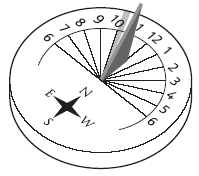
Q19. Identify the time-measuring device shown in the figure. What is the principle behind its working?
Time-measuring device science question for Class 7

Q20. Explain in detail the steps involved in constructing a distance–time graph. Draw a rough distance–time graph for an object moving with uniform speed.
Q21. Describe the working of a simple pendulum. Explain:
  • Time period
  • Oscillation
  • Factors affecting the time period
See also  Class 7 Science Half Yearly Question Paper (Set 2) | Mid-Term Exam Preparation
Q22. What is meant by uniform and non-uniform speed? Explain with suitable examples and draw a neat, labelled distance–time graph for both.

Case Study 1: Riya’s Bicycle Trip

Riya recorded the distance travelled by her bicycle at different times.

Time (min)05101520
Distance (m)060130130200

Answer the following:

(a) What was Riya’s speed during the first 5 minutes?
(b) Was she at rest at any time?
(c) Was her motion uniform or non-uniform? Why?

Case Study 2: A Car Journey

A car’s odometer reading at the start of a journey is 10,520 km. After 2 hours, it reads 10,600 km. The speedometer shows a nearly constant speed.

(a) What is an odometer?
(b) How much distance did the car travel?
(c) Calculate the average speed of the car.

Case Study 3: Distance–Time Graph

The graph below shows the change in distance covered by a student as he walks from home to the playground.
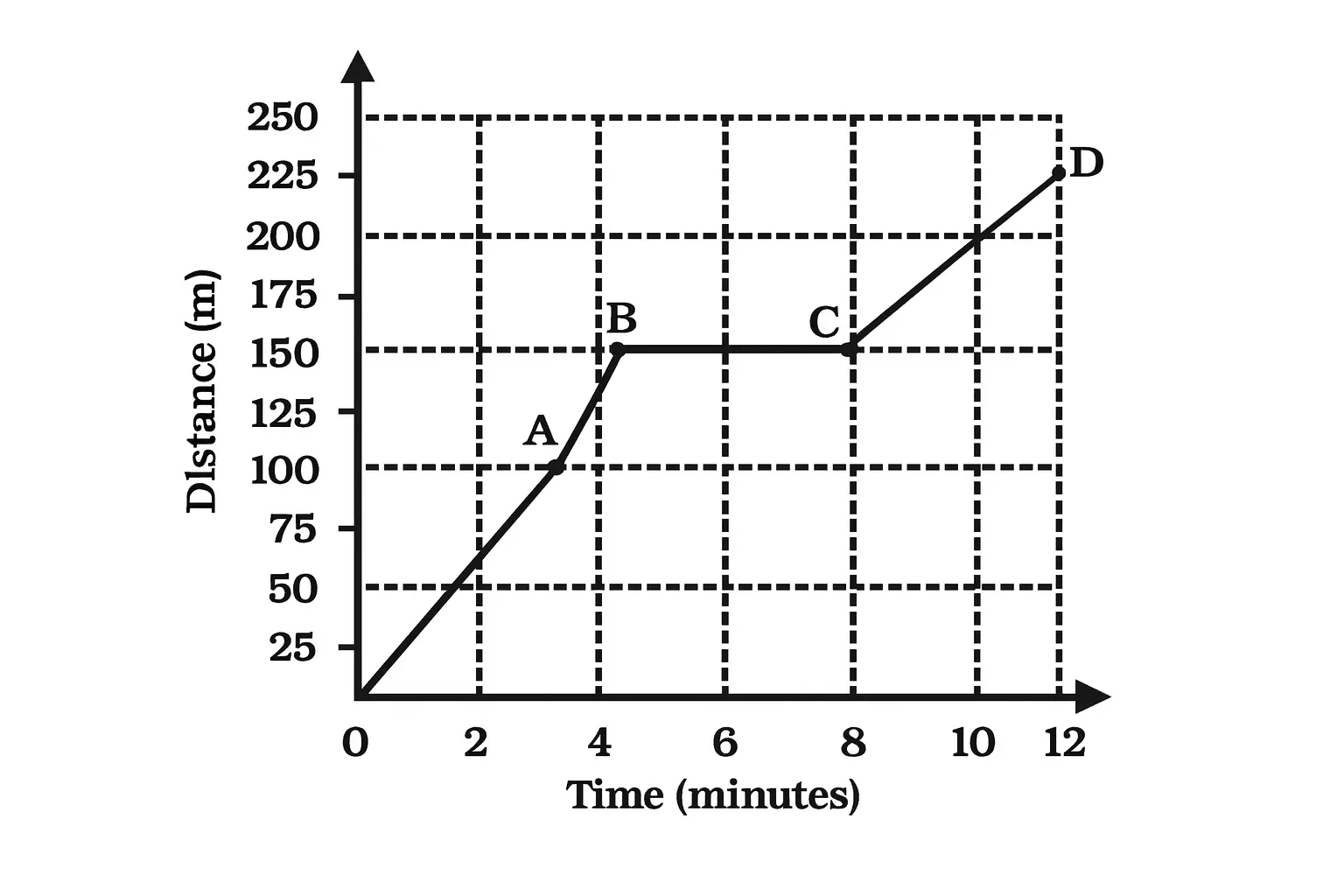
Distance-time graph for Class 7 Science motion worksheet

Study the distance–time graph carefully and answer the following questions:

(a) What does the horizontal line between points B and C tell you about the student's movement during that interval?
(b) From 0 to 4 minutes, is the student moving with a constant speed? Explain your answer using the graph.
(c) Calculate the speed of the student between 8 and 12 minutes, based on the information shown in the graph.

Print or Save the Worksheet as PDF

Save this Class 7 Science Measurement of Time and Motion worksheet for revision, homework or classroom practice.

In the print window, select “Save as PDF” to save a digital copy.

See also  Cryptarithm Practice Questions for Grade 7 & Grade 8 NCERT

Leave A Comment

Your email address will not be published. Required fields are marked *

error: Content is protected !!