
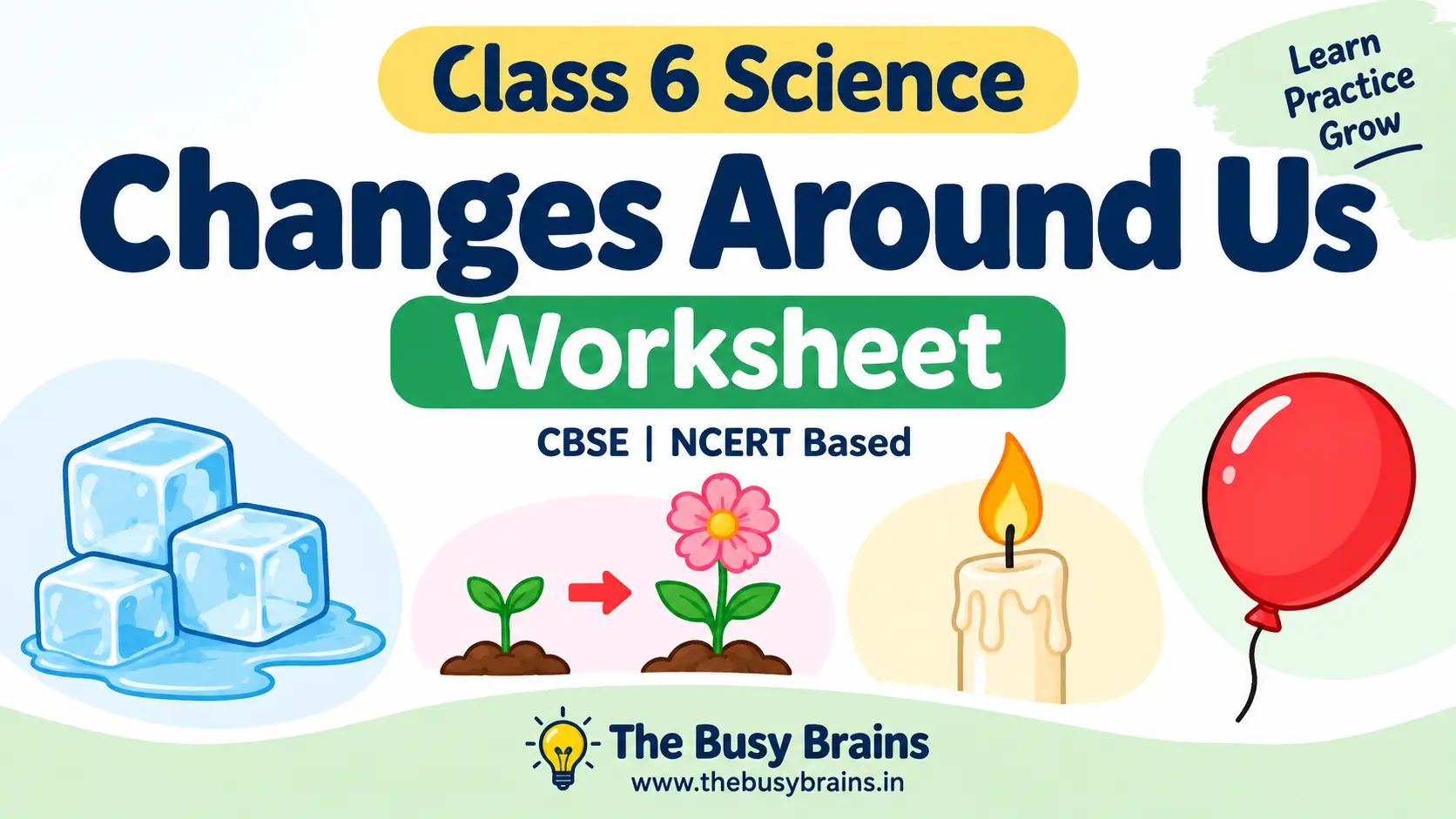
Class 6 Science Changes Around Us Worksheet | CBSE Grade 6 Practice Paper

Class 6 Changes Around Us Worksheet

Class 6 Science Changes Around Us Worksheet

Looking for a useful Class 6 Science tbb-paper on Changes Around Us? This practice sheet is designed for students revising the chapter through a mix of MCQs, Assertion-Reason questions, short-answer questions, classification tasks and application-based questions. It focuses on the important ideas of reversible and irreversible changes, changes caused by heating, cooling and mixing, and familiar examples such as melting ice, drying clothes, setting curd, heating metal and changing water into vapour.

The tbb-paper is suitable for Class 6 CBSE Science revision, homework, classroom practice, unit-test preparation and concept reinforcement. Students should read each tbb-question carefully and use observations from everyday life to decide whether a change can be reversed.

Class 6 Science Changes Around Us CBSE Worksheet Reversible Changes Irreversible Changes NCERT Revision
COACHING ACADEMY

GRADE 6 SCIENCE WORKSHEET – CHANGES AROUND US

Name: ______________________________
Date: ______________
Section: __________

A. Multiple-Choice Questions

1Which example represents a change that can be undone?
a) A clay pot after baking
b) Ice turning into water
c) Milk changing into curd
d) Bread being toasted
2A balloon is inflated and then the air is allowed to escape. What does this tell us?
a) The change can be reversed
b) A new substance is formed
c) The material is burnt
d) The change needs cooling
3When a metal ring is heated, it becomes slightly larger. This is known as:
a) contraction
b) expansion
c) freezing
d) condensation
4Why is a metal rim heated before fitting it onto a wooden wheel?
a) Heating makes the rim expand
b) Heating makes it shrink
c) The wood expands more
d) Cooling makes the rim larger
5Water in an uncovered pan gradually decreases during prolonged heating because it:
a) freezes
b) becomes vapour
c) becomes salt
d) becomes ice
6Which pair contains changes that can be reversed?
a) Burning paper and cooking rice
b) Melting ice and dissolving salt in water
c) Ripening a mango and baking bread
d) Setting curd and burning an incense stick

B. Assertion–Reason

Choose: (a) Both A and R are true and R explains A.   (b) Both are true but R does not explain A.   (c) A is true, R is false.   (d) A is false, R is true.
7Assertion (A): Melting ice is a reversible change.
Reason (R): Water can be cooled again to form ice.
8Assertion (A): A baked roti can be changed back into the same dough by cooling it.
Reason (R): Baking causes a change that cannot be reversed by simply cooling the roti.
9Assertion (A): A heated metal ring contracts when it cools.
Reason (R): Cooling causes the ring to reduce from its expanded size.

C. Think and Answer

10Paper aeroplane: A sheet is folded into an aeroplane and then opened again. Is the change reversible? Give one reason.
11Clay and pottery: A potter shapes clay and later bakes the pot. Compare the two stages and state which change is easier to reverse.
12Heating water: What happens to water when it is heated continuously in an open pan? Explain the change in the amount of water.
13Tool handles: Explain how heating and cooling help a metal ring hold a wooden handle tightly.
14Candle and wax: A burning candle becomes shorter, while wax melts when heated. Why are these two changes different in terms of reversibility?

D. Classify the Changes

Write Reversible or Not Reversible.

No.SituationYour Answer
15Ice cream melting on a warm day________________
16Sugar mixing completely with water________________
17A mango becoming ripe________________
18A piece of wood being cut into smaller pieces________________
19Wet clothes drying in the sun________________
20Milk changing into curd________________

E. Apply the Idea

21Salt is mixed with water until it disappears from view. Suggest a method that could help recover the salt.
22A worker heats tar before spreading it on a road. What effect does heating have on the tar? How would you decide whether the change can be reversed?
23Think of a rubber band, a sheet of paper and a slice of bread. Give one example of a change for each and tbb-classify it as reversible or not reversible.
Quick Recall: Changes may occur due to heating, cooling or mixing. One useful way to group changes is to check whether the original material can be obtained again.
LEARN • PRACTISE • GROW

Enjoyed This Class 6 Science Worksheet?

Take your learning further with The Busy Brains on YouTube. Watch concept explanations, chapter-wise tbb-question solutions, exam preparation videos, worksheets and useful revision content designed for school students.

▶ Subscribe to The Busy Brains on YouTube

@TheBusyBrains_

Leave A Comment

Your email address will not be published. Required fields are marked *

error: Content is protected !!