


THE BUSY BRAINS PRESENTS
CBSE CLASS 10 SCIENCE
BOARD EXAMINATION – SAMPLE PAPER
Board Examination Preparation | Session 2026–27
General Instructions
- This paper contains 39 questions divided into three sections: Section A – Biology, Section B – Chemistry and Section C – Physics.
- All three sections are compulsory. Internal choices are provided in selected questions. Attempt only one alternative wherever a choice is given.
- Read every question carefully before answering.
- Draw neat and properly labelled diagrams wherever required.
- Show all necessary calculations and write appropriate units in numerical questions.
- Marks allotted to each question are indicated alongside it.
SECTION A – BIOLOGY
Questions 1–16 | Human Physiology, Life Processes, Reproduction, Heredity and Environment
Q1.
During inhalation in humans, which combination of changes takes place in the rib cage and diaphragm?
1 MarkQ2.
Suppose the tubular region of a nephron stops performing its normal function. What is the most likely effect on the urine produced?
1 MarkQ3.
A plant placed near a sunny window gradually bends towards the light. Which explanation correctly describes this response?
1 MarkQ4.
Which of the following activities mainly involves the cerebellum's role in coordinating voluntary muscular movements and balance?
1 MarkQ5.
Which sequence correctly represents the development of a flowering plant after fertilisation?
1 MarkQ6.
Which statement does NOT correctly describe a stable ecosystem?
1 MarkQ7.
Which characteristic is associated with biodegradable waste?
1 Mark
Questions 8 and 9: Each question contains an Assertion (A) followed by a Reason (R). Select the correct option:
- Both A and R are true, and R correctly explains A.
- Both A and R are true, but R does not correctly explain A.
- A is true, but R is false.
- A is false, but R is true.
Q8.
Assertion (A): Human females possess two X chromosomes as their sex chromosome pair.
Reason (R): The sex chromosome supplied by the father determines whether the offspring is genetically male or female.
1 MarkReason (R): The sex chromosome supplied by the father determines whether the offspring is genetically male or female.
Q9.
Assertion (A): Energy transferred to herbivores is not returned to green plants.
Reason (R): Energy moves through a food chain in only one direction.
1 MarkReason (R): Energy moves through a food chain in only one direction.
Q10.
Mention one important function of each of the following in human digestion:
2 Marks(i) Hydrochloric acid present in the stomach.
(ii) Villi lining the small intestine.
Q11.
Attempt either option A or B.
2 MarksA.
(i) Explain the meaning of double circulation in humans.
(ii) Why is it advantageous to keep oxygenated and deoxygenated blood separate?
OR
B.
(i) Name the group of animals that generally possess a three-chambered heart.
(ii) Why is such a heart structure sufficient for these animals?
Q12.
What term is used for substances that resist decomposition by natural biological processes? State two harmful effects they may have on an ecosystem.
2 MarksQ13.
Identify the likely hormonal condition or hormonal change represented by each observation:
3 Marks(i) Enlargement of the neck in people living in mountainous regions.
(ii) Excessive secretion of growth hormone during childhood.
(iii) Development of facial hair in adolescent boys.
Q14.
In a tomato plant, green stem colour (G) is dominant over purple stem colour (g). A pure-breeding green-stemmed plant (GG) is crossed with a purple-stemmed plant (gg). Answer the following:
3 Marks(i) What stem colour will appear in the first filial generation (F1)?
(ii) Determine the expected ratio of green-stemmed and purple-stemmed plants in the F2 generation.
(iii) What does this cross demonstrate about the inheritance of contrasting traits?
Q15.
Read the passage and answer the questions that follow.
4 Marks
Most plants take in carbon dioxide through stomata during photosynthesis. However, certain plants such as pineapple follow a specialised pathway. They temporarily store carbon dioxide in the form of an organic compound inside leaf cells. Later, this stored compound releases carbon dioxide for use in photosynthesis. This adaptation allows these plants to reduce water loss and survive in dry habitats.
(i) Which process of water loss is reduced by this special adaptation?
(ii) At what time of the day are such plants generally able to absorb carbon dioxide from the atmosphere?
Attempt either (iii) or (iv).
(iii) Explain how storing carbon dioxide in an organic compound helps these plants conserve water.
OR
(iv) Predict how covering the leaves of a plant with aluminium foil would affect its normal functioning. Give a reason.
Q16.
Attempt either option A or B.
5 MarksA.
(i) Describe three methods or devices used to prevent pregnancy in human females. Mention one possible side effect associated with each.
(ii) Explain what happens in the female reproductive system when:
(a) The released egg gets fertilised.
(b) The egg remains unfertilised.
OR
B. Give scientific reasons for the following statements:
(i) Changes in inherited proteins can result in differences in body design.
(ii) Fertilisation in a flower is not possible without pollination.
(iii) Fragmentation and regeneration are not suitable methods of reproduction for every multicellular organism.
(iv) Vegetative propagation is useful only for selected groups of plants.
(v) Sexual reproduction maintains the chromosome number of a species across generations.
SECTION B – CHEMISTRY
Questions 17–29 | Chemical Reactions, Acids and Bases, Metals and Non-metals, Carbon Compounds
Q17.
A sample of white silver chloride is exposed to sunlight for some time. What change is expected?
1 MarkQ18.
Which of these processes releases heat into its surroundings?
1 MarkQ19.
When zinc granules are added to dilute sulphuric acid, which gas is released?
1 MarkQ20.
Which of the following substances may be used to neutralise an acidic bee sting?
1 MarkQ21.
Which positively charged ion is produced when an acid dissolves in water?
1 MarkQ22.
Which acid is naturally present in tomatoes?
1 MarkQ23.
An element X combines with hydrogen on heating and produces a covalent compound H2X. The compound has the characteristic smell of rotten eggs. Identify X.
1 Mark
Question 24: Choose the correct option based on Assertion (A) and Reason (R).
- Both statements are true, and R correctly explains A.
- Both statements are true, but R does not correctly explain A.
- A is true, but R is false.
- A is false, but R is true.
Q24.
Assertion (A): Aldehydes and ketones both contain the carbonyl functional group.
Reason (R): In aldehydes, the carbonyl carbon is attached to at least one hydrogen atom.
1 MarkReason (R): In aldehydes, the carbonyl carbon is attached to at least one hydrogen atom.
Q25.
A clean copper coin is placed in a beaker containing silver nitrate solution and left undisturbed. Describe the changes that will be observed on the coin and in the solution.
2 MarksQ26.
Name any two suitable metals for each of the following purposes:
3 Marks(i) Manufacturing electrical wires.
(ii) Producing household utensils and industrial equipment.
(iii) Making ornaments and decorative jewellery.
Q27.
Attempt either option A or B.
3 MarksA. Explain the scientific reason behind each observation:
(i) Lemon juice is used to clean tarnished copper articles.
(ii) Sulphide ores are usually converted into oxides before extracting the metal.
(iii) Copper is preferred for making electrical connecting wires.
OR
B. A metal remains liquid at ordinary room temperature. It is extracted by heating its sulphide ore in the presence of air. Identify the metal and its sulphide ore. Also write the chemical equation for the extraction reaction.
Q28.
A laboratory student accidentally gets concentrated sulphuric acid on his hand. After washing the affected area, a friend suggests using sodium hydrogen carbonate as a neutralising substance. Answer the following questions:
4 Marks(i) Name another suitable mild base available in a school laboratory that could be used in a neutralisation demonstration.
(ii) Write the balanced chemical equation for the reaction between sulphuric acid and sodium hydrogen carbonate.
Attempt either (iii) or (iv).
(iii) Mention any two common uses of bases in daily life or industry.
OR
(iv) How does an increase in hydrogen ion concentration affect the acidic nature of an aqueous solution?
Safety note: Chemical burns require immediate, thorough rinsing with plenty of running water and appropriate medical attention. Do not apply solid chemicals to an injured area.
Q29.
Attempt either option A or B.
5 MarksA.
(i) Define hydrocarbons and give two examples.
(ii) Differentiate between saturated and unsaturated hydrocarbons with one suitable example of each.
(iii) What is a functional group? Name four different functional groups found in organic compounds.
OR
B.
(i) Explain how soap is prepared. Write the chemical equation for the process.
(ii) Describe the cleansing action of soap with the help of a labelled diagram showing the formation of micelles.
SECTION C – PHYSICS
Questions 30–39 | Light, Human Eye, Electricity and Magnetic Effects of Electric Current
Q30.
In vehicle headlights, searchlights and torches, the bulb is generally positioned at which location relative to a concave mirror?
1 MarkQ31.
Study the labelled eye diagram given below. Identify the part indicated by X.
1 Mark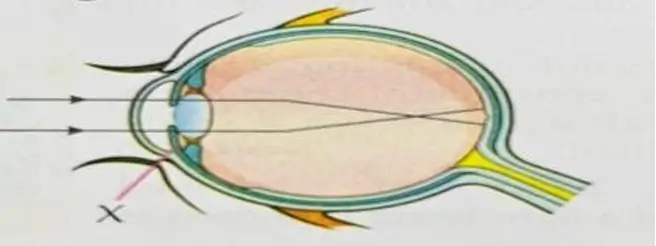
For visually impaired students only: Which structure of the eye is responsible for producing the greatest refraction of incoming light?
Question 32: Select the appropriate answer based on the following Assertion and Reason:
- Both A and R are true, and R correctly explains A.
- Both A and R are true, but R does not correctly explain A.
- A is true, but R is false.
- A is false, but R is true.
Q32.
Assertion (A): The eye can focus on objects at different distances by changing the focal length of its lens. This ability is known as accommodation.
Reason (R): The cornea changes its focal length to focus on nearby and distant objects.
1 MarkReason (R): The cornea changes its focal length to focus on nearby and distant objects.
Q33.
A spherical mirror produces an upright and smaller image of an object regardless of the object's position in front of it.
2 Marks(i) Identify the type of mirror.
(ii) Draw a labelled ray diagram to illustrate the image formation.
Q34.
Attempt either option A or B.
2 MarksA. State two important safety devices or protective arrangements used in household electrical circuits and appliances.
OR
B. Three resistors, each having a resistance of 9 Ω, are available. Explain how they can be connected to obtain equivalent resistances of:
(i) 13.5 Ω
(ii) 6 Ω
Q35.
Examine the given diagram showing the path of light rays in a human eye and answer the questions below:
3 Marks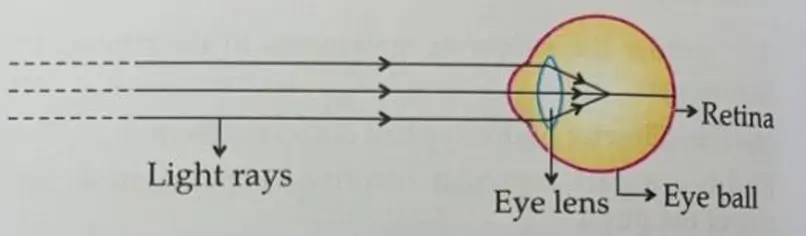
(i) Name the defect of vision represented in the figure.
(ii) State any two possible reasons for the development of this defect.
(iii) Which type of lens is prescribed to correct it?
For visually impaired students only: A person can read a book held nearby without difficulty, but objects located far away appear blurred.
(i) Identify the visual defect.
(ii) Mention two possible causes.
(iii) Name the lens used for its correction.
Q36.
An electric motor operating on a 220 V supply has a power rating of 1100 W. Calculate the following:
3 Marks(i) The electric current drawn by the motor.
(ii) The electrical energy used when the motor operates for 5 hours each day over 6 days.
(iii) The total electricity cost if one unit of energy is charged at ₹5.
Q37.
Answer the following questions related to a current-carrying solenoid:
3 Marks(i) Define a solenoid.
(ii) Draw a labelled diagram showing the magnetic field pattern around it.
(iii) Explain how a solenoid can be used to magnetise a soft iron rod.
Q38.
A student points a concave mirror towards the Sun and places a white card in front of it. By moving the card, a small, bright and sharp spot of light is obtained. This spot represents the image of the Sun at the principal focus of the mirror.
4 Marks(i) Mention two practical applications of concave mirrors.
(ii) If the distance between the pole and principal focus of the mirror is 15 cm, calculate its radius of curvature.
Attempt either (iii) or (iv).
(iii) Draw a ray diagram showing image formation when an object is placed between the pole and principal focus of a concave mirror.
OR
(iv) An object is placed 100 cm in front of a concave mirror. Its image is formed at the same position as the object. Calculate the focal length of the mirror.
Q39.
Attempt either option A or B.
5 MarksA.
(i) State Ohm's law and express it in mathematical form.
(ii) Define resistivity and mention its SI unit.
(iii) A potential difference of 2 V is applied across a conductor and a current of 0.5 A flows through it. Calculate its resistance.
OR
B.
(i) List the factors that determine the resistance of a uniform cylindrical conductor.
(ii) A wire has a resistance of 10 Ω and a radius of 0.01 cm. If its resistivity is 50 × 10−8 Ω m, calculate the length of the wire.