



THE BUSY BRAINS | CBSE BOARD EXAM PREPARATION
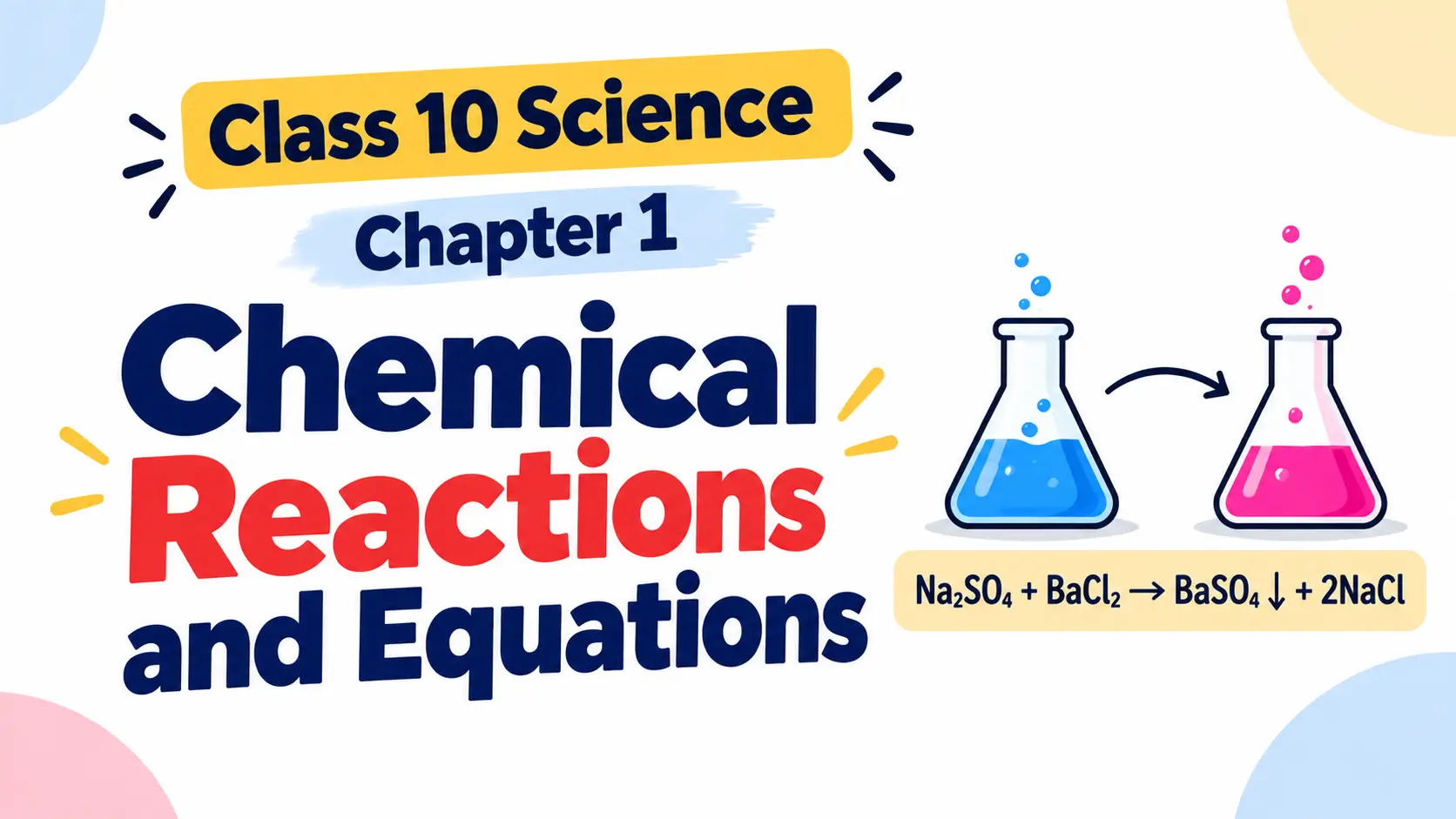
Class 10 Chemistry Chapter 1: Chemical Reactions and Equations
Learn chemical reactions, balanced chemical equations, types of reactions, oxidation and reduction, corrosion and rancidity with these NCERT-based revision notes. These notes focus on important definitions, chemical equations, observations and concepts useful for CBSE Class 10 Science board examination preparation.
Jump to Quick Revision ↓Chemical Reactions Chemical Equations Balancing Equations Combination Reactions Decomposition Displacement Double Displacement Oxidation & Reduction Corrosion & Rancidity Board Exam Focus Quick Revision
1. Chemical Reactions: Meaning and Characteristics
A chemical reaction is a process in which one or more substances undergo a chemical change to form new substances with different properties.
Examples from everyday life
- Milk turning sour.
- Iron articles rusting in moist air.
- Fermentation of grapes.
- Cooking food.
- Digestion of food.
- Respiration in living organisms.
How can we identify a chemical reaction?
The following observations may indicate that a chemical reaction has taken place:
- Change in state: A substance changes from one physical state to another.
- Change in colour: A visible colour change occurs.
- Evolution of gas: A gas is released during the reaction.
- Change in temperature: Heat may be released or absorbed.
NCERT Activity: Burning Magnesium Ribbon
Magnesium ribbon burns with a dazzling white flame and forms a white powder called magnesium oxide.
2Mg(s) + O₂(g) → 2MgO(s)Magnesium ribbon is cleaned with sandpaper before burning to remove the oxide layer present on its surface.
2. Chemical Equations
A chemical equation represents a chemical reaction using chemical symbols and formulae.
Word equation and chemical equation
Word equation
Magnesium + Oxygen → Magnesium oxide
Chemical equation
Mg + O₂ → MgOThis is a skeletal, unbalanced equation.
Important terms
- Reactants: Substances that take part in a chemical reaction. They are written on the left-hand side (LHS).
- Products: New substances formed during a reaction. They are written on the right-hand side (RHS).
- Arrow (→): Indicates the direction of the reaction.
- Plus sign (+): Separates two or more reactants or products.
- Skeletal equation: An equation written using correct chemical formulae but not yet balanced.
- Balanced equation: An equation in which the number of atoms of each element is equal on both sides.
Symbols used for physical states
| Symbol | Meaning | Example |
|---|---|---|
| (s) | Solid | Fe(s) |
| (l) | Liquid | H₂O(l) |
| (g) | Gas | H₂(g) |
| (aq) | Aqueous solution; substance dissolved in water | CuSO₄(aq) |
Reaction conditions such as heat, sunlight, pressure and catalysts may be written above or below the reaction arrow.
3. Balanced Chemical Equations
The law of conservation of mass states that mass can neither be created nor destroyed in a chemical reaction. Therefore, the total number of atoms of each element must remain the same before and after the reaction.
Steps for balancing equations: Hit-and-Trial Method
- Write the correct chemical formulae of the reactants and products.
- Count the atoms of each element on both sides.
- Choose an element and balance its atoms by changing coefficients.
- Continue balancing the remaining elements.
- Check the number of atoms of every element on both sides.
- Use the smallest whole-number coefficients.
- Add physical-state symbols and reaction conditions if required.
Worked example
Balance the following skeletal equation:
Fe + H₂O → Fe₃O₄ + H₂Step 1: Balance oxygen. There are four oxygen atoms in Fe₃O₄, so place 4 before H₂O.
Fe + 4H₂O → Fe₃O₄ + H₂Step 2: Balance hydrogen. There are eight hydrogen atoms on the left, so place 4 before H₂.
Fe + 4H₂O → Fe₃O₄ + 4H₂Step 3: Balance iron. There are three iron atoms on the right, so place 3 before Fe.
3Fe + 4H₂O → Fe₃O₄ + 4H₂Final balanced equation with state symbols:
3Fe(s) + 4H₂O(g) → Fe₃O₄(s) + 4H₂(g)4. Combination Reactions and Exothermic Reactions
Combination reaction
A combination reaction is a reaction in which two or more substances combine to form a single product.
General form:
A + B → ABImportant examples
1. Formation of slaked lime:
CaO(s) + H₂O(l) → Ca(OH)₂(aq) + HeatCalcium oxide (quicklime) reacts with water to form calcium hydroxide (slaked lime), releasing heat.
2. Burning of coal:
C(s) + O₂(g) → CO₂(g)3. Formation of water:
2H₂(g) + O₂(g) → 2H₂O(l)4. Burning of natural gas:
CH₄(g) + 2O₂(g) → CO₂(g) + 2H₂O(g)Exothermic reaction
An exothermic reaction releases heat or energy during the reaction.
Examples include burning fuels, the reaction of quicklime with water and respiration.
Respiration as an exothermic process
During respiration, glucose reacts with oxygen and releases energy.
C₆H₁₂O₆ + 6O₂ → 6CO₂ + 6H₂O + EnergyAnswer: Respiration releases energy when glucose reacts with oxygen in the cells of the body. Hence, it is an exothermic process.
Whitewashing reaction
Calcium hydroxide reacts slowly with carbon dioxide in the air to form calcium carbonate, which gives walls a shiny finish.
Ca(OH)₂(aq) + CO₂(g) → CaCO₃(s) + H₂O(l)Calcium carbonate is also the main chemical component of marble.
5. Decomposition Reactions
A decomposition reaction is a reaction in which a single reactant breaks down into two or more simpler substances.
General form:
AB → A + BDecomposition reactions are the opposite of combination reactions.
A. Thermal decomposition
When a substance decomposes due to heat, the reaction is called thermal decomposition.
1. Calcium carbonate:
CaCO₃(s) —heat→ CaO(s) + CO₂(g)Calcium carbonate (limestone) decomposes to form calcium oxide (quicklime) and carbon dioxide.
2. Lead nitrate:
2Pb(NO₃)₂(s) —heat→ 2PbO(s) + 4NO₂(g) + O₂(g)Brown fumes of nitrogen dioxide are released on heating lead nitrate.
3. Ferrous sulphate:
2FeSO₄(s) —heat→ Fe₂O₃(s) + SO₂(g) + SO₃(g)Green ferrous sulphate crystals change on heating, producing ferric oxide and sulphur oxides.
B. Electrolytic decomposition
When electricity causes a compound to decompose, the reaction is called electrolytic decomposition.
2H₂O(l) —electricity→ 2H₂(g) + O₂(g)During electrolysis of water, hydrogen and oxygen gases are produced. The volume of hydrogen collected is twice the volume of oxygen under the same conditions.
C. Photochemical decomposition
When a compound decomposes in the presence of light, the reaction is called photochemical decomposition.
2AgCl(s) —sunlight→ 2Ag(s) + Cl₂(g)White silver chloride turns grey in sunlight due to the formation of silver.
2AgBr(s) —sunlight→ 2Ag(s) + Br₂(g)These reactions are used in traditional black-and-white photography.
Endothermic reaction
An endothermic reaction absorbs energy from its surroundings. Decomposition reactions often require heat, light or electricity to break down the reactant.
Combination
Two or more reactants form one product.
A + B → ABDecomposition
One reactant forms two or more products.
AB → A + B6. Displacement Reactions
A displacement reaction occurs when a more reactive element displaces a less reactive element from its compound.
Reaction between iron and copper sulphate
Fe(s) + CuSO₄(aq) → FeSO₄(aq) + Cu(s)When an iron nail is placed in copper sulphate solution:
- The blue colour of copper sulphate solution fades as iron sulphate forms.
- A brown coating of copper appears on the iron nail.
- Iron displaces copper from copper sulphate because iron is more reactive than copper.
Other examples
Zn(s) + CuSO₄(aq) → ZnSO₄(aq) + Cu(s) Pb(s) + CuCl₂(aq) → PbCl₂(s) + Cu(s)7. Double Displacement and Precipitation Reactions
A double displacement reaction occurs when two compounds exchange ions to form two new compounds.
Reaction between sodium sulphate and barium chloride
Na₂SO₄(aq) + BaCl₂(aq) → BaSO₄(s) + 2NaCl(aq)A white insoluble solid called barium sulphate is formed.
Precipitation reaction
A precipitation reaction is a reaction in which an insoluble solid, called a precipitate, forms from a solution.
Another important example
Pb(NO₃)₂(aq) + 2KI(aq) → PbI₂(s) + 2KNO₃(aq)Lead iodide forms a yellow precipitate.
8. Oxidation, Reduction and Redox Reactions
Oxidation and reduction: definitions
| Oxidation | Reduction |
|---|---|
| Gain of oxygen | Loss of oxygen |
| Loss of hydrogen | Gain of hydrogen |
Example 1: Oxidation of copper
2Cu + O₂ —heat→ 2CuOCopper gains oxygen and forms black copper(II) oxide. Therefore, copper is oxidised.
Example 2: Reduction of copper oxide
CuO + H₂ —heat→ Cu + H₂O- Copper oxide loses oxygen and is reduced to copper.
- Hydrogen gains oxygen and is oxidised to water.
When oxidation and reduction occur simultaneously in the same reaction, the reaction is called a redox reaction.
Example 3
ZnO + C → Zn + COCarbon is oxidised to carbon monoxide, while zinc oxide is reduced to zinc.
9. Effects of Oxidation in Everyday Life
A. Corrosion
Corrosion is the gradual damage of a metal due to reactions with substances in its surroundings, such as moisture and acids.
- Iron: develops a reddish-brown coating called rust.
- Silver: develops a black coating.
- Copper: develops a green coating.
Corrosion damages vehicles, bridges, iron railings, ships and other metal structures.
Why is paint applied to iron articles?
Paint prevents iron from coming into direct contact with air and moisture, thereby reducing rusting.
B. Rancidity
Rancidity occurs when fats and oils in food are oxidised, causing changes in smell and taste.
Methods to prevent rancidity:
- Add antioxidants to foods containing fats and oils.
- Store food in airtight containers.
- Keep food away from excessive heat and exposure to air.
- Manufacturers may flush packets of chips with nitrogen to reduce oxidation.
Answer: Nitrogen reduces the contact of fats and oils with oxygen, slowing oxidation and preventing rancidity.
10. CBSE Board Exam Preparation: Important Areas
Practise these question types while revising the chapter. They cover the key concepts and skills presented in the NCERT chapter.
Definitions to learn
- Chemical reaction
- Balanced chemical equation
- Combination reaction
- Decomposition reaction
- Exothermic and endothermic reactions
- Displacement reaction
- Double displacement reaction
- Precipitation reaction
- Oxidation and reduction
- Corrosion and rancidity
Skills to practise
- Balance chemical equations.
- Write equations with state symbols.
- Classify reactions and justify the classification.
- Identify oxidised and reduced substances.
- Explain colour changes and precipitate formation.
- Answer everyday-life application questions.
How to identify reaction types quickly
| What you observe in the equation | Reaction type |
|---|---|
| Two or more reactants form one product. | Combination |
| One reactant breaks into two or more products. | Decomposition |
| An element replaces another element in a compound. | Displacement |
| Two compounds exchange ions. | Double displacement |
| An insoluble solid is formed. | Precipitation |
| Oxidation and reduction happen together. | Redox |
Important NCERT-style practice prompts
- Why should magnesium ribbon be cleaned before burning in air?
- What is a balanced chemical equation? Why must chemical equations be balanced?
- Write and balance equations for combination and decomposition reactions.
- Differentiate between displacement and double displacement reactions with examples.
- Why is respiration considered an exothermic reaction?
- Why are decomposition reactions called the opposite of combination reactions?
- Explain oxidation and reduction in terms of gain or loss of oxygen.
- Why do we paint iron articles?
- Why are food packets containing fats and oils flushed with nitrogen?
- Explain corrosion and rancidity with examples.
⚡ Quick Revision: Chapter at a Glance
- Chemical reaction: Formation of new substance(s).
- Signs of reaction: Change in state, colour or temperature, or evolution of gas.
- Reactants: Left-hand side; products: right-hand side.
- Balanced equation: Equal numbers of atoms of each element on both sides.
- Balancing rule: Change coefficients, never subscripts in chemical formulae.
- Combination: Two or more substances form one product.
- Decomposition: One substance breaks into simpler substances.
- Exothermic: Releases energy.
- Endothermic: Absorbs energy.
- Displacement: A more reactive element replaces a less reactive one.
- Double displacement: Two compounds exchange ions.
- Precipitation: An insoluble solid is formed.
- Oxidation: Gain of oxygen or loss of hydrogen.
- Reduction: Loss of oxygen or gain of hydrogen.
- Redox: Oxidation and reduction occur together.
- Corrosion: Gradual damage to a metal due to its surroundings.
- Rancidity: Oxidation of fats and oils changes food's smell and taste.
For better board-exam performance, revise definitions, practise balancing equations, learn the key observations and solve sample papers under timed conditions.
Get Class 10 Practice Papers Subscribe on YouTubeKeep Learning with The Busy Brains!
NCERT-based notes • CBSE board preparation • Practice papers • Exam revision
Explore Practice Papers Subscribe to YouTubeStudy Smart • Revise Regularly • Practise with Purpose
THE BUSY BRAINS
Preparing for Class 10 Boards?
Practise with Class 10 sample papers and question papers to strengthen your exam preparation.
Get Class 10 Practice Papers Subscribe on YouTubeKeep practising with The Busy Brains.