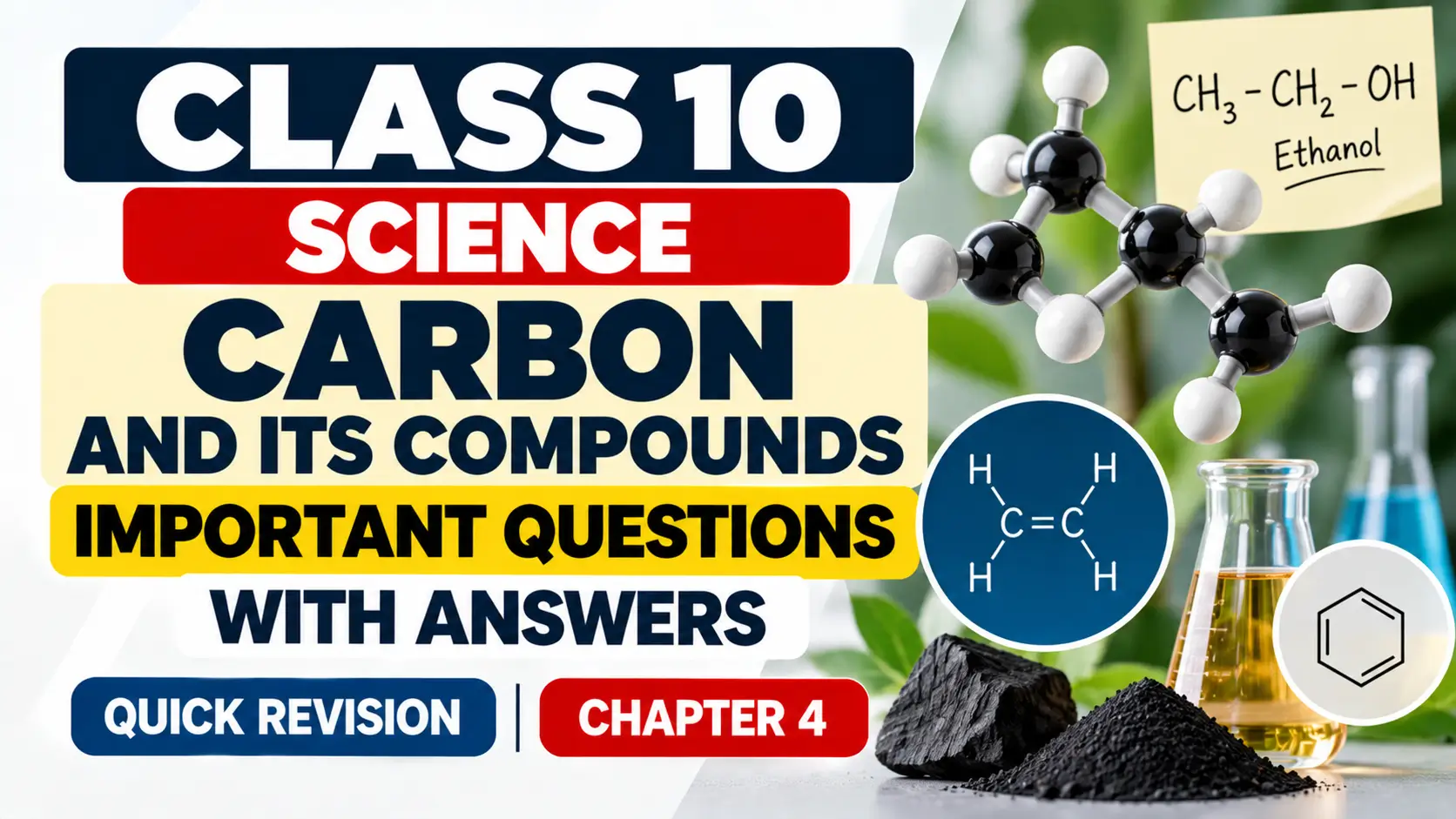
Class 10 Carbon and Its Compounds Important Questions with
Answers are designed for students preparing for
CBSE Class 10 Science Pre-Board and Board Exams.
Carbon and its Compounds is an important Class 10 Chemistry chapter
that explains why carbon forms such a large number of compounds and
how these compounds behave.
This complete Class 10 Carbon and Its Compounds question
bank covers covalent bonding, tetravalency,
catenation, saturated and unsaturated hydrocarbons, alkanes,
alkenes, alkynes, structural isomers, functional groups,
homologous series and nomenclature of carbon compounds.
It also includes important questions on
combustion, oxidation, addition and substitution reactions,
hydrogenation, ethanol, ethanoic acid, esterification,
saponification, soaps, detergents, micelle formation and cleaning
action of soap.
Use these Class 10 Science important questions
for quick revision, NCERT-based preparation, MCQ practice,
case-based questions, chemical equations and important
board-exam diagrams.
MUST DO
Covalent bonding, tetravalency, catenation,
functional groups, homologous series,
chemical reactions and nomenclature.
VERY IMPORTANT
Ethanol, ethanoic acid, esterification,
oxidation, hydrogenation, soaps,
detergents and micelles.
PRACTICE
Electron-dot structures, structural formulae,
chemical equations, MCQs and case-based questions.
1. Carbon and Its Importance – Important Questions
Q1. Why is carbon an important element?
Carbon is an extremely versatile element. It forms a very large
number of compounds and is present in living organisms and many
substances used in everyday life. Its ability to form strong
bonds with itself and with other elements gives rise to enormous
variety in carbon compounds.
Q2. What is meant by the tetravalency of carbon?
Carbon has valency four. It can form four covalent bonds with
carbon or other atoms to complete its outermost shell. This
property is called tetravalency.
Q3. What is catenation?
The ability of carbon to form bonds with other carbon atoms,
producing long chains, branched chains and rings, is called
catenation.
Q4. Why does carbon form a very large number of compounds?
Carbon forms a large number of compounds mainly because of
tetravalency and catenation. Carbon-carbon
bonds are strong and stable, allowing carbon atoms to form
straight chains, branched chains and cyclic structures.
Q5. What are hydrocarbons?
Compounds containing only carbon and hydrogen are called
hydrocarbons.
Q6. What are organic compounds?
Carbon compounds, except certain simple carbon compounds such
as carbides, oxides of carbon, carbonates and hydrogencarbonates,
are generally studied under organic chemistry.
2. Covalent Bonding in Carbon – Important Questions
Q7. What is a covalent bond?
A covalent bond is formed by the sharing of electrons
between atoms so that the atoms can achieve a completely filled
outermost shell.
Q8. Why does carbon form covalent compounds?
Carbon has four valence electrons. It is difficult for carbon to
gain or lose four electrons. Therefore, carbon completes its
outer shell by sharing electrons with other atoms and forms
covalent bonds.
Q9. Explain the formation of methane using covalent bonding.
Carbon has four valence electrons and each hydrogen atom has
one electron. Carbon shares one electron with each of four
hydrogen atoms, forming four C–H covalent bonds. Thus the
carbon atom completes its outer shell.
Q10. Why are covalent compounds generally poor conductors of electricity?
Covalent compounds generally do not contain charged particles
such as free ions. Therefore, they usually do not conduct
electricity effectively.
Q11. Why do covalent compounds generally have low melting and
boiling points?
Covalent compounds are generally made up of molecules with
comparatively weak forces between the molecules. Therefore,
less energy is usually required to separate the molecules.
Q12. Draw the electron-dot structure of methane.
Carbon is placed at the centre and shares one pair of electrons
with each of four hydrogen atoms. The resulting molecule has
four C–H covalent bonds.
Q13. Draw the electron-dot structure of carbon dioxide.
Carbon forms two double covalent bonds with the two oxygen atoms.
The structure can be represented as:
O=C=O, with shared electron pairs forming the
double bonds.
Q14. Explain the nature of covalent bonding using CH3Cl.
In CH3Cl, carbon shares electrons with three hydrogen
atoms and one chlorine atom. Thus carbon forms four covalent
bonds. Each shared pair contributes to completing the outer
shell of the participating atoms.
⭐ MUST PRACTISE:
Electron-dot structures of CH4, CO2,
ethane, ethene, ethyne, ethanoic acid, H2S and F2.
These structures are directly connected with the NCERT questions
and exercises. :chatgpt-content-reference{index="2"}
3. Versatile Nature of Carbon
Q15. What is the difference between a straight-chain,
branched-chain and cyclic carbon compound?
In a straight-chain compound, carbon atoms are
arranged in an unbranched chain. In a branched-chain
compound, one or more carbon chains branch from the
main chain. In a cyclic compound, carbon atoms
are arranged in a ring.
Q16. What are structural isomers?
Compounds having the same molecular formula but different
structural arrangements are called structural isomers.
For example, C4H10 can exist in two different
structural arrangements.
Q17. Give the structures of the two structural isomers of butane.
n-Butane:
CH3–CH2–CH2–CH3
2-Methylpropane:
CH3–CH(CH3)–CH3
Q18. What is cyclohexane?
Cyclohexane is a cyclic saturated hydrocarbon having the
molecular formula C6H12.
Q19. What is benzene?
Benzene is a cyclic carbon compound with the molecular formula
C6H6. It contains a ring of
six carbon atoms with alternating bonding represented in its
structural form.
Q20. What are allotropes of carbon?
Different forms of the same element having different physical
properties due to different arrangements of atoms are called
allotropes. Important allotropes of carbon discussed in the
chapter include diamond, graphite and fullerenes.
Q21. Differentiate between diamond and graphite.
Diamond
Graphite
Each carbon atom is bonded to four other carbon atoms.
Each carbon atom is bonded to three other carbon atoms in layers.
Has a rigid three-dimensional structure.
Has layered hexagonal structures.
Extremely hard.
Soft and slippery.
Does not conduct electricity effectively.
Conducts electricity.
4. Saturated and Unsaturated Hydrocarbons
Q22. What are saturated carbon compounds?
Carbon compounds in which the carbon atoms are linked only by
single bonds are called saturated compounds.
Alkanes are examples.
Q23. What are unsaturated carbon compounds?
Carbon compounds containing one or more double or triple bonds
between carbon atoms are called unsaturated compounds.
Alkenes and alkynes are examples.
Q24. What are alkanes?
Saturated hydrocarbons containing only single carbon-carbon
bonds are called alkanes.
Q25. What are alkenes?
Unsaturated hydrocarbons containing one or more carbon-carbon
double bonds are called alkenes.
Q26. What are alkynes?
Unsaturated hydrocarbons containing one or more carbon-carbon
triple bonds are called alkynes.
Q27. Write the general formula of alkanes.
The general formula for alkanes is:
CnH2n+2
Q28. Write the general formula of alkenes.
For the alkene series discussed in the chapter:
CnH2n
Q29. Write the general formula of alkynes.
For the alkyne series:
CnH2n-2
Q30. Differentiate between saturated and unsaturated hydrocarbons.
Q31. How can you experimentally distinguish between saturated
and unsaturated hydrocarbons?
Unsaturated hydrocarbons can decolourise bromine water because
they undergo addition reactions at the multiple bond, whereas
saturated hydrocarbons generally do not decolourise bromine
water under the same conditions.
5. Functional Groups – Important Questions
Q32. What is a functional group?
An atom or group of atoms attached to a carbon chain that gives
characteristic properties to the carbon compound is called a
functional group.
Q33. What is the functional group of alcohols?
The functional group of alcohols is –OH.
Q34. What is the functional group of aldehydes?
The functional group of aldehydes is –CHO.
Q35. What is the functional group of ketones?
Ketones contain the functional group represented by
>C=O within the carbon chain.
Q36. What is the functional group of carboxylic acids?
Carboxylic acids contain the –COOH functional group.
Class of Compound
Functional Group
Example
Alcohol
–OH
CH3CH2OH
Aldehyde
–CHO
CH3CHO
Ketone
>C=O
CH3COCH3
Carboxylic Acid
–COOH
CH3COOH
Halo group
–Cl / –Br
CH3Cl
6. Homologous Series
Q37. What is a homologous series?
A homologous series is a series of carbon compounds having
the same functional group and similar chemical properties,
in which successive members differ by a –CH2–
unit.
Q38. Give an example of a homologous series.
The alcohol series provides an example:
CH3OH → C2H5OH →
C3H7OH → C4H9OH
Q39. What is the difference between two successive members of
a homologous series?
Two successive members differ by a –CH2–
unit. Their molecular masses differ by 14 u.
Q40. How do physical properties change across a homologous series?
Physical properties such as melting point and boiling point
generally show a gradual change as molecular mass increases.
Q41. Why do members of a homologous series have similar chemical properties?
Their chemical properties are mainly determined by the
functional group. Since members of a homologous series have
the same functional group, they show similar chemical behaviour.
7. Nomenclature of Carbon Compounds
Q42. What is nomenclature?
Nomenclature is the systematic process of naming carbon
compounds according to the carbon chain and functional group
present in the molecule.
Q43. What are the basic prefixes used for carbon chains?
Number of Carbon Atoms
Prefix
1
Meth-
2
Eth-
3
Prop-
4
But-
5
Pent-
6
Hex-
Q44. How is a carbon compound named?
The number of carbon atoms is identified first. The appropriate
prefix is selected. The nature of the carbon-carbon bond and
functional group are then represented using suitable suffixes
or prefixes.
Q45. Name CH4.
Methane.
Q46. Name C2H6.
Ethane.
Q47. Name C2H4.
Ethene.
Q48. Name C2H2.
Ethyne.
Q49. Name CH3CH2OH.
Ethanol.
Q50. Name CH3COOH.
Ethanoic acid.
Q51. Name CH3COCH3.
Propanone.
8. Chemical Reactions of Carbon Compounds
Q52. What is combustion?
Combustion is the burning of a substance in oxygen with the
release of heat and usually light. Carbon compounds generally
produce carbon dioxide, water, heat and light when they undergo
complete combustion.
C + O2 → CO2 + Heat + Light
Q53. Write the combustion reaction of methane.
The balanced equation is:
CH4 + 2O2
→ CO2 + 2H2O + Heat
Q54. Why does incomplete combustion produce a sooty flame?
When the supply of oxygen is insufficient, carbon compounds
may undergo incomplete combustion. This can produce carbon
particles, resulting in a yellow, sooty flame and black deposits.
Q55. What is an oxidation reaction in carbon compounds?
Oxidation may involve the addition of oxygen or removal of
hydrogen. In the chapter, ethanol is oxidised to ethanoic acid
using oxidising agents.
Q56. What are oxidising agents?
Substances that can add oxygen to another substance are called
oxidising agents. Alkaline potassium permanganate
and acidified potassium dichromate are examples discussed in
the chapter.
Q57. Why is conversion of ethanol to ethanoic acid an oxidation reaction?
Ethanol is converted into ethanoic acid by the addition of
oxygen. Since addition of oxygen is oxidation, this conversion
is an oxidation reaction.
Ethanol + Oxygen → Ethanoic Acid + Water
Q58. What is an addition reaction?
A reaction in which atoms are added to an unsaturated compound
across a double or triple bond is called an
addition reaction.
Q59. What is hydrogenation?
Hydrogenation is the addition of hydrogen to an unsaturated
compound in the presence of a catalyst such as nickel or
palladium to produce a saturated compound.
Q60. What is the industrial application of hydrogenation?
Hydrogenation is used in the processing of vegetable oils.
Unsaturated vegetable oils can be hydrogenated using a nickel
catalyst to produce more saturated products.
Q61. What is a substitution reaction?
A substitution reaction is a reaction in which one type of atom
or group of atoms replaces another atom or group in a compound.
CH4 + Cl2
→ CH3Cl + HCl
in the presence of sunlight
Q62. Which hydrocarbons undergo addition reactions:
C2H6, C3H8,
C3H6, C2H2
and CH4?
C3H6 and C2H2
are unsaturated and can undergo addition reactions.
9. Ethanol – Important Questions and Reactions
Q63. What is ethanol?
Ethanol is an alcohol with the molecular formula
C2H5OH. It is a liquid at
room temperature and is soluble in water.
Q64. Give two uses of ethanol.
Ethanol is used as a solvent in medicines such as tincture
iodine and some syrups. It is also used as an industrial
solvent and can be used as a fuel or fuel additive.
Q65. How does ethanol react with sodium?
Ethanol reacts with sodium to produce sodium ethoxide and
hydrogen gas.
2Na + 2CH3CH2OH
→ 2CH3CH2O−Na+
+ H2
Q66. What happens when ethanol is heated with excess concentrated
sulphuric acid at 443 K?
Ethanol undergoes dehydration and produces ethene.
CH3CH2OH
→ CH2=CH2 + H2O
Hot concentrated H2SO4, 443 K
Q67. What is denatured alcohol?
Ethanol produced for industrial use may be made unfit for
drinking by adding poisonous substances such as methanol.
Dyes may also be added so that it can be identified easily.
Such alcohol is called denatured alcohol.
⚠️ Exam Note:
Do not confuse the two important reactions of ethanol:
Q75. How can you experimentally distinguish between an alcohol
and a carboxylic acid?
Add sodium hydrogencarbonate or sodium carbonate. A carboxylic
acid reacts with it and produces carbon dioxide gas, while
an alcohol does not give the same reaction.
Q76. What is esterification?
The reaction between an alcohol and a carboxylic acid in the
presence of an acid catalyst to form an ester and water is
called esterification.
CH3COOH + C2H5OH
⇌
CH3COOC2H5 + H2O
Ethanoic Acid + Ethanol → Ester + Water
Q77. What are esters?
Esters are compounds formed by the reaction of an alcohol
and a carboxylic acid. They are generally sweet-smelling and
are used in perfumes and as flavouring agents.
Q78. What is saponification?
When an ester reacts with an alkali such as sodium hydroxide,
it is converted into an alcohol and the sodium salt of the
carboxylic acid. This reaction is called
saponification because it is used in the
preparation of soap.
11. Soaps and Detergents – Important Questions
Q79. What are soaps?
Soaps are sodium or potassium salts of long-chain carboxylic
acids.
Q80. What are detergents?
Detergents are cleansing agents that contain molecules with
a hydrophilic part and a hydrophobic part and are effective
in cleaning oily dirt.
Q81. What are hydrophilic and hydrophobic parts of soap?
The ionic end of a soap molecule interacts with water and is
called the hydrophilic end. The hydrocarbon
chain interacts with oil and grease and is called the
hydrophobic end.
Q82. What is a micelle?
A micelle is a structure formed by soap molecules in water
in which the hydrophobic tails point towards the oily dirt
while the hydrophilic ends remain oriented towards the water.
Q83. Explain the cleaning action of soap.
Soap molecules contain two different parts. The hydrophobic
hydrocarbon tail attaches to oil and grease, while the
hydrophilic end interacts with water. Soap molecules arrange
themselves around oily dirt to form micelles. The dirt is
then suspended in water and can be washed away.
Soap Molecule
↓
Hydrophobic Tail → Oil / Grease
+
Hydrophilic Head → Water
↓
Micelle Formation
↓
Dirt Removed with Water
Q84. Why does micelle formation take place when soap is added to water?
Soap molecules have both hydrophobic and hydrophilic parts.
In water, they arrange themselves so that the hydrophobic
tails avoid water and remain directed towards oily substances,
while the hydrophilic ends interact with water. This produces
micelles.
Q85. Will a micelle be formed when soap is added to ethanol?
Micelle formation depends on the interaction between the
hydrophobic and hydrophilic parts of soap and the solvent.
The typical micelle structure formed in water is not formed
in the same way in solvents such as ethanol.
Q86. Why does soap form scum in hard water?
Hard water contains calcium and magnesium ions. These ions
react with soap to form insoluble calcium and magnesium salts
of fatty acids. These insoluble substances form a curdy
precipitate called scum.
Q87. Why are detergents more effective than soaps in hard water?
Detergents generally do not form insoluble precipitates with
calcium and magnesium ions in hard water in the same way that
soaps do. Therefore, detergents remain effective in hard water.
Q88. What happens when soap is tested with litmus paper?
Soap solution is generally basic. Therefore, it can turn
red litmus blue, while blue litmus generally
remains blue.
⭐ Board Exam Favourite:
Learn the complete mechanism of micelle formation and
cleaning action of soap. It is explicitly included
among the NCERT exercise questions. :chatgpt-content-reference{index="3"}
12. Important Structure & Diagram Questions
Diagram Q1. Draw the electron-dot structure of methane.
Show carbon at the centre and four shared electron pairs
between carbon and hydrogen.
Diagram Q2. Draw the electron-dot structure of ethane.
Show the C–C single bond and all C–H bonds.
Diagram Q3. Draw the electron-dot structure of ethene.
Show the carbon-carbon double bond.
Diagram Q4. Draw the electron-dot structure of ethyne.
Show the carbon-carbon triple bond.
Diagram Q5. Draw the electron-dot structure of carbon dioxide.
Important point: carbon forms double bonds with both oxygen atoms.
Diagram Q6. Draw the structure of ethanoic acid.
Formula:
CH3COOH
Diagram Q7. Draw the structure of propanone.
Formula:
CH3COCH3
Diagram Q8. Draw the structure of cyclohexane.
Show six carbon atoms arranged in a ring with single bonds.
Diagram Q9. Draw the two structural isomers of butane.
Practise both straight-chain and branched-chain structures.
Diagram Q10. Draw the formation of a micelle.
Show hydrophobic tails directed towards oily dirt and
hydrophilic heads directed towards water.
🎯 Diagram Practice Tip:
Do not only memorise molecular formulae. For Board Exams,
practise converting molecular formula → structural formula →
name → functional group.
13. NCERT-Based Board Questions
Q89. Why are carbon and its compounds used as fuels for most applications?
Many carbon compounds undergo combustion and release a large
amount of heat and light. This makes carbon and its compounds
important sources of fuel.
Q90. Explain the nature of the covalent bond using the formation
of CH3Cl.
Carbon shares electrons with three hydrogen atoms and one
chlorine atom. The sharing of electrons forms four covalent
bonds and allows the atoms to achieve stable outer shells.
Q91. How can ethanol and ethanoic acid be differentiated on
the basis of their physical and chemical properties?
Ethanol is an alcohol and is a neutral organic compound,
whereas ethanoic acid is a weak carboxylic acid. Ethanoic
acid reacts with sodium hydrogencarbonate and produces
carbon dioxide, whereas ethanol does not give this reaction.
Ethanoic acid is also responsible for the acidic nature of
vinegar.
Q92. Explain the formation of scum when hard water is treated with soap.
Calcium and magnesium ions present in hard water react with
soap molecules and form insoluble salts. These insoluble
salts appear as a curdy precipitate called scum.
Q93. What is hydrogenation and where is it used?
Hydrogenation is the addition of hydrogen to an unsaturated
compound in the presence of a catalyst such as nickel.
It is used in the processing of vegetable oils.
Q94. Explain the mechanism of cleaning action of soaps.
Soap molecules contain hydrophilic and hydrophobic parts.
The hydrophobic part attaches to oily dirt while the
hydrophilic part interacts with water. Soap molecules form
micelles around oily dirt, allowing the dirt to be suspended
in water and removed during washing.
Q95. What are the conditions required for substitution of
chlorine in methane?
Chlorine reacts rapidly with methane in the presence of
sunlight, replacing hydrogen atoms one by one.
Q96. Why do carbon compounds generally have low melting and
boiling points?
Most carbon compounds are covalent and consist of molecules
held together by relatively weak intermolecular forces.
Therefore, relatively little energy is required to separate
the molecules.
Q97. What is the relationship between functional groups and
chemical properties?
Functional groups give carbon compounds their characteristic
chemical properties. Compounds containing the same functional
group generally show similar chemical behaviour.
Q98. Why is carbon able to form long chains?
Carbon-carbon bonds are strong and stable. Because of its
tetravalency and catenation, carbon can link with other
carbon atoms repeatedly to form long chains, branches and
rings.
14. Important MCQs – Carbon and Its Compounds
Q99. The valency of carbon is:
A. 1
B. 2
C. 3
D. 4
Answer: D. 4
Q100. The ability of carbon to form bonds with other carbon
atoms is called:
Q101. Which of the following is a saturated hydrocarbon?
A. C2H4
B. C2H2
C. C2H6
D. C3H6
Answer: C. C2H6
Q102. The functional group present in ethanol is:
A. –COOH
B. –OH
C. –CHO
D. –CO–
Answer: B. –OH
Q103. The functional group present in ethanoic acid is:
A. Alcohol
B. Aldehyde
C. Carboxyl
D. Ketone
Answer: C. Carboxyl
Q104. Successive members of a homologous series differ by:
A. CH3
B. CH2
C. C2H2
D. OH
Answer: B. CH2
Q105. Butanone contains which functional group?
A. Alcohol
B. Aldehyde
C. Ketone
D. Carboxylic acid
Answer: C. Ketone
Q106. Which reaction is commonly used in hydrogenation of
vegetable oils?
A. Substitution
B. Addition
C. Neutralisation
D. Decomposition
Answer: B. Addition
Q107. Ethanoic acid reacts with sodium hydrogencarbonate to
produce:
A. Hydrogen
B. Oxygen
C. Carbon dioxide
D. Nitrogen
Answer: C. Carbon dioxide
Q108. The reaction between an alcohol and a carboxylic acid
is called:
A. Hydrogenation
B. Esterification
C. Substitution
D. Combustion
Answer: B. Esterification
Q109. Soap molecules have:
A. Only hydrophilic parts
B. Only hydrophobic parts
C. Hydrophilic and hydrophobic parts
D. Neither
Answer: C. Hydrophilic and hydrophobic parts
Q110. Soap forms scum in hard water mainly because of:
A. Sodium ions
B. Calcium and magnesium ions
C. Chloride ions
D. Hydrogen ions
Answer: B. Calcium and magnesium ions
Q111. Which of the following can undergo addition reaction?
A. C2H6
B. C3H8
C. C3H6
D. CH4
Answer: C. C3H6
Q112. Which compound is commonly called acetic acid?
A. Ethanol
B. Ethanoic acid
C. Methanol
D. Methanoic acid
Answer: B. Ethanoic acid
Q113. Which catalyst is used in hydrogenation of vegetable oils?
A. Nickel
B. Sodium chloride
C. Calcium carbonate
D. Copper sulphate
Answer: A. Nickel
Q114. Which of the following is a carboxylic acid?
A. CH3OH
B. CH3COOH
C. CH3CHO
D. CH3COCH3
Answer: B. CH3COOH
15. Case-Based Questions – Carbon and Its Compounds
Case Study 1 – Versatile Nature of Carbon
Carbon forms a very large number of compounds. It can form
bonds with itself and with elements such as hydrogen, oxygen,
nitrogen, sulphur and chlorine.
(a) What is catenation?
The ability of carbon to form bonds with other carbon atoms
and produce chains, branches and rings is called catenation.
(b) What is the valency of carbon?
Four.
(c) Name the two major properties responsible for the versatility
of carbon.
Tetravalency and catenation.
Case Study 2 – Homologous Series
Consider the following alcohols:
CH3OH, C2H5OH,
C3H7OH and C4H9OH.
(a) Do these compounds form a homologous series?
Yes.
(b) What is the common difference between successive members?
–CH2–.
(c) Why do they have similar chemical properties?
They contain the same functional group, –OH.
Case Study 3 – Ethanol and Ethanoic Acid
Ethanol and ethanoic acid are two important carbon compounds.
Ethanol contains the –OH group, while ethanoic acid contains
the –COOH group.
(a) What is the formula of ethanol?
C2H5OH.
(b) What is the formula of ethanoic acid?
CH3COOH.
(c) Which of the two reacts with sodium hydrogencarbonate
to produce carbon dioxide?
Ethanoic acid.
Case Study 4 – Hydrogenation
Vegetable oils may contain unsaturated carbon chains.
Hydrogen can be added to such compounds in the presence
of a suitable catalyst.
(a) Name the reaction.
Hydrogenation or addition reaction.
(b) Name a catalyst used.
Nickel.
(c) Which type of hydrocarbon undergoes this reaction?
Unsaturated hydrocarbons.
Case Study 5 – Soaps and Micelles
Soap molecules contain a long hydrocarbon chain and an ionic
end. When soap is added to water containing oily dirt,
soap molecules arrange themselves around the oil particles.
(a) Which part of soap is hydrophobic?
The long hydrocarbon chain.
(b) Which part is hydrophilic?
The ionic end.
(c) What is the structure formed around oily dirt called?
A micelle.
16. Carbon and Its Compounds – Quick Revision
Concept
Quick Revision
Tetravalency
Carbon has valency four.
Catenation
Carbon forms bonds with other carbon atoms to form chains and rings.
Covalent Bond
Formed by sharing of electrons.
Hydrocarbon
Compound containing only carbon and hydrogen.
Alkane
Saturated hydrocarbon.
Alkene
Unsaturated hydrocarbon containing a double bond.
Alkyne
Unsaturated hydrocarbon containing a triple bond.
Functional Group
Group responsible for characteristic properties of a carbon compound.
Homologous Series
Successive members differ by CH2.
Combustion
Carbon compounds burn in oxygen and release heat and light.
Oxidation
May involve addition of oxygen.
Addition
Atoms are added across a multiple bond.
Hydrogenation
Addition of hydrogen to an unsaturated compound.
Substitution
One atom or group replaces another.
Ethanol
C2H5OH.
Ethanoic Acid
CH3COOH; commonly called acetic acid.
Esterification
Alcohol + Carboxylic acid → Ester + Water.
Saponification
Alkaline hydrolysis of an ester producing alcohol and salt.
Soap
Sodium or potassium salts of long-chain carboxylic acids.
Micelle
Arrangement of soap molecules around oily dirt in water.
✅ Class 10 Board Exam Final Checklist
✔ I can explain tetravalency and catenation.
✔ I can explain covalent bonding.
✔ I can draw electron-dot structures.
✔ I can differentiate saturated and unsaturated compounds.
✔ I know alkanes, alkenes and alkynes.
✔ I can explain structural isomerism.
✔ I can identify important functional groups.
✔ I can explain homologous series.
✔ I can name basic carbon compounds.
✔ I can write combustion reactions.
✔ I can explain oxidation reactions.
✔ I can explain addition and substitution reactions.
✔ I can explain hydrogenation.
✔ I know the important reactions of ethanol.
✔ I know the important reactions of ethanoic acid.
✔ I can explain esterification and saponification.
✔ I can explain the cleaning action of soap.
✔ I can explain micelle formation.
✔ I can explain why soap forms scum in hard water.
✔ I have practised NCERT MCQs and case-based questions.
17. Exam Strategy for Carbon and Its Compounds
1. Learn the reaction map.
Make a one-page revision sheet containing
combustion, oxidation, addition, substitution,
esterification and saponification reactions.
2. Practise structures daily.
Draw methane, ethane, ethene, ethyne, ethanoic acid,
propanone, cyclohexane and structural isomers of butane.
3. Memorise functional groups.
Functional groups are essential for both nomenclature
and chemical-reaction questions.
4. Don't skip soaps and detergents.
Micelle formation, hydrophilic/hydrophobic parts,
scum formation and cleaning action are important
conceptual questions.
🎯 High-Value Revision List:
Covalent bonding → Catenation → Hydrocarbons →
Functional Groups → Homologous Series →
Nomenclature → Chemical Reactions →
Ethanol → Ethanoic Acid → Esterification →
Saponification → Soaps → Micelles.
🎯 Ready for Your Class 10 Science Exam?
Revise Carbon and Its Compounds, practise important questions,
solve MCQs and strengthen your NCERT concepts before your
Pre-Board and Board Exams.




Class 10 Science Important Questions With Answers | All Chapters | CBSE Board Exam - The Busy Brains
[…] Bonding Hydrocarbons Homologous Series Functional Groups Ethanol View Chapter 4 Questions → Chapter […]