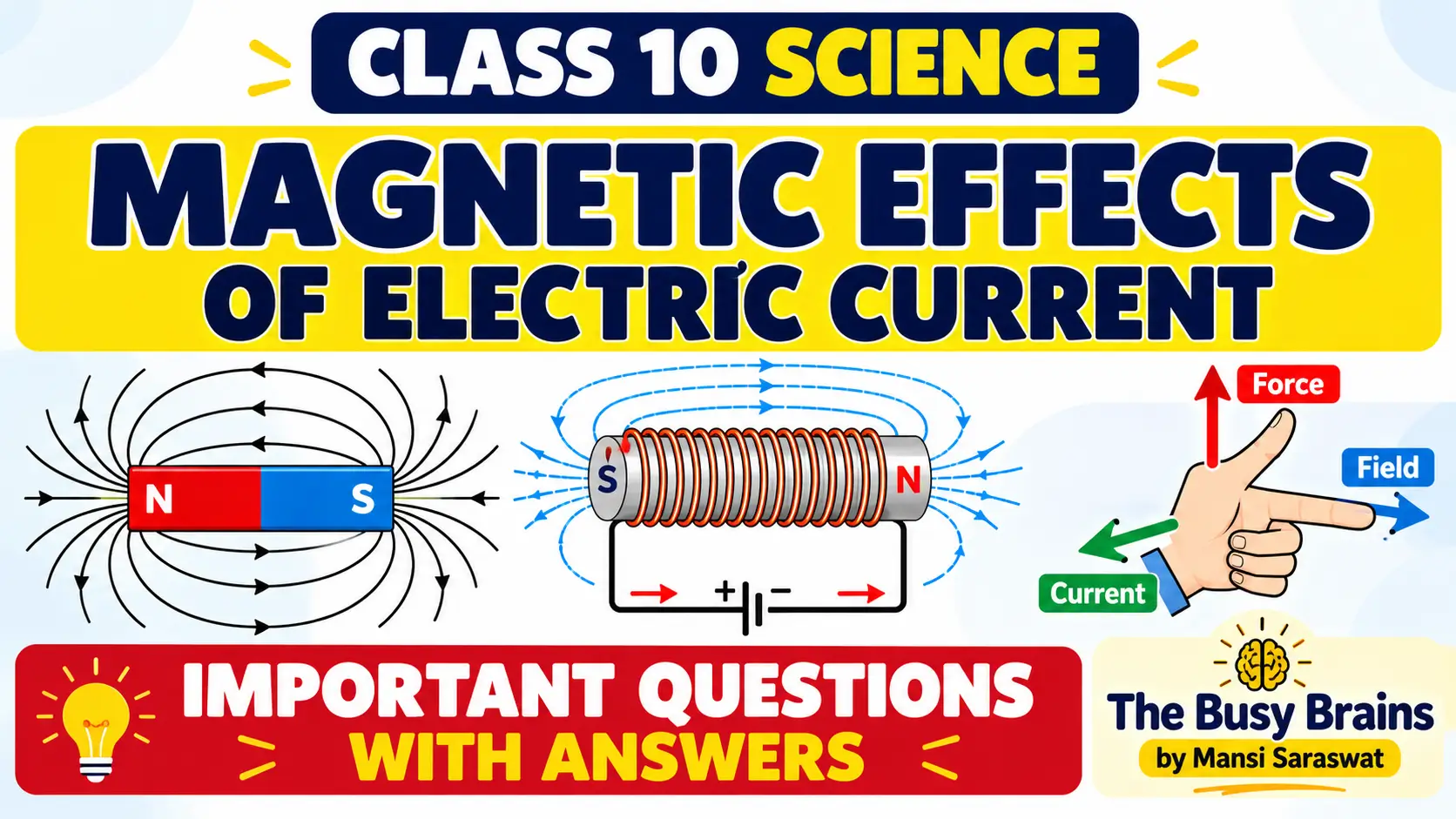
CLASS 10 SCIENCE • BOARD EXAM 2026–27
Magnetic Effects of Electric Current
Important Questions with Answers
Pre-Board & Board Exam Preparation | Most Important Questions,
Concepts, Rules, Diagrams & Domestic Electric Circuits
Why is this chapter important for Class 10 Board Exams?
Magnetic Effects of Electric Current is one of the most
important chapters of Class 10 Science for Pre-Board and Board
examination preparation. Students should not prepare this chapter
only by memorising definitions. Questions can test
magnetic field lines, Right-Hand Thumb Rule, Fleming’s
Left-Hand Rule, solenoid, electromagnet, force on a
current-carrying conductor, charged particles in magnetic fields,
and domestic electric circuits.
This page brings together the most important questions from the
chapter and organises them according to exam priority so that
students know exactly what to revise first.
⭐ Board Exam Alert – Do Not Skip These Topics
If you have limited revision time, first prepare:
- Fleming’s Left-Hand Rule
- Right-Hand Thumb Rule
- Magnetic field lines and their properties
- Magnetic field due to a straight current-carrying conductor
- Magnetic field due to a circular loop
- Solenoid and electromagnet
- Force on a current-carrying conductor
- Direction-based questions involving electrons, protons and α-particles
- Domestic electric circuits
- Fuse, overloading, short-circuiting and earthing
🔴 MUST DO
- Fleming’s Left-Hand Rule
- Right-Hand Thumb Rule
- Field-line diagrams
- Force on conductor
- Solenoid
- Domestic circuit
- Fuse & earthing
🟠 VERY IMPORTANT
- Charged particle direction questions
- Current-carrying circular loop
- Electromagnet
- Magnetic field strength
- Short circuit & overloading
- Application-based questions
🔵 PRACTICE
- MCQs
- Assertion/Reason style questions
- Diagram-based questions
- Direction questions
- Case-based questions
- Conceptual questions
1. Magnetic Field & Magnetic Field Lines
⭐ Important Question 1
Q1. What is a magnetic field?
Answer:
The region surrounding a magnet in which the force of
the magnet can be detected is called a
magnetic field.
Q2. What are magnetic field lines?
Answer:
Magnetic field lines are imaginary lines used to
represent a magnetic field. The direction of the
magnetic field at a point is given by the direction
in which a north pole of a compass would move.
Q3. State the properties of magnetic field lines.
Answer:
- Outside a magnet, field lines emerge from the
north pole and enter the south pole.
- Inside the magnet, field lines travel from
south pole to north pole.
- Magnetic field lines form closed curves.
- Closer field lines indicate a stronger
magnetic field.
- No two magnetic field lines intersect each
other.
Q4. Why do two magnetic field lines never intersect
each other?
Answer:
If two magnetic field lines intersected, the compass
needle placed at the point of intersection would have
to point in two different directions simultaneously,
which is impossible.
2. Magnetic Field Due to a Current-Carrying Conductor
Q5. What happens when electric current passes through a
straight conductor?
Answer:
A magnetic field is produced around the current-carrying
conductor. The magnetic field lines around a straight
current-carrying conductor are concentric circles.
Q6. What happens to the magnetic field when the current
through a conductor is increased?
Answer:
The strength of the magnetic field increases when the
current through the conductor increases.
Q7. What happens to the magnetic field when the distance from
a straight current-carrying conductor is increased?
Answer:
The magnetic field becomes weaker as the distance from the
current-carrying conductor increases.
Q8. State the Right-Hand Thumb Rule.
Answer:
Imagine holding a straight current-carrying conductor in your
right hand. If the thumb points in the direction of current,
the curled fingers give the direction of the magnetic field
lines around the conductor.
Remember:
Thumb → Current
Curled fingers → Magnetic field
Q9. A current-carrying wire produces magnetic field lines in
what pattern?
Answer:
The magnetic field lines are in the form of
concentric circles centred on the current-carrying
straight wire.
3. Magnetic Field Due to a Circular Loop
Q10. How does the magnetic field of a current-carrying
circular loop differ from that of a straight conductor?
Answer:
A current-carrying circular loop produces a magnetic field
whose field lines become more nearly straight near the centre
of the loop. The magnetic field due to different parts of the
loop acts in the same direction at the centre.
Q11. How does the magnetic field change when the number of
turns in a circular coil is increased?
Answer:
If a circular coil has n turns, the magnetic field
produced is approximately n times that produced by a
single turn, because the fields due to individual turns add
together.
Q12. What factors affect the magnetic field produced by a
current-carrying coil?
Answer:
- Magnitude of current
- Number of turns of the coil
- Arrangement and shape of the conductor
4. Solenoid & Electromagnet – HIGH PRIORITY
Q13. What is a solenoid?
Answer:
A solenoid is a coil of many circular turns of insulated
copper wire wrapped closely in the shape of a cylinder.
Q14. How does a current-carrying solenoid behave like a bar
magnet?
Answer:
A current-carrying solenoid produces a magnetic field pattern
similar to that of a bar magnet. One end behaves like a
north pole and the other end behaves like a
south pole.
The field lines inside a solenoid are nearly parallel,
indicating a strong and nearly uniform magnetic field.
Q15. What are the factors on which the strength of magnetic
field of a solenoid depends?
Answer:
- Number of turns per unit length
- Magnitude of current
- Material of the core
A soft iron core increases the strength of the magnetic
field.
Q16. The strength of the magnetic field produced by a
current-carrying solenoid does not depend upon:
Answer:
Direction of current.
Changing the direction of current changes the direction
or polarity of the magnetic field, but not its strength.
Q17. What is an electromagnet?
Answer:
An electromagnet is a magnet produced by placing a magnetic
material such as soft iron inside a current-carrying solenoid.
5. Force on a Current-Carrying Conductor
Q18. Why does a current-carrying conductor placed in a
magnetic field experience a force?
Answer:
A magnetic field exerts a force on a current-carrying
conductor placed in it. The force acts perpendicular to both
the direction of current and the magnetic field when the two
are perpendicular.
Q19. What happens to the direction of force if the direction
of current is reversed?
Answer:
The direction of force on the conductor is reversed.
Q20. What happens to the direction of force if the direction
of magnetic field is reversed?
Answer:
The direction of force is reversed.
Q21. When is the force on a current-carrying conductor
maximum?
Answer:
The force is maximum when the direction of current is at
right angles (90°) to the magnetic field.
F ∝ IBL sin θ
Q22. State Fleming’s Left-Hand Rule.
Answer:
Stretch the thumb, forefinger and middle finger of your
left hand so that they are mutually perpendicular.
- Forefinger → Direction of magnetic field
- Middle finger → Direction of current
- Thumb → Direction of force or motion
Exam Tip:
Memorise this rule exactly. Direction-based questions are
extremely important for board preparation.
6. Direction-Based Questions – MUST PRACTISE
Q23. A student observes that an aluminium rod gets displaced
when current is passed through it in a magnetic field.
Why?
Answer:
A current-carrying conductor placed in a magnetic field
experiences a magnetic force, causing the rod to be displaced.
Q24. If the direction of current through the conductor is
reversed, what happens to the direction of displacement?
Answer:
The direction of displacement is reversed because the
direction of magnetic force changes when the direction of
current is reversed.
Q25. A positively charged particle enters a magnetic field.
Which rule can be used to determine the direction of
deflection?
Answer:
Fleming’s Left-Hand Rule can be used by treating the motion
of the positive charge as the direction of conventional
current.
Q26. What is the direction of force on an electron compared
with a positive charge moving in the same direction?
Answer:
An electron has negative charge, so the direction of force on
the electron is opposite to the direction of force on a
positive charge moving in the same direction.
Q27. A positive charge enters a magnetic field parallel to
the field. What magnetic force acts on it?
Answer:
The magnetic force is zero because the angle between the
velocity and magnetic field is 0°.
F = qvB sin θ
Q28. When is the magnetic force on a moving charged particle
maximum?
Answer:
The magnetic force is maximum when the particle moves
perpendicular to the magnetic field, i.e. when
θ = 90°.
7. Domestic Electric Circuits – VERY IMPORTANT
Q29. Why are domestic electrical appliances connected in
parallel?
Answer:
Domestic appliances are connected in parallel so that each
appliance receives the same potential difference and can be
operated independently using its own switch.
Q30. What is the function of an electric fuse?
Answer:
An electric fuse is a safety device used to protect an
electrical circuit and appliances from excessive current.
When the current exceeds the safe limit, the fuse wire
becomes hot and melts, breaking the circuit and stopping
the current.
Q31. What is short-circuiting?
Answer:
Short-circuiting occurs when the live and neutral wires come
into direct contact, usually due to damaged insulation or a
fault. This creates a very low-resistance path and causes a
sudden large current to flow.
Q32. What is overloading?
Answer:
Overloading occurs when too many appliances are connected to
a circuit or when appliances draw more current than the
circuit can safely carry.
Q33. How does a fuse protect an electrical circuit?
Answer:
During excessive current caused by overloading or
short-circuiting, the fuse wire heats up and melts. This
breaks the circuit and prevents damage to appliances and
possible fire.
Q34. Why is the earth wire necessary?
Answer:
The earth wire provides a low-resistance path for leakage
current to flow safely to the ground. It protects the user
from electric shock, especially when an appliance has a
metallic body.
Q35. Why is it dangerous to touch a live wire?
Answer:
A live wire is at a high potential. If a person touches it
while being connected to the earth, a potential difference
exists across the body and current can flow through the body,
causing an electric shock.
8. Solenoid – Diagram-Based Board Question
Q36. In a current-carrying solenoid, where is the magnetic
field strongest?
Answer:
The magnetic field inside the solenoid is strong and nearly
uniform. The field lines inside are close together and nearly
parallel.
Q37. At which point is the magnetic field strength greater:
where field lines are close together or where they are far
apart?
Answer:
The magnetic field is stronger where the magnetic field lines
are closer together.
Q38. A freely suspended current-carrying solenoid cannot stay
in any arbitrary direction. Explain.
Answer:
A current-carrying solenoid behaves like a bar magnet.
Therefore, when freely suspended, it aligns approximately
along the north-south direction.
Q39. What happens when the direction of current in a solenoid
is reversed?
Answer:
The magnetic poles of the solenoid interchange. Its north
pole becomes south and its south pole becomes north.
9. Important MCQs for Pre-Board & Board Revision
Q40. The magnetic field around a long straight
current-carrying conductor consists of:
Answer: (d) Concentric circles centred on the wire.
Q41. The strength of the magnetic field of a solenoid does
NOT depend upon:
Answer: Direction of current.
Q42. The magnetic field inside a long current-carrying
solenoid is:
Answer: Nearly uniform.
Q43. Fleming’s Left-Hand Rule is used to determine:
Answer: Direction of force/motion of a
current-carrying conductor in a magnetic field.
Q44. The Right-Hand Thumb Rule gives the direction of:
Answer: Magnetic field around a current-carrying
conductor.
Q45. The force on a current-carrying conductor is maximum
when the angle between current and magnetic field is:
Answer: 90°.
Q46. At the time of a short circuit, the current:
Answer: Increases heavily.
Q47. Appliances in a domestic circuit are connected:
Answer: In parallel.
10. Most Important Case-Based / Competency Questions
Case Study 1: Force on a Current-Carrying Conductor
A student places an aluminium rod between the poles of a
horseshoe magnet. When current is passed through the rod, the
rod gets displaced. When the direction of current is reversed,
the direction of displacement also changes.
Questions:
- Why does the rod get displaced?
- Which rule determines the direction of force?
- What happens when the direction of current is reversed?
- What happens if the direction of magnetic field is reversed?
Key Answers:
- The conductor experiences magnetic force.
- Fleming’s Left-Hand Rule.
- Direction of force reverses.
- Direction of force reverses.
Case Study 2: Domestic Electric Circuit
A house contains several electrical appliances connected to
the mains. A fuse and earth connection are provided for
safety.
Questions:
- Why are appliances connected in parallel?
- What is the role of the fuse?
- What is overloading?
- Why is earthing necessary?
Key Answers:
- To provide the same potential difference and independent operation.
- To protect the circuit from excessive current.
- When the circuit draws more current than its safe limit.
- To provide a safe low-resistance path for leakage current.
11. One-Page Quick Revision Table
| Concept |
Remember This |
| Magnetic Field |
Region around a magnet where magnetic force can be detected. |
| Field Lines |
Closer lines → stronger magnetic field. |
| Field Lines Around Straight Wire |
Concentric circles. |
| Right-Hand Thumb Rule |
Thumb → current; fingers → magnetic field. |
| Circular Coil |
More turns → stronger magnetic field. |
| Solenoid |
Behaves like a bar magnet. |
| Electromagnet |
Soft iron core inside a current-carrying coil. |
| Fleming’s Left-Hand Rule |
Forefinger → field; middle finger → current; thumb → force. |
| Maximum Force |
Current and magnetic field at 90°. |
| Parallel Appliances |
Same potential difference and independent operation. |
| Fuse |
Protects circuit against excessive current. |
| Short Circuit |
Live and neutral wires come into direct contact. |
| Earth Wire |
Provides safe path for leakage current. |
12. Class 10 Board Exam – Final Checklist
Before your Pre-Board / Board Exam, make sure you can:
- ☐ Draw magnetic field lines around a bar magnet.
- ☐ State all important properties of magnetic field lines.
- ☐ Draw the magnetic field around a straight current-carrying wire.
- ☐ Apply the Right-Hand Thumb Rule.
- ☐ Explain magnetic field due to a circular loop.
- ☐ Explain the construction and working of a solenoid.
- ☐ Explain why a solenoid behaves like a bar magnet.
- ☐ State the factors affecting the strength of a solenoid.
- ☐ Define an electromagnet.
- ☐ Apply Fleming’s Left-Hand Rule.
- ☐ Solve direction questions involving electrons and positive charges.
- ☐ Explain maximum force conditions.
- ☐ Explain domestic electric circuits.
- ☐ Explain fuse, overloading and short-circuiting.
- ☐ Explain the importance of earthing.
- ☐ Practise all important diagrams.
13. How to Prepare This Chapter for Boards
📌 Step 1 – Learn the Rules
First memorise and practise the
Right-Hand Thumb Rule and
Fleming’s Left-Hand Rule.
📌 Step 2 – Practise Diagrams
Practise magnetic field lines around a bar magnet, straight
conductor, circular coil and solenoid.
📌 Step 3 – Practise Direction Questions
These questions become easy only after repeated practice.
Always identify the direction of current, magnetic field and
force separately.
📌 Step 4 – Prepare Domestic Circuits
Learn the functions of the live wire, neutral wire, earth
wire and fuse. Also understand short-circuiting and
overloading.
📌 Step 5 – Write Answers Scientifically
Use keywords such as
magnetic field, current-carrying conductor, force,
magnetic field lines, perpendicular, solenoid, fuse,
overloading, short-circuiting and earthing.
🎯 Final Board Preparation Tip
Do not simply read this chapter. Write and practise the
questions. In particular, revise the rules, diagrams,
direction-based questions, solenoid, force on a
current-carrying conductor and domestic electric circuits.
If you can confidently solve the Must Do questions on this
page, you will have covered the core concepts that students need
for strong Pre-Board and Board exam preparation.
📚 Want More Class 10 Board Preparation?
Subscribe to The Busy Brains on YouTube for
Class 10 Science, Maths, CBSE worksheets, important questions,
solutions, revision videos and exam preparation.
▶ SUBSCRIBE TO THE BUSY BRAINS