

Atomic Foundations of Matter – Class 9 Science Notes
Chapter notes, concept checks and exam-time revision
Conservation of Mass
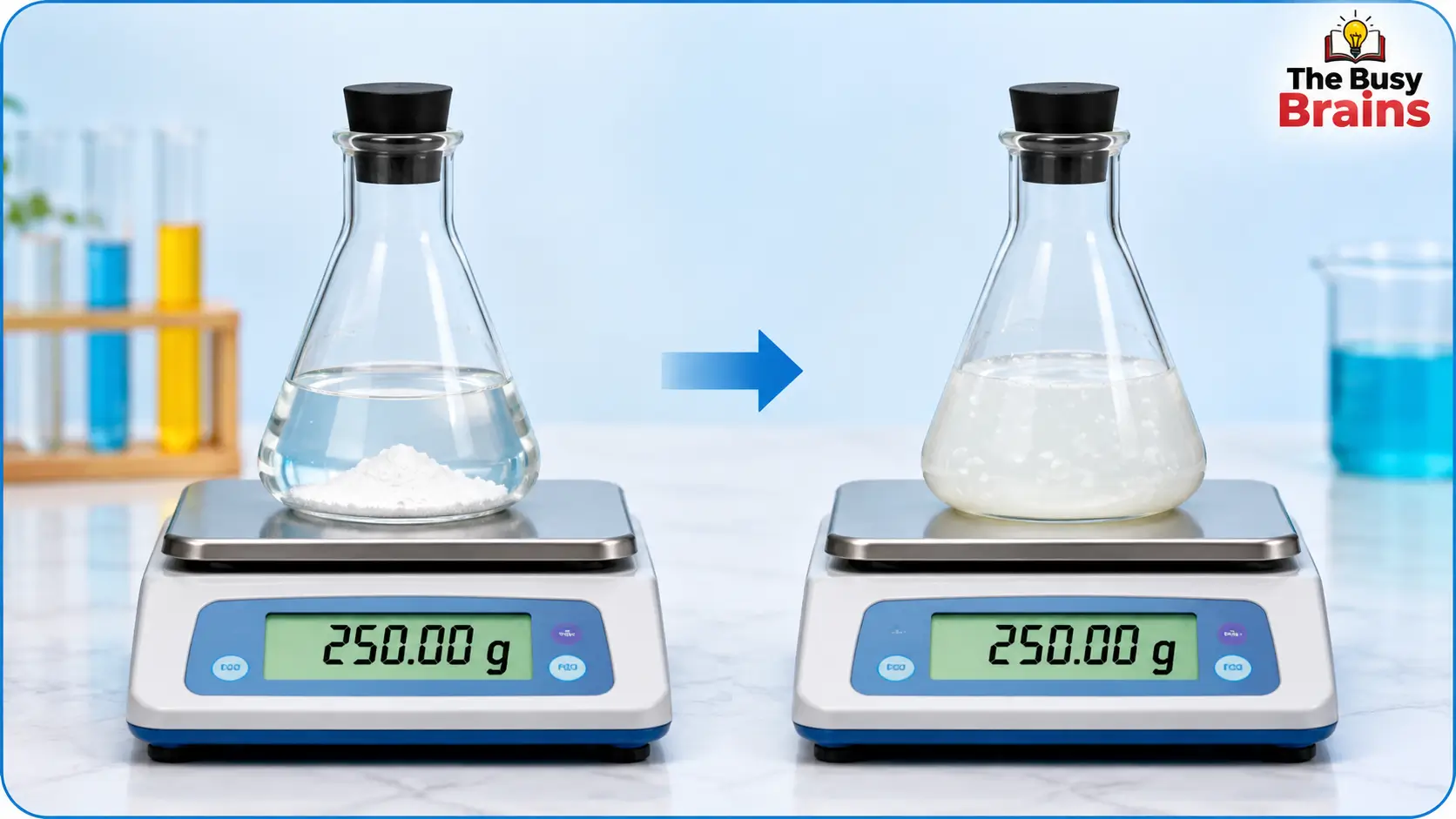
During a physical or chemical change, the total mass remains unchanged when all substances involved are included. In a chemical reaction, atoms are rearranged to form new substances; they are not created or destroyed.
When salt dissolves in water, the mass of the solution equals the combined mass of the salt and water taken. In the reaction between vinegar and baking soda, carbon dioxide gas is produced. In an open arrangement the gas escapes, so the balance may show a lower final reading. In a closed arrangement, a balloon traps the gas and the total mass before and after the reaction remains the same.
Worked example: Reactants have masses 4.0 g and 2.92 g. Products have masses 1.76 g, 0.72 g and 4.44 g. Reactants total = 6.92 g; products total = 6.92 g. The law is obeyed.
A reaction in an open beaker appears to lose mass because a gas is formed. Has the law been violated?
Show answer
No. The gas has escaped into the surroundings. Include the gas and all other products and the total mass is conserved.
12 g of carbon combines completely with 32 g of oxygen. Find the mass of carbon dioxide.
Show answer
12 + 32 = 44 g.
Law of Constant Proportions
A pure compound always contains the same elements combined in a fixed proportion by mass, regardless of its source or method of preparation. This is also called the Law of Definite Proportions or Proust’s Law.
Purified water from a river, borewell or ocean has the same composition. Hydrogen and oxygen are present in water in the mass ratio 1:8. Thus, 9 g of water contains 1 g of hydrogen and 8 g of oxygen. Joseph Louis Proust established this principle through careful experiments.
Worked example: Sodium and chlorine combine in the mass ratio 23:35.5. For 46 g sodium, chlorine required = (35.5 ÷ 23) × 46 = 71 g.
A compound contains 40% sulfur and 60% oxygen. How much oxygen is present in a 20 g sample?
Show answer
60% of 20 g = 12 g.
Why does this law apply to compounds but not mixtures?
Show answer
A compound has a definite chemical composition. Mixtures can be prepared using different proportions of their components.
Dalton’s Atomic Theory
John Dalton used the laws of chemical combination to develop an atomic theory. Its main postulates in this chapter are:
- All matter is made up of tiny particles called atoms, which participate in chemical reactions.
- Atoms cannot be created or destroyed in a chemical reaction.
- Atoms of a given element are identical in mass and chemical properties.
- Atoms of different elements have different masses and chemical properties.
- Atoms combine in simple whole-number ratios to form compounds.
- The relative number and kinds of atoms are constant in a given compound.
During a reaction, atoms are rearranged. Hydrogen and oxygen atoms combine to form water; magnesium atoms combine with oxygen atoms to form magnesium oxide.
Which postulate helps explain why mass is conserved during a chemical reaction?
Show answer
Atoms cannot be created or destroyed in a chemical reaction; they are rearranged to form products.
Assertion: 2 g hydrogen combines with 16 g oxygen to form 18 g water. Reason: atoms combine in simple whole-number ratios. Are both true, and does the reason fully explain the assertion?
Show answer
Both statements are true, but the reason is not the correct explanation of the mass equality. Conservation of mass explains why the total mass is 18 g.
Molecules and Chemical Bonds
Atoms of the same element can combine to form molecules of that element, such as H₂. Atoms of different elements can form molecules of compounds, such as HCl. A molecule is an electrically neutral group of more than one atom that can exist independently and shows the properties of that substance. Some elements, such as helium, exist as individual atoms because their atoms are stable.
Atoms generally become more stable by completing their outermost shell. They may share electrons or transfer electrons. The force that holds atoms together is called a chemical bond.
Differentiate between a molecule of an element and a molecule of a compound, with one example of each.
Show answer
A molecule of an element contains atoms of the same element, e.g. H₂ or O₂. A molecule of a compound contains atoms of different elements, e.g. HCl or H₂O.
Covalent Bonding by Sharing of Electrons
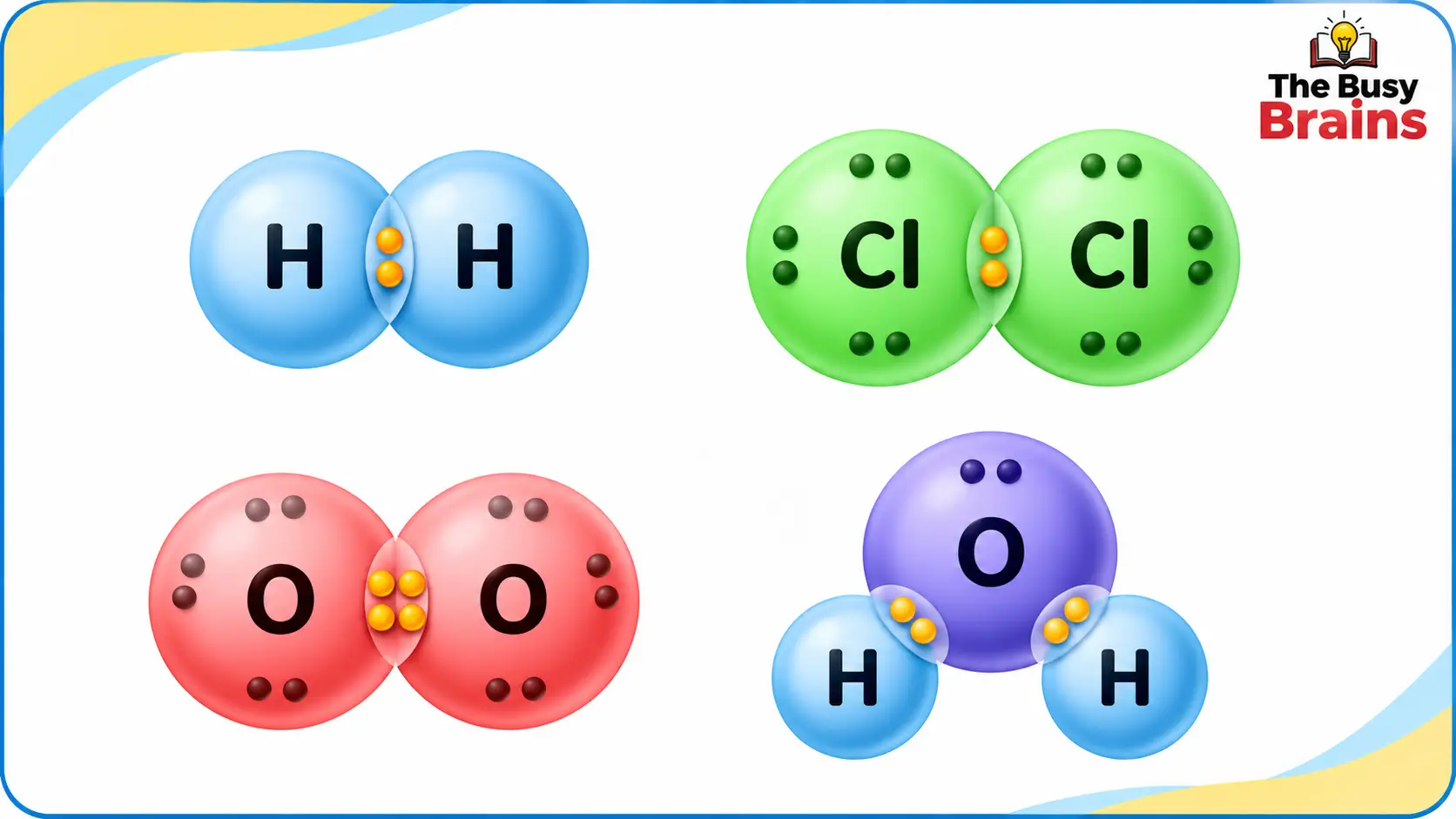
A covalent bond forms when atoms share electrons to attain stable electronic configurations. A shared pair is represented by a line between the symbols of the bonded atoms.
- Hydrogen (H₂): each hydrogen contributes one electron; one pair is shared. H—H is a single bond.
- Chlorine (Cl₂): each chlorine has seven valence electrons and shares one electron. Cl—Cl is a single bond.
- Oxygen (O₂): each oxygen has six valence electrons; two pairs are shared. O=O is a double bond.
- Hydrogen chloride (HCl): hydrogen and chlorine share one pair, represented H—Cl.
- Water (H₂O): oxygen shares one pair with each of two hydrogen atoms; the arrangement is H—O—H.
Why do two oxygen atoms share two pairs of electrons in O₂?
Show answer
Each oxygen atom has six valence electrons and needs two more to complete its octet. Sharing two pairs helps both atoms attain stable configurations.
Describe the bonding in H₂ and H₂O.
Show answer
In H₂, the two hydrogen atoms share one pair. In H₂O, the oxygen atom shares one pair with each of two hydrogen atoms.
Naming Covalent Compounds
Prefixes indicate the number of atoms of each element. The first element keeps its usual name; the second generally ends in -ide. The prefix mono- is usually omitted for the first element but may be used for the second.
| Number | Prefix | Number | Prefix |
|---|---|---|---|
| 1 | mono- | 4 | tetra- |
| 2 | di- | 5 | penta- |
| 3 | tri- | 6 | hexa- |
- CO – carbon monoxide
- CO₂ – carbon dioxide
- CS₂ – carbon disulfide
- PCl₃ – phosphorus trichloride
- SF₆ – sulfur hexafluoride
- N₂O₄ – dinitrogen tetroxide
- N₂O₅ – dinitrogen pentoxide
Some compounds are commonly known by familiar names: H₂O is water and NH₃ is ammonia. H₂S is named hydrogen sulfide.
Name CO₂, PCl₃ and N₂O₅. Write the formulae of carbon monoxide and sulfur hexafluoride.
Show answer
Carbon dioxide; phosphorus trichloride; dinitrogen pentoxide. Formulae: CO and SF₆.
Ionic Bonding by Transfer of Electrons
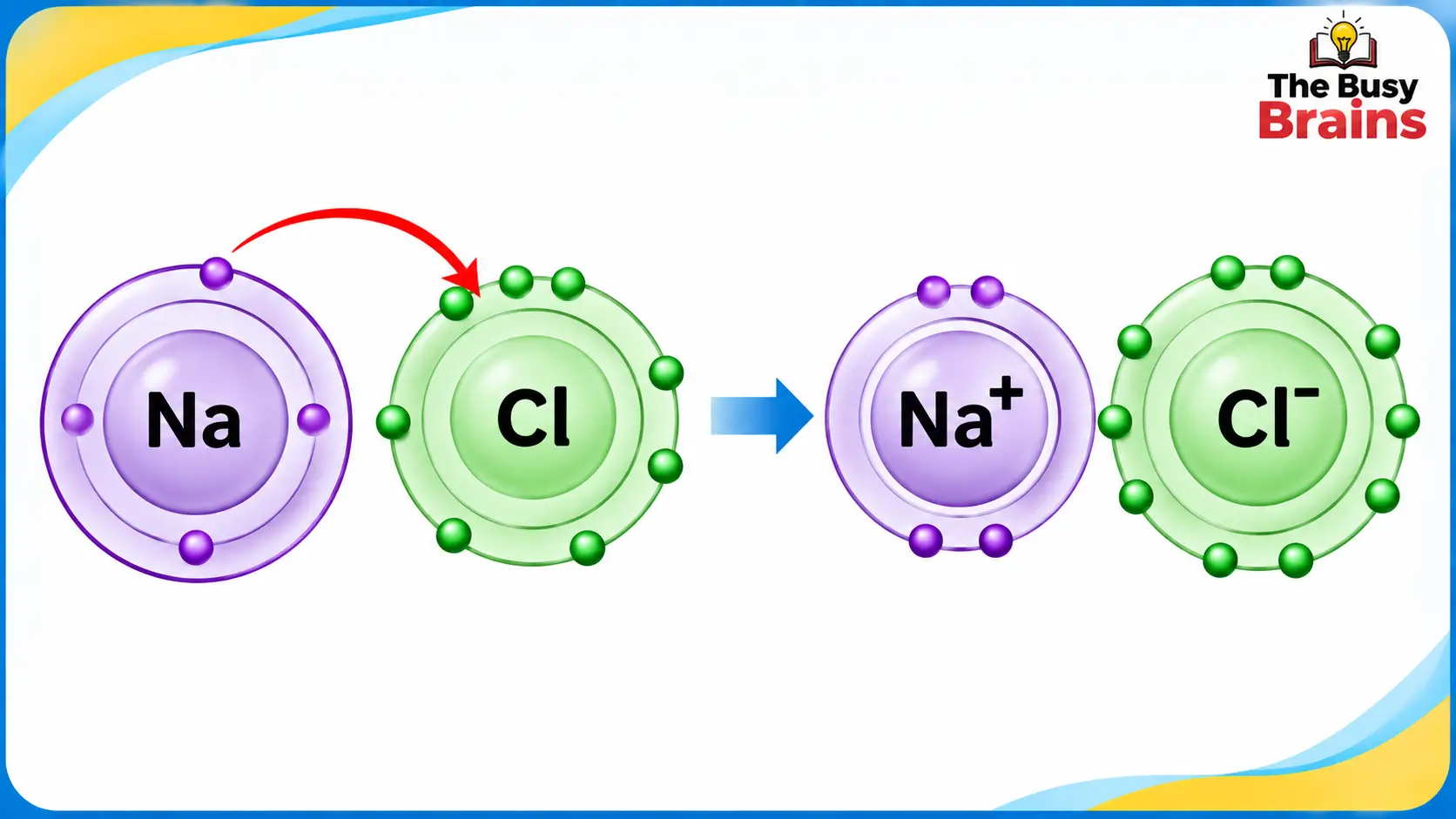
When an atom loses electrons it becomes positively charged; when it gains electrons it becomes negatively charged.
- Cation: positive ion formed by loss of electrons.
- Anion: negative ion formed by gain of electrons.
- Ionic bond: electrostatic attraction between oppositely charged ions.
Sodium chloride: sodium loses one valence electron to form Na⁺. Chlorine gains that electron to form Cl⁻. Their opposite charges attract to form NaCl.
Ionic compounds generally form three-dimensional crystal structures rather than separate molecules. In a sodium chloride crystal, each sodium ion is surrounded by six chloride ions, and each chloride ion by six sodium ions.
| Common cation | Formula | Common anion | Formula |
|---|---|---|---|
| Sodium | Na⁺ | Chloride | Cl⁻ |
| Potassium | K⁺ | Oxide | O²⁻ |
| Calcium | Ca²⁺ | Sulfide | S²⁻ |
| Magnesium | Mg²⁺ | Fluoride | F⁻ |
| Aluminium | Al³⁺ | Hydroxide | OH⁻ |
| Ammonium | NH₄⁺ | Nitrate | NO₃⁻ |
| Carbonate | CO₃²⁻ | ||
| Sulfate | SO₄²⁻ | ||
| Phosphate | PO₄³⁻ |
In naming ionic compounds, write the cation name first and the anion name second. Simple anion names usually end in -ide. Examples include sodium chloride, calcium oxide and magnesium sulfide. A charged group of two or more atoms is a polyatomic ion.
What ions form when magnesium loses two electrons and oxygen gains two? Give the compound formula.
Show answer
Mg²⁺ and O²⁻ form. The charges balance in a 1:1 ratio, so the formula is MgO.
Why is Na⁺ positive and Cl⁻ negative?
Show answer
Na⁺ has lost one electron, leaving more protons than electrons. Cl⁻ has gained one electron, giving it more electrons than protons.
Writing Chemical Formulae
A chemical formula shows the elements or ions present and their simplest whole-number ratio. For covalent compounds, write element symbols, note valencies and cross over the valencies as subscripts. A subscript 1 is not written.
- Hydrogen chloride: H(1), Cl(1) → HCl
- Hydrogen sulfide: H(1), S(2) → H₂S
- Carbon tetrachloride: C(4), Cl(1) → CCl₄
For ionic compounds, write the cation first and anion second, cross over the numerical parts of their charges, and reduce to the simplest ratio. The final compound must be electrically neutral.
- Calcium chloride: Ca²⁺ + Cl⁻ → CaCl₂
- Aluminium oxide: Al³⁺ + O²⁻ → Al₂O₃
- Magnesium oxide: Mg₂O₂ simplifies to MgO
- Calcium carbonate: Ca²⁺ + CO₃²⁻ → CaCO₃
- Magnesium hydroxide: Mg²⁺ + OH⁻ → Mg(OH)₂
- Aluminium sulfate: Al³⁺ + SO₄²⁻ → Al₂(SO₄)₃
Write the formulae of aluminium hydroxide, calcium bromide and potassium sulfate.
Show answer
Al(OH)₃; CaBr₂; K₂SO₄.
Why is magnesium oxide MgO and not Mg₂O₂?
Show answer
An ionic formula shows the simplest whole-number ratio. 2:2 reduces to 1:1, giving MgO.
Properties of Ionic and Covalent Compounds
The type of bonding affects solubility, electrical conductivity and melting and boiling points.
| Property | Ionic compounds | Covalent compounds |
|---|---|---|
| Solubility | Generally soluble in water; generally insoluble in kerosene and petrol. | Many are insoluble in water but dissolve in kerosene or petrol. Some, such as sugar, dissolve in water. |
| Solid-state conductivity | Do not conduct: ions are fixed in the lattice. | Generally do not conduct because they have no mobile ions. |
| Aqueous conductivity | Conduct when dissolved because ions can move. | Generally do not conduct; sugar solution contains molecules, not mobile ions. |
| Melting/boiling points | Generally high due to strong attraction between ions. | Usually lower than those of ionic compounds. |
The chapter uses sodium chloride and copper sulfate as ionic examples, and camphor and naphthalene as covalent examples. Sugar is a useful reminder that water solubility alone does not establish ionic bonding.
Why does solid sodium chloride not conduct electricity, while its aqueous solution does?
Show answer
In the solid, ions are fixed in the crystal lattice. In solution, ions are free to move and carry charge.
A solid does not conduct, but its aqueous solution does. Which type of bonding is likely?
Show answer
Ionic bonding is likely because mobile ions are present in the aqueous solution.
Molecular Mass of Covalent Compounds
Molecular mass is the sum of the atomic masses of all atoms in one molecule. Multiply each atomic mass by the number of atoms shown in the formula and add the values. The unit used is atomic mass unit (u).
Water, H₂O: H = 1 u; O = 16 u. Molecular mass = (2 × 1) + 16 = 18 u.
Carbon dioxide, CO₂: C = 12 u; O = 16 u. Molecular mass = 12 + (2 × 16) = 44 u.
Calculate the molecular mass of methane (CH₄). C = 12 u and H = 1 u.
Show answer
12 + (4 × 1) = 16 u.
Calculate the molecular mass of nitric acid (HNO₃). H = 1 u, N = 14 u and O = 16 u.
Show answer
1 + 14 + (3 × 16) = 63 u.
Formula Unit Mass of Ionic Compounds
Ionic compounds form three-dimensional arrangements of ions rather than separate molecules. The simplest whole-number ratio of ions is called a formula unit. Its mass is the formula unit mass.
Sodium oxide, Na₂O: Na = 23 u; O = 16 u. Formula unit mass = (2 × 23) + 16 = 62 u.
Calcium nitrate, Ca(NO₃)₂: Ca = 40 u, N = 14 u and O = 16 u. Formula unit mass = 40 + 2 × [14 + (3 × 16)] = 164 u.
Find the formula unit mass of KCl. K = 39 u and Cl = 35.5 u.
Show answer
39 + 35.5 = 74.5 u.
Find the formula unit mass of Mg(OH)₂. Mg = 24 u, O = 16 u and H = 1 u.
Show answer
24 + 2 × (16 + 1) = 58 u.
Quick Revision for Examination
- Conservation of mass: total mass of reactants equals total mass of products.
- Lavoisier: proposed the law of conservation of mass in 1789.
- Constant proportions: a compound always has a fixed ratio of elements by mass.
- Proust: associated with the Law of Definite Proportions.
- Water: hydrogen : oxygen = 1 : 8 by mass.
- Dalton: atoms are rearranged, not created or destroyed, in chemical reactions.
- Molecule: neutral group of atoms capable of independent existence.
- Covalent bond: formed by sharing electrons.
- Ionic bond: attraction between oppositely charged ions after electron transfer.
- Cation: positive ion formed by loss of electrons.
- Anion: negative ion formed by gain of electrons.
- Single bond: one shared pair; double bond: two shared pairs.
- Ionic formula: simplest whole-number ratio with balanced charges.
- Polyatomic ions: charged groups such as OH⁻, NO₃⁻ and SO₄²⁻.
- Ionic compounds: generally high melting/boiling points; conduct when molten or in aqueous solution if ions are mobile.
- Covalent compounds: generally lower melting/boiling points and usually do not conduct electricity.
- Molecular mass: sum of atomic masses in a molecule.
- Formula unit mass: sum of atomic masses in the simplest ionic formula unit.
Formulae worth revising
H₂O – water | NH₃ – ammonia | HCl – hydrogen chloride | CO₂ – carbon dioxide | NaCl – sodium chloride | MgO – magnesium oxide | CaCl₂ – calcium chloride | Al₂O₃ – aluminium oxide | Mg(OH)₂ – magnesium hydroxide | Al₂(SO₄)₃ – aluminium sulfate
Common exam mistakes
- Do not confuse mass ratio with atom ratio.
- Do not say mass disappears when gas escapes from an open vessel.
- Balance ionic charges and simplify subscripts.
- Use brackets when more than one polyatomic ion is present, e.g. Al(OH)₃.
- Do not call the mass of an ionic formula unit its molecular mass.
Ready to Test Your Preparation?
Notes revise the concepts, but solving questions shows whether you can apply them. Attempt the chapter worksheet and practise exam-style questions on Atomic Foundations of Matter.
Attempt Chapter WorksheetFinished most of the chapter?
Take the next step in your preparation. Attempt the Atomic Foundations of Matter worksheet and practise exam-style questions.
Attempt Worksheet Now
Class 9 Science Atomic Foundations Of Matter Worksheet | NCERT Questions With Answers - The Busy Brains
[…] atomic foundations of matter notes […]