


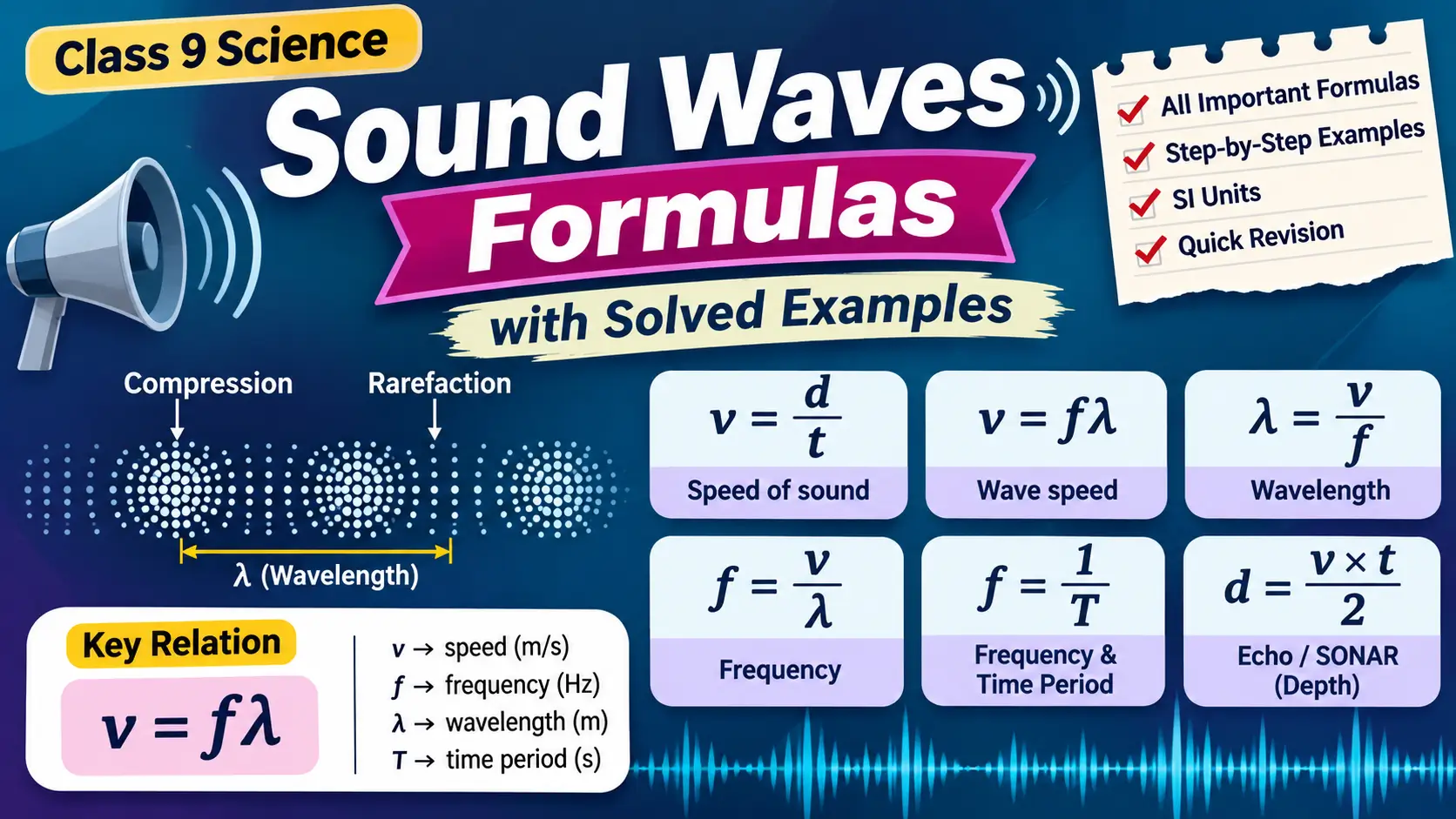
Sound Waves – All Important Formulas with Solved Examples
Your complete formula revision sheet for Class 9 Science.
Understand every formula, learn how to apply it and practise numerical questions with confidence.
Many students remember formulas but find it difficult to decide which formula to use in a numerical. This revision guide explains each important formula step by step, with simple examples and correct units.
Read the formula, understand the symbols and then follow the solved example. You will be better prepared to solve examination questions independently.
1. Speed of Sound
1Speed = Distance ÷ Time
v = Speed of sound (m/s)
d = Distance travelled (m)
t = Time taken (s)
When do we use it? Use this formula when the distance travelled by sound and the time taken are given.
A sound wave travels 680 metres in 2 seconds. Calculate its speed.
Given: Distance = 680 m, Time = 2 s
- Formula: Speed = Distance / Time
- Substitute: Speed = 680 / 2
- Answer = 340 m/s
2. Relation Between Speed, Frequency and Wavelength
2Wave Speed Formula
v = Wave speed (m/s)
f = Frequency (Hz)
λ = Wavelength (m)
This is one of the most important formulas in the chapter. It connects the speed, frequency and wavelength of a wave.
A sound wave has a frequency of 200 Hz and a wavelength of 1.7 m. Find its speed.
Given: f = 200 Hz, λ = 1.7 m
- Formula: v = f × λ
- Substitute: v = 200 × 1.7
- Answer = 340 m/s
3Finding Wavelength
v = Wave speed (m/s)
f = Frequency (Hz)
When do we use it? Use this formula when speed and frequency are known, but wavelength is required.
A sound wave travels at 340 m/s and has a frequency of 170 Hz. Find its wavelength.
Given: v = 340 m/s, f = 170 Hz
- Formula: λ = v / f
- Substitute: λ = 340 / 170
- Answer = 2 m
4Finding Frequency
v = Wave speed (m/s)
λ = Wavelength (m)
A sound wave travels at 330 m/s and has a wavelength of 1.5 m. Calculate its frequency.
Given: v = 330 m/s, λ = 1.5 m
- Formula: f = v / λ
- Substitute: f = 330 / 1.5
- Answer = 220 Hz
3. Frequency and Time Period
5Frequency from Time Period
T = Time period (s)
Frequency is the number of complete vibrations per second. Time period is the time required for one complete vibration.
A vibrating object takes 0.02 seconds to complete one vibration. Calculate its frequency.
Given: T = 0.02 s
- Formula: f = 1 / T
- Substitute: f = 1 / 0.02
- Answer = 50 Hz
6Time Period from Frequency
f = Frequency (Hz)
A tuning fork vibrates at a frequency of 256 Hz. Calculate its time period.
Given: f = 256 Hz
- Formula: T = 1 / f
- Substitute: T = 1 / 256
- Answer ≈ 0.0039 s
Frequency and time period are inversely proportional.
When frequency increases, the time period decreases. When frequency decreases, the time period increases.
4. Echo – Important Numerical Formula
7Distance of the Reflecting Surface
v = Speed of sound (m/s)
t = Total time taken by sound to travel to the surface and return (s)
A person hears an echo 2 seconds after shouting. If the speed of sound is 340 m/s, find the distance of the reflecting surface.
Given: v = 340 m/s, t = 2 s
- Formula: d = (v × t) / 2
- Substitute: d = (340 × 2) / 2
- d = 680 / 2
- Answer = 340 m
5. SONAR – Finding the Depth of the Sea
8Depth Using SONAR
t = Total time taken by the ultrasonic signal to travel to the seabed and return (s)
SONAR uses ultrasonic waves to detect underwater objects and measure the depth of the sea. The time recorded is for the complete journey of the signal.
A SONAR device receives an echo from the seabed after 0.8 seconds. The speed of sound in seawater is 1500 m/s. Find the depth of the sea.
Given: v = 1500 m/s, t = 0.8 s
- Formula: Depth = (v × t) / 2
- Substitute: Depth = (1500 × 0.8) / 2
- Depth = 1200 / 2
- Answer = 600 m
6. Minimum Distance for a Distinct Echo
9Distance for Hearing an Echo
The human ear generally needs a time interval of at least 0.1 second to distinguish an echo from the original sound.
Taking the speed of sound in air as 340 m/s:
Calculate the minimum distance of a reflecting surface required to hear a distinct echo. Take the speed of sound as 340 m/s.
Given: v = 340 m/s, t = 0.1 s
- Formula: d = (v × t) / 2
- Substitute: d = (340 × 0.1) / 2
- d = 34 / 2
- Answer = 17 m
The 17 m value is an approximate result for a sound speed of 340 m/s.
7. Quick Formula Summary
| Quantity | Formula | SI Unit |
|---|---|---|
| Speed | v = d / t | m/s |
| Wave speed | v = fλ | m/s |
| Wavelength | λ = v / f | m |
| Frequency | f = v / λ | Hz |
| Frequency and time period | f = 1 / T | Hz |
| Time period | T = 1 / f | s |
| Echo distance | d = vt / 2 | m |
| SONAR depth | Depth = vt / 2 | m |
8. Important Units to Remember
Metre per second
Hertz
Second
Metre
9. Common Mistakes Students Should Avoid
- Forgetting to divide by 2: In echo and SONAR problems, the given time is usually for the sound's journey to the reflecting surface and back.
- Mixing up frequency and time period: Remember that f = 1/T and T = 1/f.
- Using the wrong formula: Identify the quantity given and the quantity to be calculated before selecting a formula.
- Forgetting units: Write Hz for frequency, seconds for time period, metres for wavelength and m/s for speed.
- Incorrect substitution: Write the formula first, substitute the values next and then calculate.
Last-Minute Revision – Remember These!
1. Speed = Distance / Time
2. Wave speed = Frequency × Wavelength
3. Wavelength = Speed / Frequency
4. Frequency = 1 / Time Period
5. Time Period = 1 / Frequency
6. Echo distance = Speed × Time / 2
7. SONAR depth = Speed × Time / 2
8. Minimum echo distance is approximately 17 m when sound travels at 340 m/s and the time gap is 0.1 s.
Always follow this order in your examination:
Given → Formula → Substitution → Calculation → Final Answer with Unit
This makes your solution clear and helps avoid calculation and presentation mistakes.
Continue Your Sound Waves Preparation
Now that you have revised all the important formulas, strengthen your understanding with the complete chapter notes and practice worksheet.
Read Complete Chapter Notes Practise the WorksheetRevise the concepts, practise the numericals and check your answers to prepare confidently for your examination.