


Sound Waves: Characteristics and Applications
Understand how sound is produced, how it travels, the properties of sound waves, reflection, echoes and the applications of ultrasound.
Sound is part of our everyday experience. We hear voices, music, vehicles, birds and many other sounds. But how does a vibrating object produce sound? How does sound travel through air, water and solids? This chapter explains the science behind these familiar experiences and explores how sound is used in medicine, navigation and technology.
What You Will Learn
- Production of sound and vibrating objects
- Propagation of sound through different media
- Sound waves, compressions and rarefactions
- Transfer of energy through sound waves
- Graphical representation of sound waves
- Wavelength, frequency, time period and amplitude
- Intensity, speed, pitch and loudness
- Reflection of sound, echoes and reverberation
- Infrasonic and ultrasonic waves and their applications
Production of Sound
Sound is produced when an object vibrates. A vibrating object moves repeatedly to and fro about its mean position. This repeated motion produces disturbances in the surrounding medium, which we hear as sound.
Vibration: The periodic to-and-fro motion or oscillation of an object about its mean position.
Consider a stretched rubber band fixed across an open cardboard box. When the band is plucked, it vibrates and produces sound. Once the vibrations stop, the sound also stops.
Examples of sound production
- Musical instruments: A stretched string vibrates when plucked. The membrane of a drum vibrates when struck.
- Wind instruments: In a flute or bansuri, the air column inside the hollow pipe vibrates.
- Human voice: Sound is produced by the vibration of vocal cords inside the voice box or larynx.
- Insects: Crickets and grasshoppers produce sound by rubbing certain body parts, such as wings or legs.
- Metal objects: Some metals produce a ringing sound when struck. This property is called sonority.
Tuning Fork
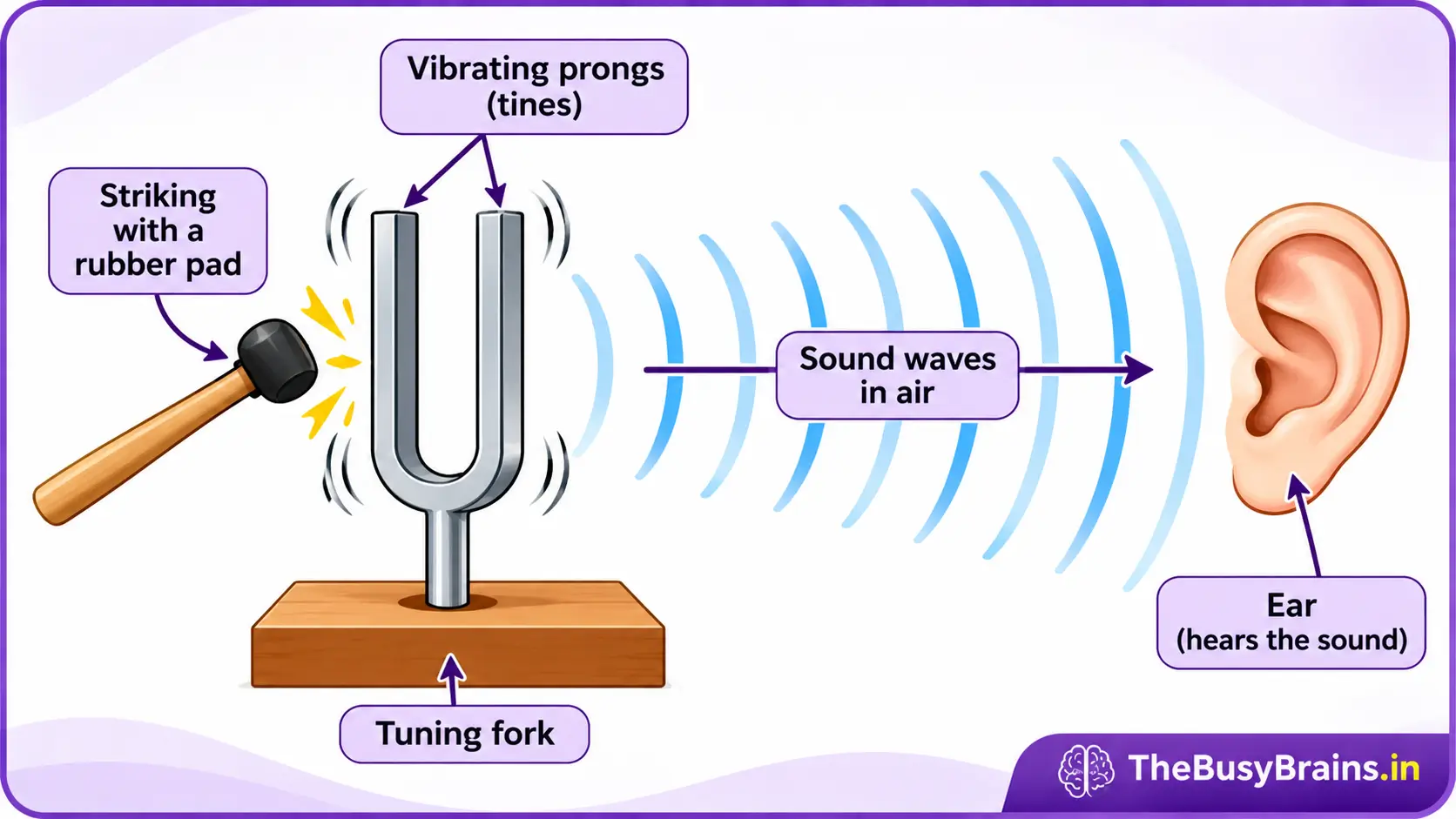
A tuning fork is a U-shaped metal instrument, usually made of steel or aluminium. Its two arms are called prongs or tines, and the lower part is called the stem.
When a prong is struck gently against a rubber pad, the prongs vibrate and produce sound. If a vibrating prong touches water, ripples appear on the water surface. This provides evidence that the prongs are vibrating.
Important Questions – Production of Sound
- What is vibration? Explain how a vibrating rubber band produces sound.
- What happens to sound when the vibrations of an object stop?
- Describe the structure of a tuning fork.
- How can you show that the prongs of a tuning fork vibrate?
- How is sound produced in human beings?
- Identify the vibrating parts of a flute, drum and string instrument.
Propagation of Sound
After sound is produced, it must travel from its source to the listener. This movement of sound through a material substance is called propagation of sound.
The material through which sound travels is known as a medium. Sound can travel through all three common states of matter:
- Solids – such as wood, metal and a classroom desk.
- Liquids – such as water.
- Gases – such as air.
Sound travels through solids
If one person gently scratches or knocks on a desk, another person can hear the sound by placing an ear against the desk. The sound travels through the solid material.
Sound travels through liquids
When two metal spoons are tapped together while submerged in water, the sound can still be heard. This shows that sound can propagate through liquids.
Sound needs a medium to travel
A vacuum is a space where matter is absent. Sound cannot travel through a vacuum because there are no particles to transfer the disturbance.
Vacuum Bell Jar Experiment
An electric bell is placed inside a glass bell jar. Initially, the bell can be heard when it rings. When air is gradually removed using a vacuum pump, the sound becomes fainter. When most of the air is removed, the ringing bell can still be seen, but its sound is almost inaudible. When air is allowed back inside, the sound becomes audible again.
This also explains why astronauts cannot directly hear each other speaking during a spacewalk. Outer space is nearly a vacuum, so astronauts communicate using special devices fitted into their spacesuits.
Important Questions – Propagation of Sound
- What is meant by propagation of sound?
- What is a medium? Give examples of different media through which sound travels.
- Describe an experiment to show that sound travels through solids.
- How can we demonstrate that sound travels through liquids?
- Explain the vacuum bell jar experiment.
- Why can astronauts not hear one another directly in outer space?
- Assertion: Sound cannot travel through a vacuum. Reason: Sound requires particles of a medium for propagation. Explain the relationship between the statements.
Sound Waves
Sound travels through a medium in the form of a wave. To understand this, imagine pushing and pulling one end of a stretched slinky. A disturbance moves along the slinky, but its individual coils do not travel all the way to the other end.
Compressions and Rarefactions
When a vibrating source moves forward, it pushes nearby air particles closer together. This creates a region of higher density called a compression.
When the source moves backwards, the nearby air particles spread farther apart. This creates a region of lower density called a rarefaction.
- Compression (C): A region where particles are closer together and density is higher than average.
- Rarefaction (R): A region where particles are farther apart and density is lower than average.
As the source continues vibrating, compressions and rarefactions are produced alternately. These disturbances travel through the medium.
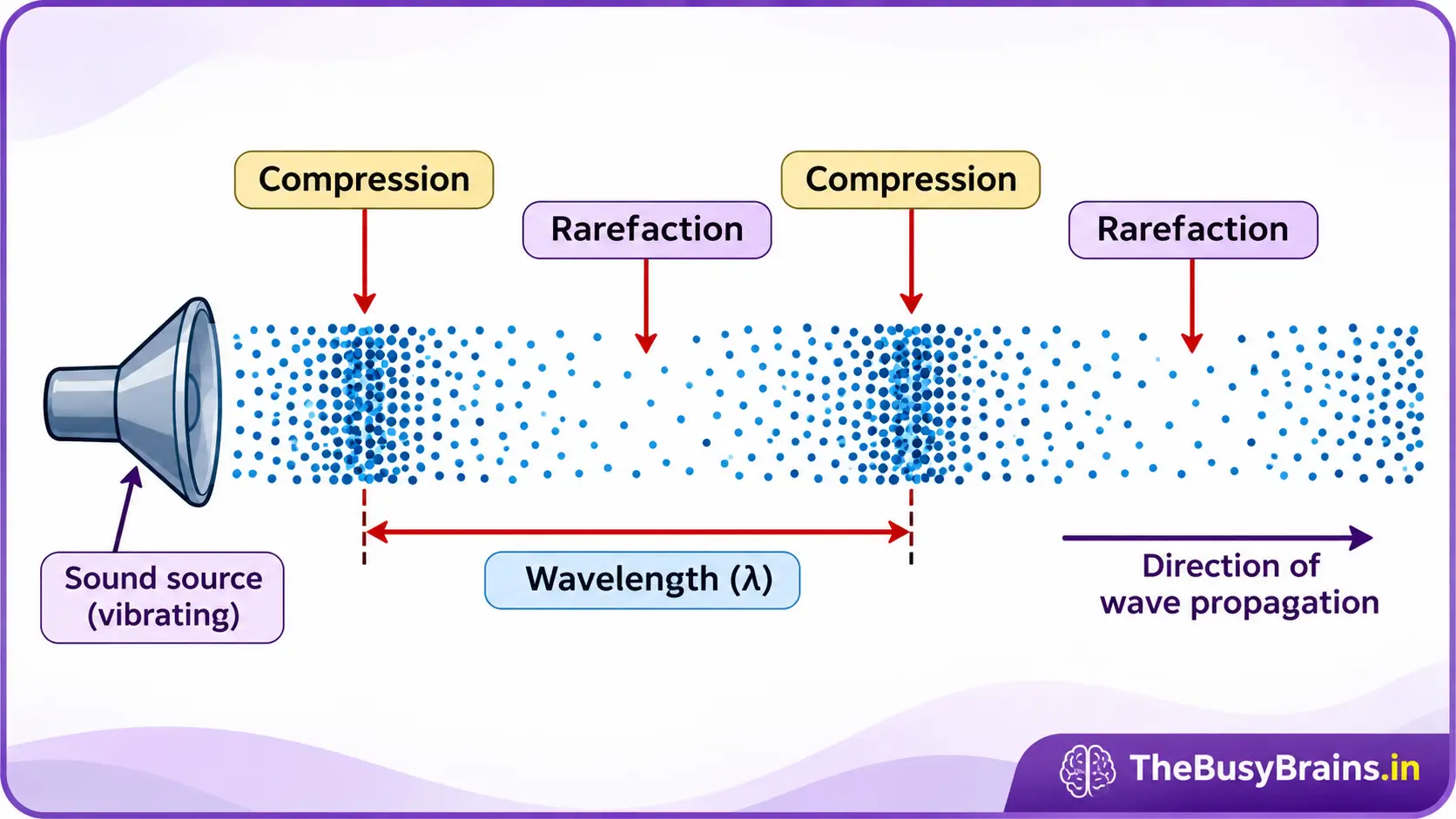
Sound wave: A disturbance consisting of alternating compressions and rarefactions that propagates through a medium without the actual flow of the particles of the medium.
Longitudinal Waves
In a sound wave, particles of the medium vibrate back and forth parallel to the direction in which the wave travels. Such waves are called longitudinal waves.
Mechanical Waves
Waves that require a material medium for propagation are called mechanical waves. Sound is a mechanical wave because it cannot travel through a vacuum.
Longitudinal and Transverse Waves
| Longitudinal Wave | Transverse Wave |
|---|---|
| Particles vibrate parallel to the direction of wave propagation. | Particles vibrate perpendicular to the direction of wave propagation. |
| Sound waves in air are an example. | Waves on a stretched string are a familiar example. |
Earthquakes produce seismic waves that can be longitudinal or transverse. Longitudinal seismic waves are detected first by seismographs.
Important Questions – Sound Waves
- What are compressions and rarefactions?
- Explain the formation of a sound wave using a vibrating piston.
- Why do particles of the medium not travel along with a sound wave?
- Define a longitudinal wave. Why is sound in air longitudinal?
- What are mechanical waves?
- Differentiate between longitudinal and transverse waves.
- Why is sound classified as a mechanical wave?
- What is the difference between the motion of a particle and the propagation of a wave?
Energy of Sound Waves
Sound is a form of energy. A vibrating source transfers energy to the surrounding medium. As the sound wave travels, particles of the medium vibrate and collide with neighbouring particles, transferring energy from one region to another.
Activity: Moving Grains with Sound
Stretch a rubber sheet or balloon membrane over the opening of a container. Sprinkle a few grains of rice or salt on it. Produce a loud sound near the container without touching it.
The sound waves reach the sheet and make it vibrate. The grains move because of these vibrations. A louder sound can cause greater movement of the grains.
Microphone and Speaker
- Microphone: Converts sound energy into electrical energy. Sound waves make a thin membrane called a diaphragm vibrate, and these vibrations are converted into an electrical signal.
- Speaker: Converts electrical energy into sound energy. An electrical signal causes a cone or diaphragm to vibrate and produce sound.
Important Questions – Energy of Sound Waves
- Why is sound considered a form of energy?
- Describe an activity to demonstrate that sound transfers energy.
- What happens to the grains placed on a stretched membrane when a loud sound is produced nearby?
- Why do the grains move even though the sound source does not touch the container?
- Differentiate between the functions of a microphone and a speaker.
- What is transferred during the propagation of a sound wave: matter or energy?
Graphical Representation of a Sound Wave
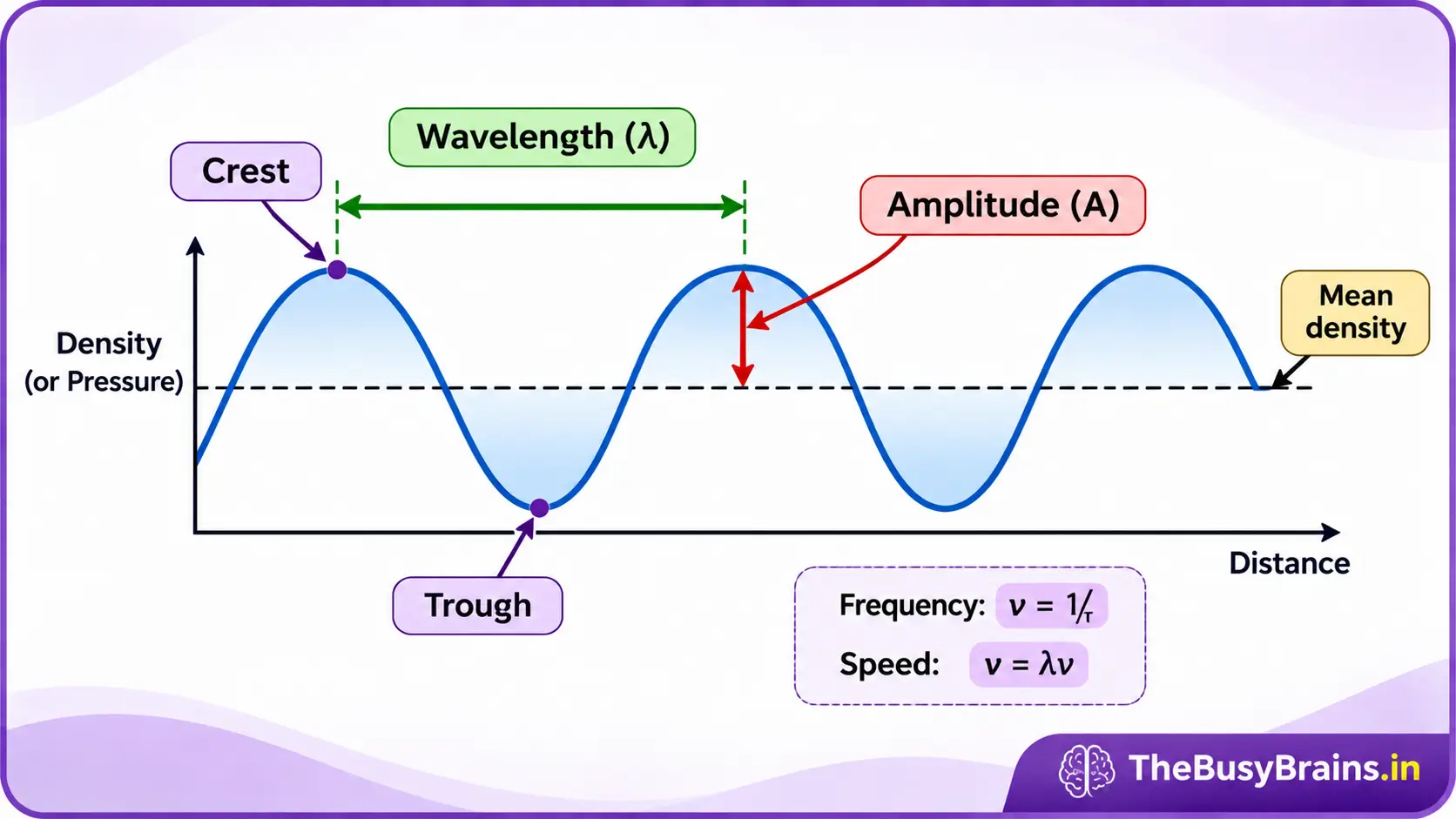
As a sound wave travels, the density of the medium changes periodically. At a particular instant, density can be plotted against distance to represent the sound wave graphically.
- The horizontal axis represents distance.
- The vertical axis represents density of the medium.
- The average density is shown by a horizontal reference line.
- Regions above average density represent compressions.
- Regions below average density represent rarefactions.
Crest and Trough
In the graphical representation:
- Crest: The highest point of the curve, representing maximum density.
- Trough: The lowest point of the curve, representing minimum density.
Important Questions – Graphical Representation
- How is a sound wave represented graphically?
- What is represented on the X-axis and Y-axis in a density-distance graph?
- Define crest and trough.
- Which part of a sound wave graph represents maximum density?
- What does a trough represent in the density graph of a sound wave?
- Draw a labelled graph showing the variation of density with distance.
Characteristics of a Sound Wave
Wavelength
The distance between two consecutive crests or two consecutive troughs is called the wavelength of a wave.
- Symbol: λ (lambda)
- SI unit: metre (m)
Frequency
Frequency is the number of complete density oscillations at a fixed point per unit time.
- Symbol: ν (nu)
- SI unit: hertz (Hz) or s−1
Time Period
The time taken for one complete density oscillation at a fixed point is called the time period.
- Symbol: T
- SI unit: second (s)
A higher frequency means more oscillations per second and a shorter time period. A lower frequency means fewer oscillations per second and a longer time period.
A sound wave completes 10 density oscillations in 2 seconds. Find its frequency and time period.
Frequency:
ν = Number of oscillations ÷ Time taken
ν = 10 ÷ 2 = 5 Hz
Time period:
T = 1/ν = 1/5 = 0.2 s
Amplitude
The amplitude of a sound wave is the maximum change in the density of air in a compression or rarefaction compared with the average density.
A larger amplitude means a greater change in density and generally a greater amount of energy carried by the wave.
Intensity of Sound
The amount of sound energy passing through a unit area perpendicular to the direction of propagation of a sound wave in a unit time is called the intensity of sound.
As sound travels away from its source, its energy spreads over a larger area. Therefore, its intensity decreases with distance from the source.
Speed of Sound
The speed of sound describes how fast the sound wave travels through a medium.
Since frequency ν = 1/T, speed can also be written as:
Factors Affecting the Speed of Sound
- Sound travels fastest in solids, slower in liquids and slowest in gases.
- In air, speed increases when temperature increases.
- In air, speed also increases with increasing humidity.
| Medium at 15°C | Approximate Speed of Sound |
|---|---|
| Steel | 5000 m/s |
| Water | 1500 m/s |
| Air | 340 m/s |
For example, the speed of sound in dry air is about 331 m/s at 0°C and nearly 344 m/s at 22°C.
A sound wave travels at 344 m/s and has a frequency of 20 Hz. Calculate its wavelength.
v = λν
λ = v/ν = 344/20
Wavelength = 17.2 m
The time gap between seeing lightning and hearing thunder is 5 seconds. Take the speed of sound as 340 m/s. Estimate the distance of the lightning strike.
Distance = Speed × Time
= 340 × 5 = 1700 m
Distance = 1.7 km
Light reaches us almost instantaneously compared with sound, which is why lightning is seen before thunder is heard.
Important Questions – Characteristics of Sound
- Define wavelength, frequency and time period. Give their SI units.
- Write the relationship between frequency and time period.
- What is amplitude? How is it related to the energy carried by a sound wave?
- Define intensity of sound.
- Write the mathematical relation between speed, wavelength and frequency.
- Why does the intensity of sound decrease as it travels away from its source?
- Compare the speed of sound in solids, liquids and gases.
- How do temperature and humidity affect the speed of sound in air?
- A wave completes 50 oscillations in 10 seconds. Calculate its frequency and time period.
- A sound wave has a frequency of 200 Hz and wavelength of 2 m. Find its speed.
- Why is lightning seen before thunder is heard?
Human Perception of Sound
The physical properties of sound include frequency, wavelength, amplitude, time period and speed. However, the way humans experience sound is described using terms such as pitch and loudness.
Pitch
Pitch is the way humans perceive the frequency of sound.
- High-frequency sounds generally have a high pitch. Examples include whistles and sirens.
- Low-frequency sounds generally have a low pitch. Examples include thunder and the rumbling of aircraft.
Different people have different voices because their vocal cords and the shape of their throat, mouth and nasal cavities affect the sound produced. During adolescence, boys' vocal cords generally become longer and thicker, which can make their voices deeper.
Human Hearing Range
The approximate audible frequency range for humans is from 20 Hz to 20,000 Hz (20 kHz). The range varies between individuals and generally decreases with age.
| Type of Sound | Frequency Range |
|---|---|
| Infrasonic waves | Below 20 Hz |
| Human audible range | 20 Hz to 20 kHz |
| Ultrasonic waves | Above 20 kHz |
Humans cannot normally hear infrasonic or ultrasonic waves. Dogs, cats, bats and dolphins can detect ultrasound, while elephants can detect infrasound.
Loudness
Loudness is the way humans perceive the amplitude of a sound wave.
- Greater amplitude is generally heard as louder sound.
- Smaller amplitude is generally heard as softer sound.
- Loudness decreases as we move farther from the source.
Intensity is a measurable physical quantity, whereas loudness depends on the listener's hearing ability. They are often used interchangeably in everyday language, but they are not exactly the same.
Measurement of Sound and Noise Pollution
Sound loudness is commonly expressed in decibels (dB). Normal conversation is approximately 60 dB, while very loud sounds such as firecrackers can exceed 100 dB.
Unwanted or harmful sound is called noise. Prolonged exposure to loud sound can affect sleep, health and hearing. Hearing loss can be tested using audiograms, and hearing aids may help people with hearing difficulties.
Tone, Musical Note and Timbre
- Tone: A sound of a single frequency, such as that produced by a tuning fork or whistling.
- Musical note: A combination of a fundamental frequency and higher frequencies called overtones.
- Timbre: The quality that makes sounds from different instruments distinguishable even when they play the same note at the same loudness.
- Octave: The interval between two notes in which one has twice the frequency of the other.
The tabla and mridangam have a black central patch on the drum membrane called syaahi. It changes the vibration of the membrane and helps produce a rich variety of sounds.
Important Questions – Human Perception
- What is pitch? How is it related to frequency?
- Differentiate between high-pitched and low-pitched sounds with examples.
- What is the audible range of human hearing?
- Define infrasonic and ultrasonic waves.
- Differentiate between loudness and intensity.
- What is noise pollution? Mention two harmful effects of prolonged exposure to loud sound.
- What is the difference between a tone and a musical note?
- Define timbre. Why do different musical instruments sound different?
- What is an octave? Give an example.
- What is the function of the syaahi on a tabla?
Reflection of Sound
When sound waves strike a solid or liquid surface, they can bounce back. This phenomenon is known as reflection of sound.
Sound follows the same laws of reflection as light:
- The angle of incidence is equal to the angle of reflection.
- The incident sound, reflected sound and normal at the point of incidence lie in the same plane.
Echo
An echo is the repetition of a sound heard after it reflects from a distant surface. For example, when we shout near a mountain or cliff, our voice may return after a short interval.
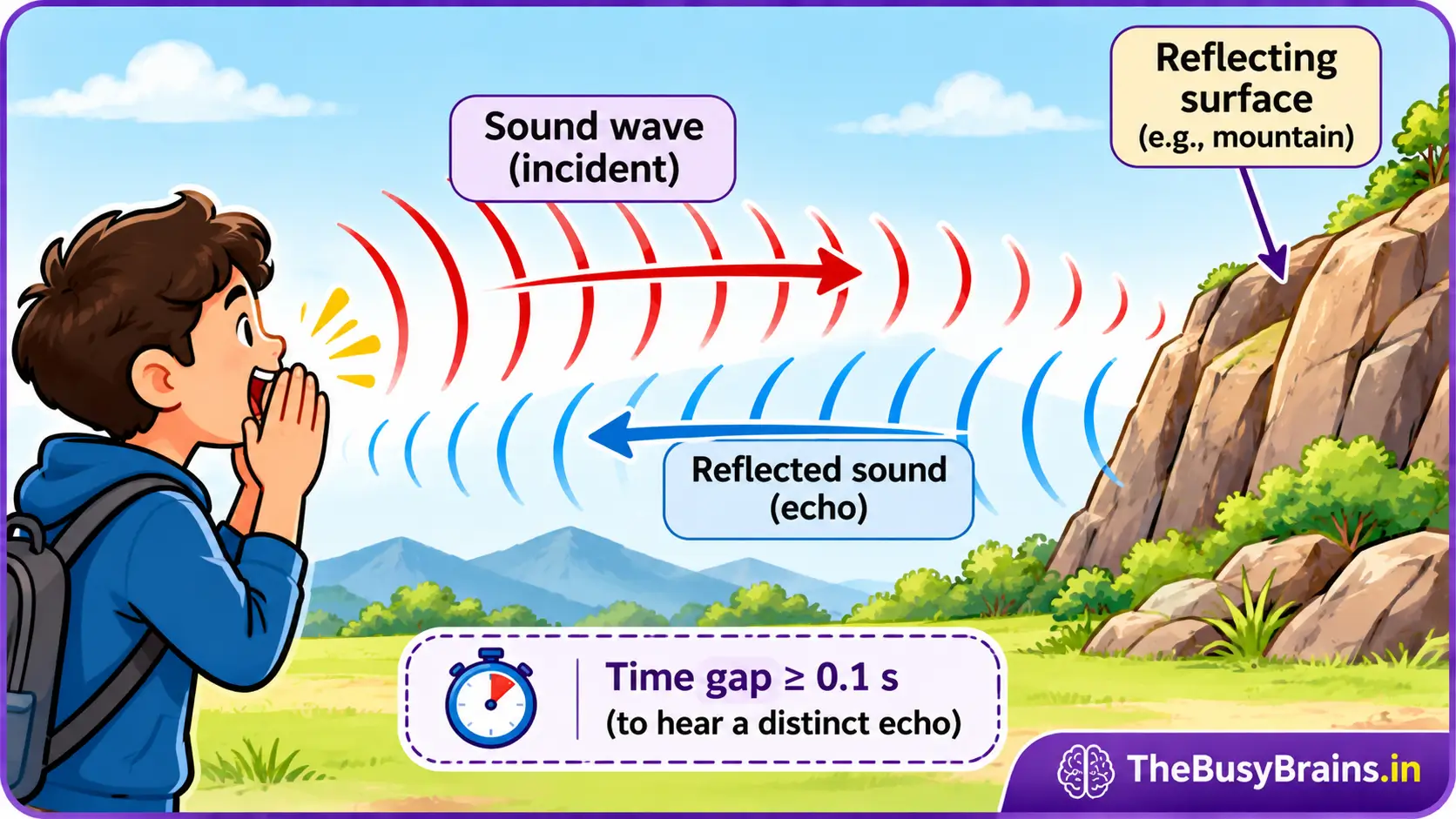
The human ear can distinguish two sounds separately when the time interval between them is at least 0.1 second.
Minimum Distance for Hearing an Echo
Taking the speed of sound as 340 m/s:
Distance travelled in 0.1 s = 340 × 0.1 = 34 m.
This is the total distance travelled by sound to the reflecting surface and back.
Minimum distance of the reflecting surface = 34 ÷ 2 = 17 m.
You clap in an empty corridor and hear an echo after 0.5 seconds. If the speed of sound is 340 m/s, find the distance from the wall.
Distance = (Speed × Time) ÷ 2
= (340 × 0.5) ÷ 2
= 85 m
Surfaces and Echoes
- Hard and smooth surfaces reflect sound effectively.
- Soft surfaces such as curtains absorb sound.
- Rough surfaces scatter sound in different directions.
Reverberation
When sound undergoes multiple reflections from the walls, ceiling and other surfaces of a large hall, the sound may continue to be heard even after the source stops producing it. This is called reverberation.
Reverberation occurs when reflected sounds persist with very small time differences, described in this chapter as less than 0.05 seconds.
Auditoriums are designed to control reverberation so that speech and music can be heard clearly. Sound-absorbing panels, curtains, upholstered chairs and soft porous materials help reduce unwanted reverberation.
Important Questions – Reflection of Sound
- What is reflection of sound?
- State the laws of reflection of sound.
- What is an echo? How is it produced?
- Why is a minimum distance required to hear an echo distinctly?
- Calculate the minimum distance required to hear an echo when the speed of sound is 340 m/s.
- Why are echoes stronger from hard and smooth surfaces?
- What is reverberation? How can it be reduced in an auditorium?
- Differentiate between echo and reverberation.
Ultrasonic and Infrasonic Waves: Applications
Sound waves outside the normal human hearing range have several important uses in science, medicine and technology.
Infrasonic Waves
Sound waves with frequencies below 20 Hz are called infrasonic waves.
Applications include:
- Detecting natural events such as earthquakes and volcanic eruptions.
- Detecting severe storms, as these waves can travel long distances through air and the Earth.
Ultrasonic Waves
Sound waves with frequencies above 20 kHz are called ultrasonic waves.
Applications include:
- Ultrasonography: Imaging internal organs without surgery.
- Medical treatment: Breaking kidney stones into smaller pieces so that they can pass out of the body.
- Industrial cleaning: Cleaning delicate machine parts.
- Ultrasonic welding: Joining materials in industries.
- Defect detection: Finding defects inside metal blocks during construction and industrial testing.
- Object detection: Locating objects by analysing reflected sound waves.
Echolocation
Echolocation is the ability to locate objects using reflected sound waves.
Most bats produce short bursts of ultrasonic waves. These waves strike nearby objects and return as echoes. By sensing the reflected waves, bats can locate obstacles and prey even in darkness.
Dolphins, whales and some birds also use echolocation for navigation and hunting.
SONAR
SONAR stands for Sound Navigation and Ranging. It uses ultrasonic waves underwater to determine the distance, direction and speed of underwater objects.
Ultrasonic waves are sent into the water. When they strike an object, they are reflected back. The time taken by the signal to return is used to calculate the distance.
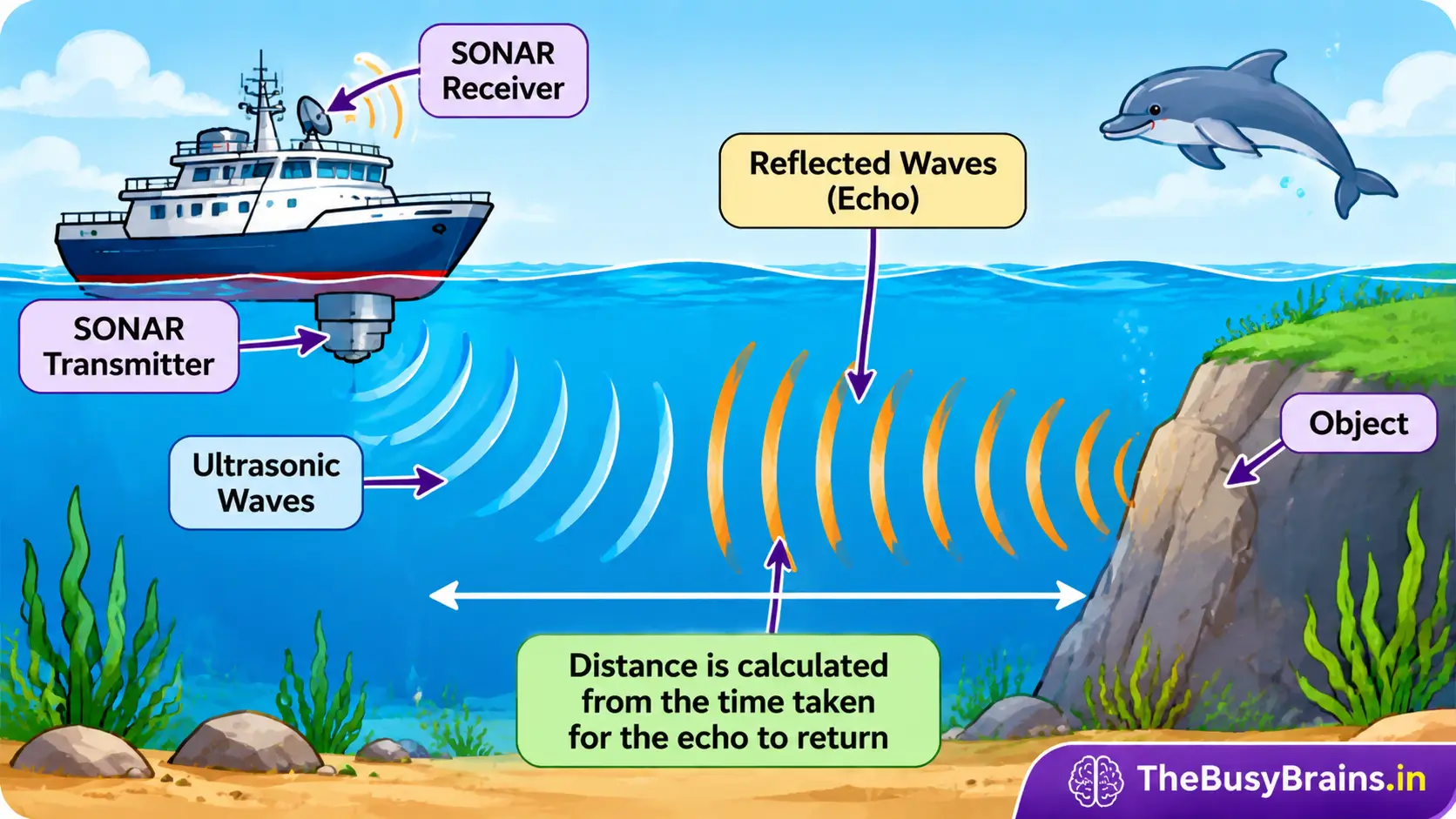
A SONAR signal returns after 0.90 seconds. The speed of sound in seawater is 1530 m/s. Find the distance of the object.
Time taken to reach the object = 0.90 ÷ 2 = 0.45 s
Distance = Speed × Time
= 1530 × 0.45
= 688.5 m
Important Questions – Infrasonic and Ultrasonic Waves
- Define infrasonic and ultrasonic waves.
- Write any two applications of infrasonic waves.
- Write four applications of ultrasonic waves.
- What is ultrasonography?
- Explain how bats use echolocation to locate their prey.
- What is SONAR? Write its full form and explain its working.
- Why are ultrasonic waves used for underwater detection?
- A SONAR signal returns after 4 seconds. If the speed of sound in seawater is 1500 m/s, calculate the depth of the ocean.
- A SONAR signal travels through seawater at 1520 m/s and returns in 2 seconds. Calculate the distance of the object.
Other Applications and Scientific Connections
Sound and Technology
Sound is used in several modern technologies. Microphones capture sound and convert it into electrical signals, while speakers convert electrical signals back into sound. Ultrasonic sensors are also used in vehicle parking assistance systems to detect obstacles.
Sound and Scientific Research
Scientists use sound to study natural processes that cannot be observed easily. Sound sensors can help monitor aircraft and drones. Researchers also study sounds produced by organisms and changes in the environment.
Human Ear
When sound enters the ear, it causes the eardrum to vibrate. Tiny bones amplify these vibrations, and the cochlea converts them into electrical signals that travel to the brain. The brain interprets these signals as sound.
Important Questions – Applications
- How does a microphone convert sound into an electrical signal?
- How does a speaker produce sound?
- Explain how an ultrasonic parking sensor helps a driver.
- Describe briefly how the human ear detects sound.
- What role does the cochlea play in hearing?
Quick Revision – Sound Waves
Revise these points before your examination. They cover the most important definitions, facts and formulas from the chapter.
Important Definitions
- Vibration: Periodic to-and-fro motion of an object about its mean position.
- Source of sound: The object that produces sound.
- Medium: The material through which sound propagates.
- Vacuum: A space without matter.
- Compression: Region of higher density in a sound wave.
- Rarefaction: Region of lower density in a sound wave.
- Sound wave: A travelling disturbance of alternating compressions and rarefactions.
- Longitudinal wave: A wave in which particles vibrate parallel to the direction of propagation.
- Mechanical wave: A wave that requires a material medium.
- Wavelength: Distance between two consecutive crests or troughs.
- Frequency: Number of complete oscillations per unit time.
- Time period: Time taken for one complete oscillation.
- Amplitude: Maximum change in density compared with average density.
- Intensity: Sound energy passing through unit area per unit time.
- Pitch: Human perception of frequency.
- Loudness: Human perception of amplitude.
- Echo: Reflected sound heard separately from the original sound.
- Reverberation: Persistence of sound due to multiple reflections.
- Echolocation: Locating objects using reflected sound waves.
Important Facts to Memorise
- Sound is produced by vibrating objects.
- Sound requires a material medium to travel.
- Sound travels through solids, liquids and gases.
- Sound cannot travel through a vacuum.
- Sound in air is a longitudinal mechanical wave.
- Particles of the medium vibrate about their mean positions.
- Energy, not matter, is transferred during sound propagation.
- Sound travels fastest in solids and slowest in gases.
- Human audible range: 20 Hz to 20 kHz.
- Infrasonic: Below 20 Hz.
- Ultrasonic: Above 20 kHz.
- Minimum distance for a distinct echo in air at 340 m/s: approximately 17 m.
- Sound loudness is commonly measured in decibels (dB).
- SONAR uses reflected ultrasonic waves.
Formula Sheet
Common Exam Mistakes to Avoid
- Do not confuse frequency with time period. They are inversely related.
- Do not say that air particles travel from the source to the listener.
- Remember that sound cannot travel through a vacuum.
- In echo and SONAR problems, divide the total distance by two because sound travels to the reflector and back.
- Do not confuse pitch with loudness. Pitch is related to frequency, while loudness is related to amplitude.
- Do not confuse intensity, which is measurable, with loudness, which depends on human perception.
Have You Completed Your Chapter Revision?
Now test your understanding with the Sound Waves Class 9 Worksheet. Practise questions and check how well you have prepared for your examination.
ATTEMPT THE WORKSHEET →Revise the concepts, practise the numericals and attempt the worksheet to strengthen your preparation.
Sound Waves Class 9 Worksheet With Answers – NCERT Practice - The Busy Brains
[…] Sound Waves: Characteristics and Applications Notes […]