


Reproduction: How Life Continues
Clear, topic-wise notes covering asexual and sexual reproduction, reproduction in plants and animals, and the human reproductive system.
What is Reproduction?
Every living organism has a definite life span. It is born, grows, matures, reproduces and eventually dies. Reproduction is the biological process by which living organisms produce new individuals of their own kind.
Reproduction ensures the continuity of a species. For example, a mango tree may die after completing its life span, but its seeds can grow into new mango plants. Similarly, cows give birth to calves and humans give birth to children.
Living organisms reproduce mainly by two methods:
- Asexual reproduction: A single parent produces offspring that are generally genetically identical to the parent.
- Sexual reproduction: Male and female gametes take part in the formation of a new individual. The offspring receive a combination of genetic material, resulting in variations.
Important Questions
- Define reproduction. Why is it essential for the continuity of a species?
- Differentiate between asexual and sexual reproduction.
- Why do offspring produced through sexual reproduction show differences from their parents?
Asexual Reproduction
Asexual reproduction involves only one parent. It is found in many unicellular organisms, such as bacteria, Amoeba and yeast, as well as in simple multicellular organisms such as Hydra and sponges. It also occurs in many plants.
In this method, offspring are generally genetically identical to the parent because they are produced through cell division without the fusion of gametes.
Some important methods of asexual reproduction are:
- Vegetative propagation in plants
- Budding in yeast and Hydra
- Spore formation in fungi
Important Questions
- What is asexual reproduction? Name three organisms that reproduce asexually.
- Why are offspring produced by asexual reproduction generally genetically identical to the parent?
- State one advantage and one limitation of asexual reproduction.
Vegetative Propagation in Plants
Some plants can produce new individuals from their roots, stems or leaves instead of producing seeds. This method is called vegetative propagation.
The vegetative parts of a plant contain growing regions that can develop into new shoots and roots. Since only one parent plant is involved, the new plants are generally genetically identical to it.
Examples of natural vegetative propagation
- Potato: New shoots develop from the buds or eyes on the stem tuber.
- Ginger: New plants develop from the underground stem called a rhizome.
- Money plant: Stem cuttings can grow into new plants.
- Sugarcane: Stem cuttings containing nodes can develop into new plants.
- Bryophyllum: Small plantlets develop along the margins of its leaves.
Artificial methods of vegetative propagation
Gardeners, farmers and horticulturists use several techniques to multiply plants with desirable characteristics.
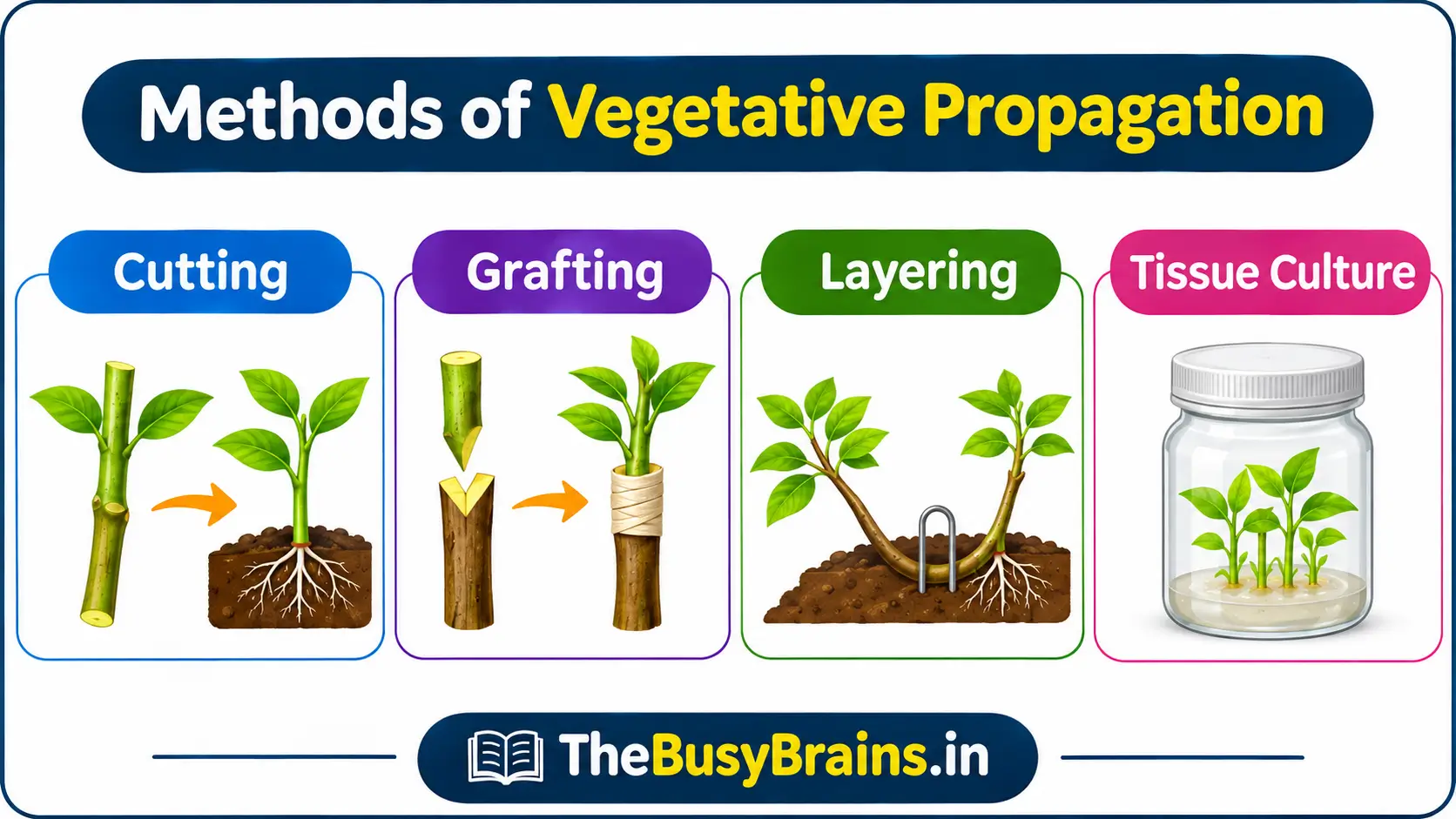
- Cutting: A piece of stem is cut from a healthy plant and placed in suitable soil. Under favourable conditions, it develops roots and shoots. Sugarcane and money plant can be propagated through stem cuttings.
- Grafting: A stem piece from one plant is joined to the rooted plant of another. The two parts grow together. This method is used to combine desirable qualities of different varieties.
- Layering: A flexible branch is bent towards the ground and a portion is covered with soil. Roots develop from the covered part. It can then be separated from the parent plant.
- Tissue culture: New plantlets are produced from small pieces of plant tissue under controlled laboratory conditions. It allows a large number of healthy plants to be produced.
Importance in agriculture
Vegetative propagation helps farmers multiply plants quickly and maintain desirable characteristics. It is useful for cultivating selected varieties on a large scale. Tissue culture is used, for example, to produce healthy banana plantlets.
Important Questions
- What is vegetative propagation? Give two natural examples.
- Explain cutting, grafting and layering.
- How is tissue culture useful in agriculture?
- Why may plants produced through vegetative propagation be more vulnerable to the same disease?
- A farmer wants to grow many plants with the same desirable fruit quality. Which method of propagation could be useful? Give a reason.
Budding in Yeast and Hydra
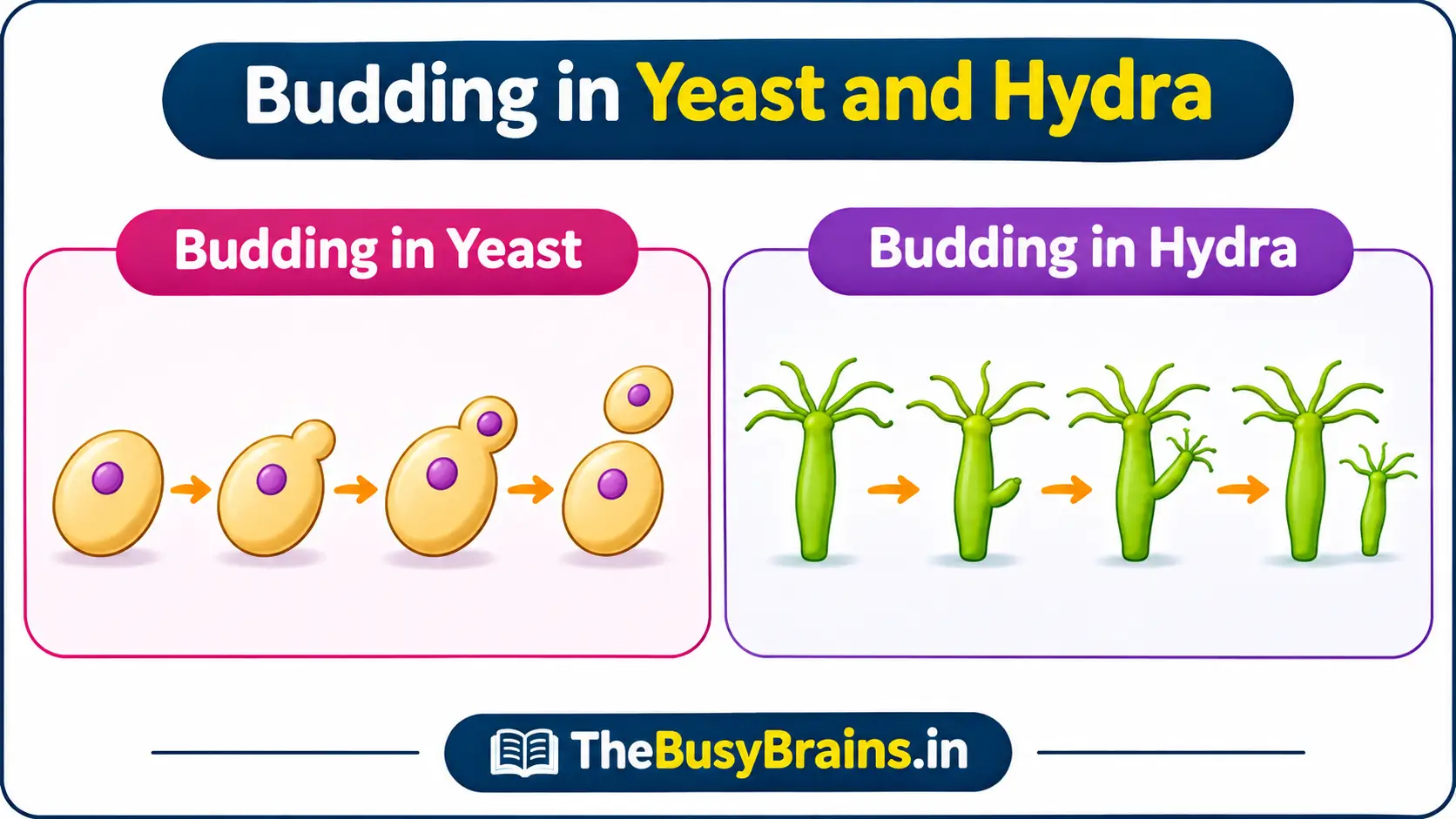
Budding is a method of asexual reproduction in which a small outgrowth, called a bud, develops on the parent organism. The bud grows and may eventually separate to live independently.
Budding in yeast
Yeast is a unicellular fungus. During budding, a small outgrowth appears on the parent cell. The cell divides, and the bud receives a copy of the genetic material. The bud grows and may separate from the parent cell.
Budding in Hydra
Hydra is a simple multicellular animal. Repeated cell division at a particular region of its body produces a small bud. The bud grows, develops structures similar to the parent and eventually separates to live independently. Several buds may sometimes be seen on one Hydra.
Important Questions
- What is budding?
- Describe the process of budding in Hydra.
- How does budding occur in yeast?
- Give one similarity and one difference between budding in yeast and Hydra.
Spore Formation in Fungi
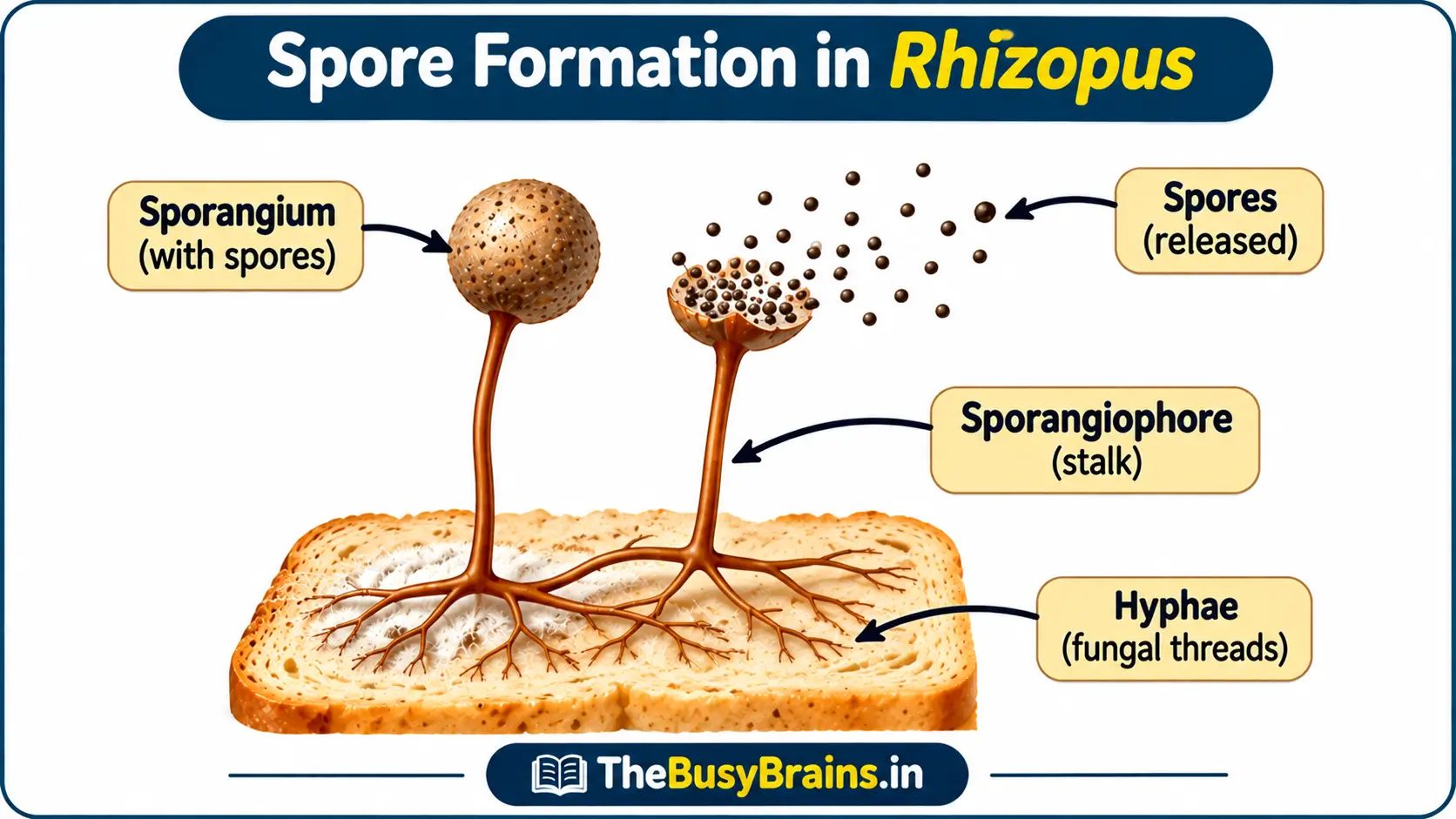
Fungi such as Rhizopus reproduce asexually through spore formation. Spores are tiny reproductive structures that can develop into new individuals under favourable conditions.
In Rhizopus, thread-like structures called hyphae form the body of the fungus. Some hyphae grow upright and bear a sac-like structure called a sporangium at the tip. Numerous spores develop inside the sporangium.
When the sporangium matures, it releases spores. These spores are light and can be carried by air. When they land on a suitable surface with adequate moisture and nutrients, they germinate and grow into new fungal individuals.
Fungi are also important decomposers. They break down dead organic matter and help recycle nutrients. Some fungi are used in the production of antibiotics, such as penicillin.
Important Questions
- What is spore formation?
- Describe spore formation in Rhizopus with the help of a labelled diagram.
- What is the function of the sporangium?
- Why are spores produced in large numbers?
- State two conditions required for spores to germinate.
Mitosis, Clones and Asexual Reproduction
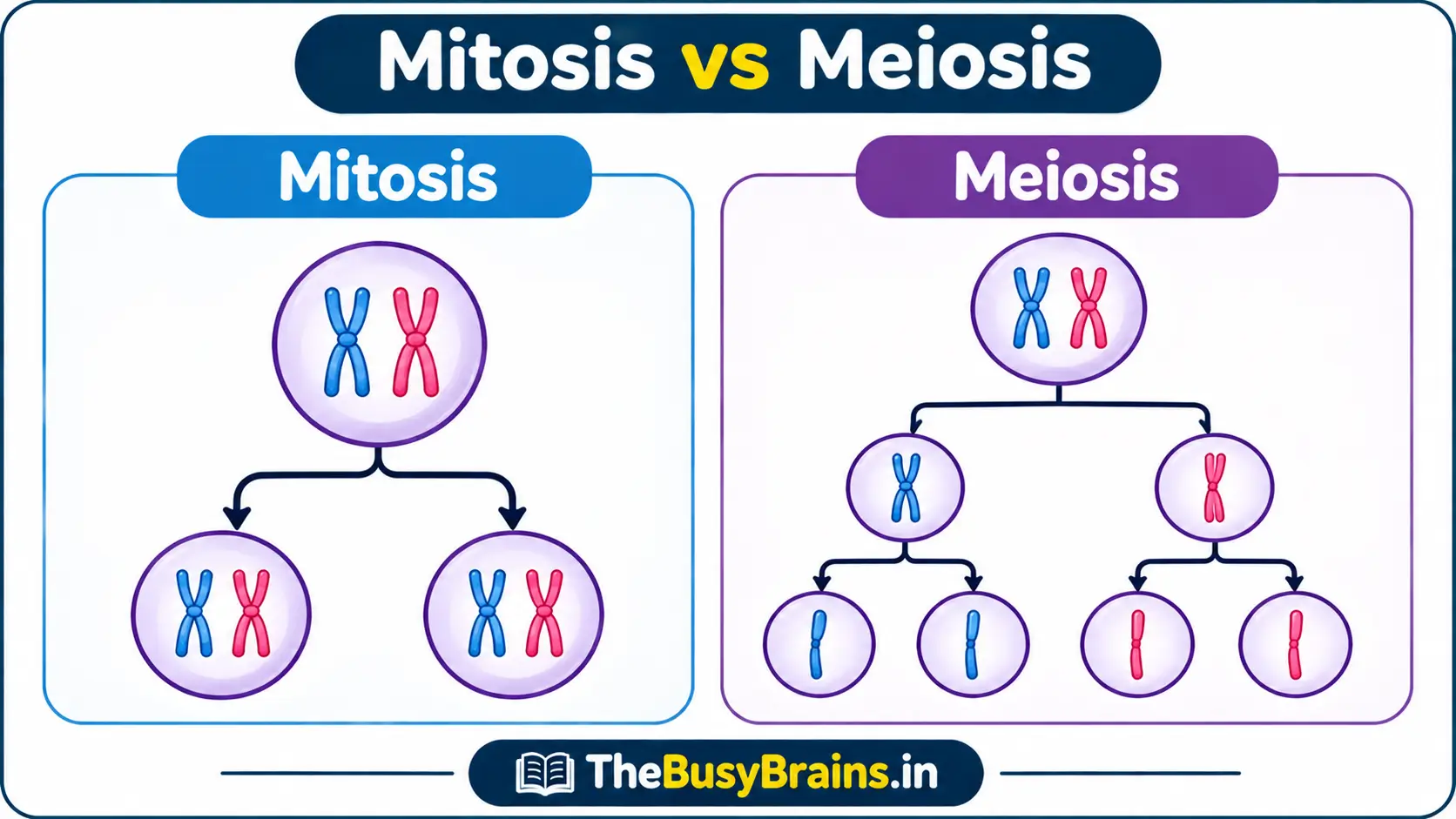
In the asexual reproduction examples discussed above, the central process of cell division is generally mitosis. Mitosis produces daughter cells with the same number of chromosomes as the parent cell.
When the genetic material is copied and distributed equally, the resulting offspring are generally genetically identical to the parent. Such genetically identical individuals are called clones.
Important Questions
- What is mitosis?
- What are clones?
- Why does mitosis generally produce genetically identical daughter cells?
- How does mitosis help in asexual reproduction?
Sexual Reproduction
Sexual reproduction involves the formation of a new individual through the contribution of genetic material from two parents. The male and female reproductive cells are called gametes.
The male and female gametes fuse during fertilisation. This fusion forms a zygote, which develops into a new individual.
Sexual reproduction creates new combinations of genetic information. As a result, offspring may differ from their parents and from one another. These differences are called variations.
Why is meiosis necessary?
If gametes carried the full chromosome number, the number of chromosomes would double after fertilisation in every generation. Meiosis solves this problem by reducing the chromosome number to half during gamete formation.
- Cells with two sets of chromosomes are called diploid.
- Gametes with one set of chromosomes are called haploid.
- During fertilisation, the haploid male and female gametes combine and restore the diploid chromosome number in the zygote.
How does meiosis create variation?
During meiosis, the chromosomes of each pair separate, so each gamete receives one chromosome from each pair. The combinations can differ from one gamete to another. This random distribution produces different combinations of genetic information.
Variations are important because some individuals may be better able to survive when environmental conditions change. Over many generations, variation contributes to evolution.
Important Questions
- What is sexual reproduction?
- Define gametes, fertilisation and zygote.
- Why is meiosis necessary for sexual reproduction?
- Differentiate between diploid and haploid cells.
- How does meiosis lead to variations among offspring?
- Why are variations important for the survival of a species?
Sexual Reproduction in Flowering Plants
In flowering plants, the flower is the reproductive organ. A flower contains structures that take part in the formation of male and female gametes and the production of seeds.
Structure of a flower
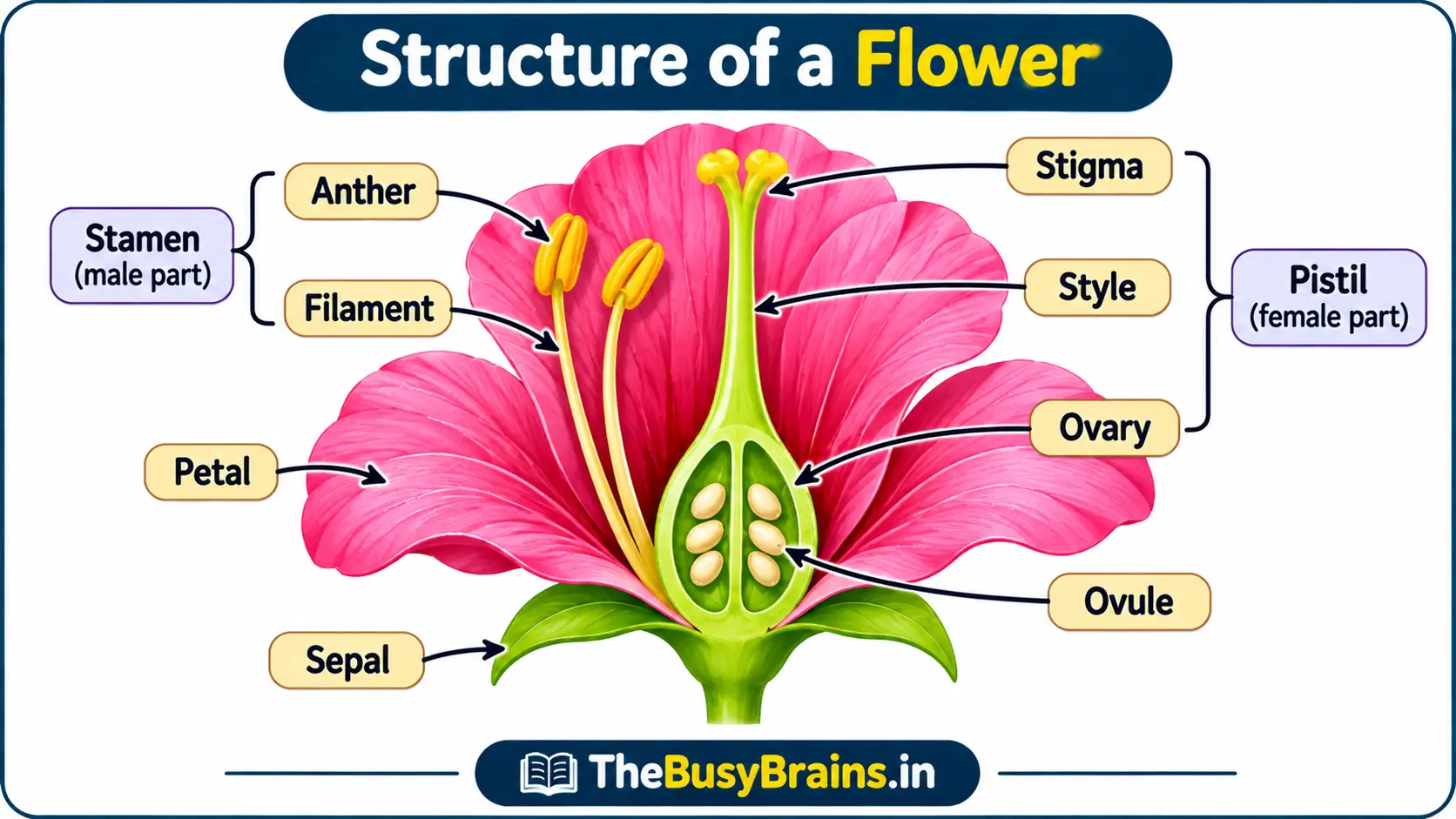
A complete flower generally has four main parts:
- Sepals: The outermost green parts that protect the flower during the bud stage.
- Petals: Often coloured and sometimes fragrant. They help attract pollinators.
- Stamen: The male reproductive part. It consists of a filament and an anther. The anther produces pollen grains containing male gametes.
- Pistil: The female reproductive part. It consists of the stigma, style and ovary. The ovary contains ovules, and each ovule contains an egg cell.
Pollination
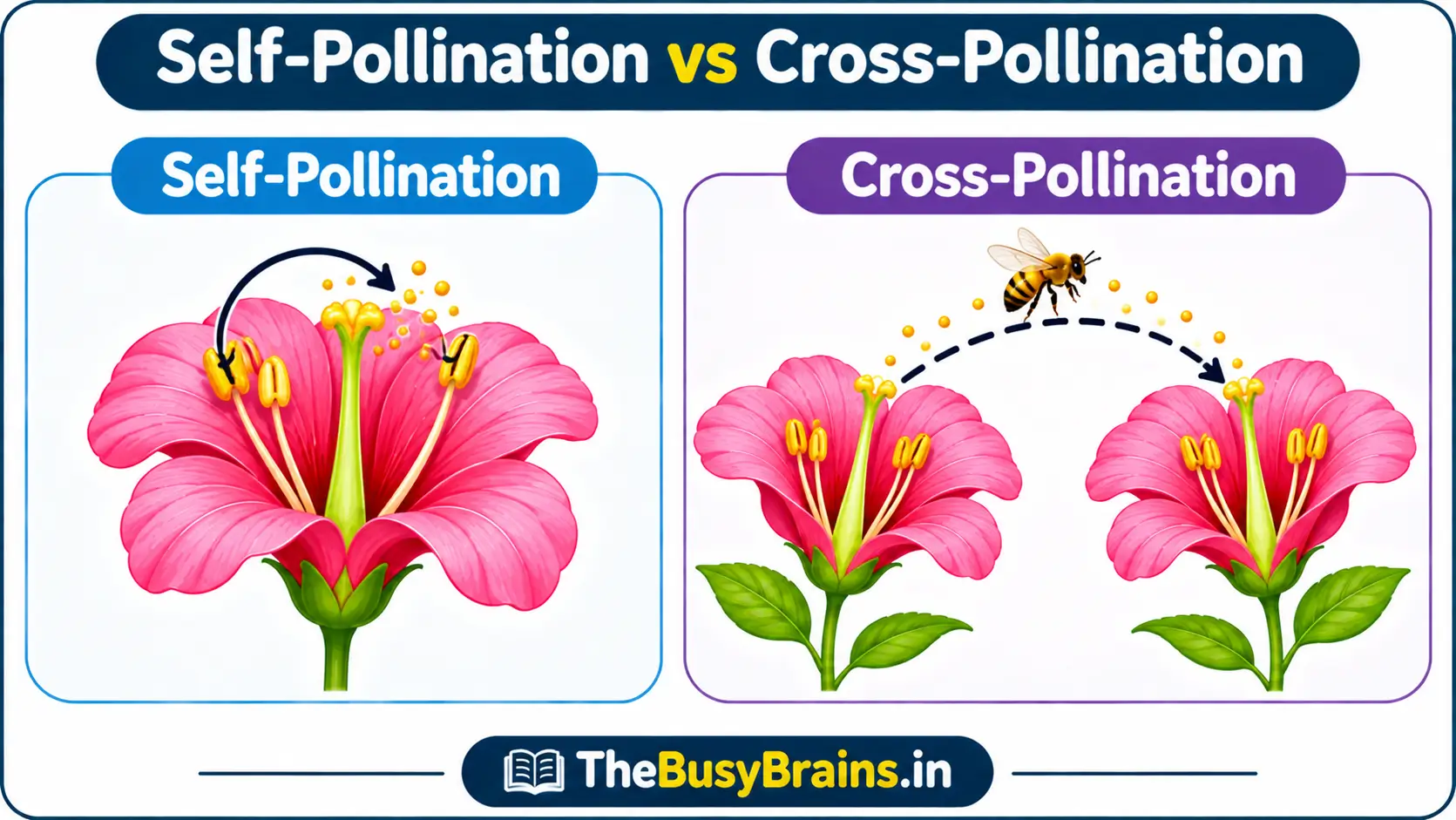
Pollination is the transfer of pollen grains from the anther to the stigma of a flower. It is an essential step in sexual reproduction in flowering plants.
Types of pollination
Self-pollination: Pollen is transferred to the stigma of the same flower or another flower on the same plant.
Cross-pollination: Pollen is transferred from a flower on one plant to a flower on another plant of the same species.
| Self-pollination | Cross-pollination |
|---|---|
| Pollen reaches the same flower or another flower on the same plant. | Pollen reaches a flower on another plant of the same species. |
| It generally involves less mixing of genetic material between different plants. | It can bring together genetic material from different plants and increase variation. |
Agents of pollination
Pollination may take place with the help of external agents called pollinators. These include wind, water, insects and birds.
- Wind: Grasses such as maize and wheat produce large quantities of light pollen. Their stigmas may be long and feathery to trap pollen.
- Water: In aquatic plants such as Vallisneria and Hydrilla, water currents help carry pollen.
- Insects: Bees and butterflies visit flowers such as sunflower, hibiscus and marigold. Bright colours, fragrance and nectar attract them.
- Birds: Some flowers are pollinated by birds such as sunbirds.
Pollination and reproductive success
Different plants use different strategies to improve the chances of pollen reaching a suitable stigma. Wind-pollinated plants may release very large quantities of pollen because much of it does not reach a flower. Insect-pollinated plants often use attractive flowers and sticky pollen to improve transfer.
The textbook gives an example comparing approximate pollen production and seed formation. Wind-pollinated grasses may release about 5,00,000–10,00,000 pollen grains per flower and produce an estimated 50–200 seeds. Insect-pollinated plants may release about 20,000–40,000 pollen grains and produce an estimated 800–1,000 seeds.
Important Questions
- Why is a flower called the reproductive organ of an angiosperm?
- Draw and label the four main parts of a complete flower.
- Differentiate between stamen and pistil.
- Define pollination. Differentiate between self-pollination and cross-pollination.
- Explain the role of wind, water and insects in pollination.
- Why do wind-pollinated plants produce pollen in very large quantities?
- How do brightly coloured and fragrant flowers attract pollinators?
Fertilisation and Seed Formation in Flowering Plants
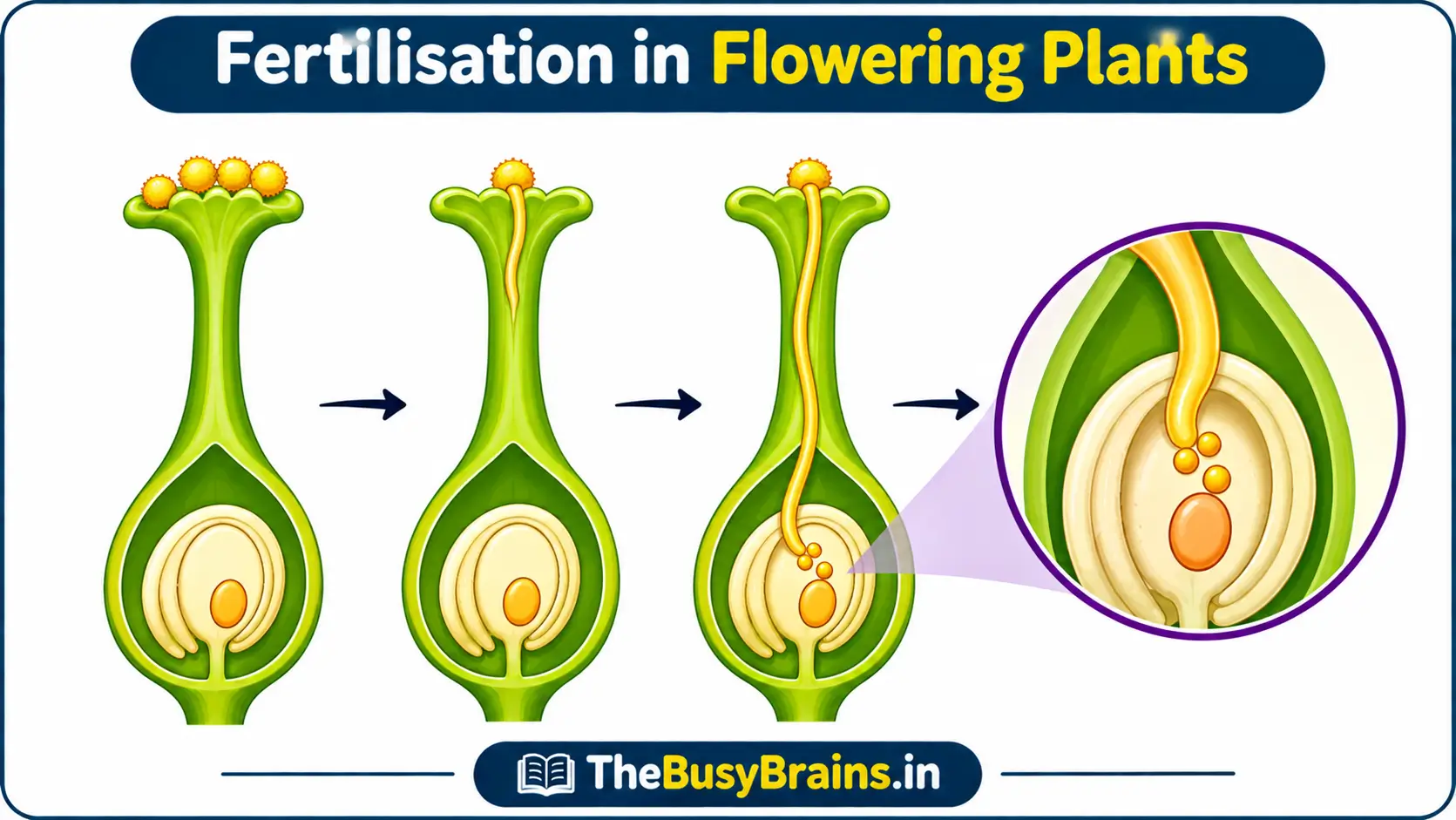
After a compatible pollen grain reaches the stigma, it germinates and forms a pollen tube. The tube grows through the style towards the ovary. The male gamete travels through the pollen tube and reaches the ovule.
The male gamete fuses with the egg cell inside the ovule. This fusion is called fertilisation. It forms a fertilised egg called the zygote.
What happens after fertilisation?
- The fertilised egg develops into an embryo.
- The ovule develops into a seed.
- The ovary enlarges and develops into a fruit.
- When suitable conditions are available, the seed germinates and grows into a new plant.
Important Questions
- What happens when a pollen grain reaches a compatible stigma?
- What is fertilisation? Where does it take place in a flowering plant?
- What is the role of the pollen tube?
- What do the ovule and ovary develop into after fertilisation?
- Arrange the stages in the correct order: fertilisation, pollination, pollen tube growth, zygote formation.
Sexual Reproduction in Animals
In sexual reproduction, male and female gametes must meet and fuse. Animals show different reproductive strategies depending on their habitat and the way their embryos develop.
External fertilisation
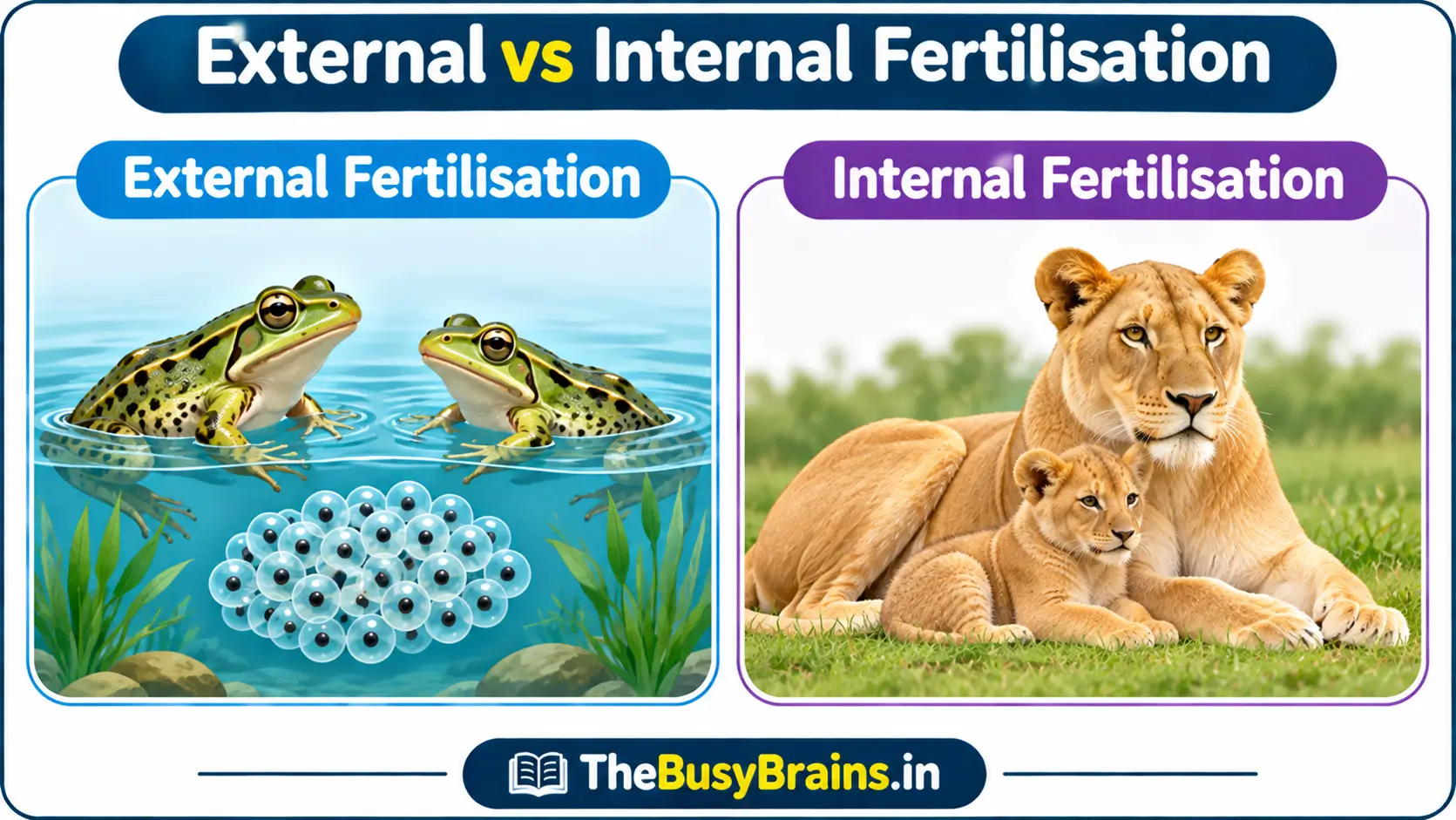
In external fertilisation, the fusion of male and female gametes takes place outside the female's body. It is common in many aquatic animals, including most fish and frogs.
The female releases eggs into the water, and the male releases sperm over them. A large number of eggs may be produced because many are lost due to water currents or are eaten by other organisms.
Internal fertilisation
In internal fertilisation, the fusion of male and female gametes takes place inside the female's body. It occurs in reptiles, birds and mammals.
The fertilised egg or developing embryo receives greater protection inside the female reproductive system. The chances of survival of the young are generally higher than in external fertilisation.
| External fertilisation | Internal fertilisation |
|---|---|
| Gametes fuse outside the female's body. | Gametes fuse inside the female's body. |
| Common in many aquatic animals, such as fish and frogs. | Occurs in reptiles, birds and mammals. |
| Usually many eggs are produced. | Generally fewer eggs or young are produced. |
| Many eggs and young may be lost; survival is often lower. | The developing offspring receive greater protection; survival is generally higher. |
Different ways of development
In some animals, the young hatch as larvae. A larva is an intermediate stage that may look very different from the adult and often feeds and grows before changing into the adult form.
For example, a butterfly passes through egg, larva, pupa and adult stages. Frogs also undergo changes as they develop from tadpoles into adult frogs.
In birds and reptiles, the embryo develops inside an egg containing yolk that provides nourishment. In mammals, the embryo develops inside the female body.
Important Questions
- Differentiate between external and internal fertilisation.
- Why do animals with external fertilisation generally produce a large number of eggs?
- Why is the survival of young ones generally higher in internal fertilisation?
- What is a larva? Give an example of an animal that has a larval stage.
- Describe the life cycle of a butterfly.
Reproduction in Human Beings
In human beings, reproductive maturity develops during adolescence. The reproductive organs mature and begin producing gametes: sperm in males and eggs in females.
When a sperm fuses with an egg inside the female reproductive system, a zygote is formed. It develops into an embryo and later into a foetus in the uterus.
The male reproductive system
The male reproductive system produces sperm and helps transfer them into the female reproductive system.
- Testes: A pair of organs that produce sperm and the hormone testosterone.
- Scrotum: A pouch of skin that holds the testes outside the main body cavity. It keeps them slightly cooler than normal body temperature, which is important for sperm formation.
- Vas deferens: A tube through which sperm travel from the testes towards the urethra.
- Seminal vesicles and prostate gland: These glands add fluids that nourish sperm and help them remain active and move.
- Urethra: A passage through which urine and semen leave the body at different times.
- Penis: An external reproductive organ that transfers semen into the female reproductive tract.
The female reproductive system
The female reproductive system produces eggs and provides the site where fertilisation and the development of the embryo can occur.
- Ovaries: A pair of organs that produce eggs and release female reproductive hormones.
- Oviducts or fallopian tubes: Tubes that connect the ovaries to the uterus. Fertilisation usually takes place in an oviduct.
- Uterus: A muscular, bag-like organ in which the embryo implants and the foetus develops.
- Cervix: The narrow lower passage of the uterus that opens into the vagina.
- Vagina: A muscular passage connecting the cervix to the outside of the body.
Important Questions
- Name the organs that produce sperm and eggs in human beings.
- What is the function of the scrotum?
- State the functions of the vas deferens and seminal vesicles.
- Name the parts of the female reproductive system and state one function of each.
- Where does fertilisation usually take place in human beings?
- What is the function of the uterus?
Formation of Reproductive Cells – Gametogenesis
The process of formation of reproductive cells is called gametogenesis. In human beings, it takes place in the testes and ovaries.
Gametes are formed by meiosis. The chromosome number is reduced to half so that fertilisation restores the normal chromosome number.
| Feature | Sperm | Egg |
|---|---|---|
| Size | Very small | Large |
| Number produced | Millions | Usually one mature egg is released in a menstrual cycle |
| Stored nutrients | Absent | Present |
| Movement | Actively motile | Non-motile |
Important Questions
- Define gametogenesis.
- Why do human gametes contain 23 chromosomes each?
- Give three differences between sperm and egg cells.
- How is the chromosome number maintained from one generation to the next?
Fertilisation and Early Development in Humans
From puberty onwards, usually one mature egg is released from an ovary during a menstrual cycle. This process is called ovulation.
During sexual intercourse, sperm may enter the female reproductive tract and travel towards the oviduct. If a sperm successfully fuses with an egg, a zygote is formed.
The zygote undergoes repeated mitotic divisions as it travels towards the uterus. It eventually attaches to the thickened inner lining of the uterus. This attachment is called implantation and marks the beginning of pregnancy.
Important Questions
- What is ovulation?
- Where does fertilisation usually occur in humans?
- What happens to the zygote after fertilisation?
- Define implantation. Why is it important?
- Differentiate between fertilisation and implantation.
Menstruation and the Menstrual Cycle
If an egg is not fertilised, it remains viable for about a day and then degenerates. The thickened inner lining of the uterus is no longer needed and is shed along with some blood through the vagina. This process is called menstruation or a period.
Menstruation usually lasts about 3–7 days. The cycle of ovulation, preparation of the uterus and menstruation repeats typically every 21–35 days, often around 28 days. The cycle usually begins during puberty and continues until menopause.
Main stages of a typical 28-day cycle
- Days 1–5: Menstruation occurs as the uterine lining is shed.
- Days 6–14: The uterine lining gradually rebuilds and an egg matures in an ovary.
- Around day 14: Ovulation may occur, releasing a mature egg from the ovary.
- Days 15–28: The uterine lining becomes thicker and richer in blood vessels. If fertilisation does not occur, the lining begins to break down and the cycle repeats.
Menstruation is a normal biological process. Maintaining menstrual hygiene includes changing menstrual products regularly, washing hands before and after changing them, cleaning the external genital area with water and disposing of used products responsibly.
Important Questions
- What is menstruation? Why does it occur?
- What happens to the uterine lining if fertilisation does not take place?
- What is the usual range of the menstrual cycle according to the chapter?
- Describe the main stages of a typical 28-day menstrual cycle.
- Why should day 14 not be considered the exact day of ovulation for every person?
- Mention four practices that help maintain menstrual hygiene.
Pregnancy and Childbirth
Human pregnancy usually lasts about nine months and is divided into three stages called trimesters. During this period, the embryo and later the foetus develop inside the uterus.
First trimester
During the first two months, the developing fertilised egg is called an embryo. Major organs begin to form. From about the ninth week, the developing baby is called a foetus.
Second trimester
The foetus grows bigger and stronger. The mother can usually begin to feel its movements.
Third trimester
The baby grows rapidly and prepares for life outside the womb. The uterus protects and nourishes the developing baby throughout pregnancy.
During childbirth, contractions of the uterine muscles help push the baby through the birth canal. If a normal vaginal birth is not possible or safe, medical or surgical procedures may be needed.
Care during pregnancy
- Eat a balanced diet containing proteins, vitamins and minerals.
- Attend regular medical check-ups.
- Follow medical advice about rest and suitable physical activity.
- Avoid smoking, alcohol and medicines taken without medical advice.
- Give attention to emotional well-being and seek support when needed.
Care after birth
Newborn babies need warmth, gentle handling, timely vaccination and appropriate nutrition. Breast milk provides nutrition and helps protect infants from many diseases. The mother's health and well-being also require care, rest and support.
Important Questions
- What is the approximate duration of human pregnancy?
- What are trimesters?
- Describe the main developments during each trimester.
- Why are regular medical check-ups important during pregnancy?
- Mention important care practices for a newborn baby.
Sexual Maturity and Responsible Choices
During adolescence, the body undergoes changes that lead to reproductive maturity. The production of sperm in boys and the development of menstrual cycles in girls are examples of these changes.
However, physical maturity does not mean that a person is automatically ready for all adult responsibilities. Emotional maturity develops over time and includes understanding feelings, communicating clearly and making thoughtful decisions.
Sexually transmitted infections
Some infections can spread through sexual contact. These are called sexually transmitted infections (STIs). The chapter mentions gonorrhoea, herpes, syphilis, genital warts and HIV. HIV can eventually lead to AIDS.
Condoms help reduce the risk of transmission of many STIs and also help prevent pregnancy. Anyone concerned about possible infection should seek advice from a qualified healthcare professional.
Methods of preventing unwanted pregnancy
- Barrier methods: Condoms and vaginal barriers help prevent sperm from reaching the egg. Condoms also reduce the risk of many STIs.
- Hormonal methods: Oral contraceptive pills use hormones to prevent pregnancy, for example by changing the release of eggs. They do not protect against STIs.
- Intra-Uterine Devices (IUDs): Devices such as Copper-T are placed inside the uterus to help prevent pregnancy.
- Surgical methods: Procedures can block the vas deferens in males or the fallopian tubes in females, preventing sperm and egg from meeting.
Responsible reproductive health
Reproductive health involves informed and responsible decisions, access to reliable information and appropriate medical care. Prenatal sex determination is strictly prohibited by law in India. Discrimination based on a child's sex can harm society and contribute to an imbalance in the sex ratio.
Important Questions
- What is meant by sexual maturity? How is it different from emotional maturity?
- What are sexually transmitted infections? Give examples mentioned in the chapter.
- How do condoms help protect reproductive health?
- Differentiate between barrier methods and hormonal methods of contraception.
- What is an IUD? Give one example.
- Why do oral contraceptive pills not protect against sexually transmitted infections?
- Why is prenatal sex determination prohibited in India?
Quick Revision – Important Points for Exams
- Reproduction: The biological process by which organisms produce new individuals of their own kind.
- Asexual reproduction: Involves one parent; offspring are generally genetically identical to the parent.
- Vegetative propagation: New plants develop from roots, stems or leaves.
- Cutting, grafting and layering: Artificial methods of vegetative propagation.
- Tissue culture: Production of plantlets from small pieces of plant tissue under controlled conditions.
- Budding: A new individual develops as an outgrowth from the parent, as in yeast and Hydra.
- Spore formation: Spores are produced in structures such as the sporangium of Rhizopus.
- Mitosis: Cell division that generally produces daughter cells with the same chromosome number as the parent cell.
- Sexual reproduction: Involves the fusion of male and female gametes.
- Meiosis: Reduces the chromosome number to half during gamete formation.
- Human chromosome number: 46 in most body cells; 23 in each sperm and egg.
- Flower: The reproductive organ of flowering plants.
- Stamen: Male part of a flower; consists of anther and filament.
- Pistil: Female part of a flower; consists of stigma, style and ovary.
- Pollination: Transfer of pollen from anther to stigma.
- Self-pollination: Pollen reaches the same flower or another flower on the same plant.
- Cross-pollination: Pollen is transferred between flowers on different plants of the same species.
- Fertilisation: Fusion of male and female gametes to form a zygote.
- After fertilisation in flowering plants: Ovule develops into a seed; ovary develops into a fruit.
- External fertilisation: Fusion of gametes takes place outside the female's body.
- Internal fertilisation: Fusion of gametes takes place inside the female's body.
- Gametogenesis: Formation of reproductive cells or gametes.
- Ovulation: Release of a mature egg from an ovary.
- Menstruation: Shedding of the uterine lining when pregnancy does not occur.
- Implantation: Attachment of the developing embryo to the uterine lining.
- Pregnancy: Usually lasts about nine months and is divided into three trimesters.
- STIs: Infections that can spread through sexual contact.
- Contraception: Methods used to prevent unwanted pregnancy.
Test Your Understanding
Now that you have revised the chapter, attempt the worksheet to check your understanding. Practise the questions before moving on to the next chapter.
Attempt Chapter Worksheet