


Patterns in Life: Diversity and Classification
Complete Chapter Notes | Concept Explanation | Important Questions | Quick Revision
Look around and you will notice that living organisms are remarkably different. A mushroom, a banyan tree, a butterfly and a fish have very little in common at first glance. Yet all of them are part of the living world. This chapter explores how scientists study this variety, recognise common features and arrange organisms into meaningful groups.
As you read, pay attention to the characteristics used for classification. The aim is not simply to memorise names, but to understand why an organism belongs to a particular group.
Biodiversity: The Variety of Life
Biodiversity refers to the enormous variety of living organisms found on Earth. It includes microscopic organisms, plants, animals and other forms of life living in different habitats.
Life is found in a wide range of environments, from the snow-covered Himalayas and deserts to forests, rivers and coral reefs. Each habitat supports organisms adapted to its conditions.
Why is biodiversity important?
- Oxygen production: Microscopic algae in oceans release a large part of the oxygen we breathe. Plants also release oxygen during photosynthesis.
- Decomposition: Fungi and bacteria break down dead organisms and fallen leaves, returning nutrients to the soil.
- Pollination: Birds, bees and bats help in the pollination of flowers.
- Food production: Plants capture sunlight and prepare food, supporting food chains.
- Human needs: People depend on biodiversity for food, medicines, shelter and livelihoods.
- Ecosystem stability: Different organisms perform different roles that help ecosystems function properly.
India as a Biodiversity Hotspot
India has varied geographical features: mountains, deserts, rainforests, plateaus and long coastlines. Differences in soil, temperature and rainfall create many habitats, supporting a rich variety of species.
Endemic species are species naturally restricted to a particular geographical region and not found naturally anywhere else.
Examples mentioned in the chapter include:
- Nilgiri tahr
- Lion-tailed macaque
- Indian pitcher plant (Nepenthes khasiana)
- Neelakurinji
Biodiversity hotspots are regions that support many endemic species and have also undergone significant habitat loss. They are important areas for conservation.
Examples include the Western Ghats, Indo-Burma region, Himalayas and Sundaland, which includes the Nicobar Islands.
Important Questions – Biodiversity
- What is biodiversity? Give two reasons why it is important for life on Earth.
- What are endemic species? Give two examples found in India.
- Define a biodiversity hotspot. Name any three biodiversity hotspots associated with India.
- How does maintaining different crop varieties help farmers?
- Explain how different organisms contribute to the stability of an ecosystem.
How Has Biodiversity Evolved?
The variety of life seen today has developed over a very long period. Biodiversity was not always the same as it is now.
Individuals within a species may show small differences. Some of these differences help organisms survive and reproduce when environmental conditions change. Over many generations, such differences can accumulate and contribute to the development of new forms of life.
Therefore, present-day biodiversity is the result of continuous changes over a vast span of time and interactions between organisms and their surroundings.
India's traditional understanding of biodiversity
The chapter also refers to the Sangam Tinai classification of landscapes and the protection of sacred groves. These traditions helped preserve local habitats and their living organisms.
Important Questions – Evolution of Biodiversity
- How has biodiversity changed over millions of years?
- How can small differences among individuals contribute to the development of new forms of life?
- What do similarities in organisms suggest about their ancestry?
- How did traditional practices such as sacred groves help conserve biodiversity?
How Do Scientists Classify Organisms?
Imagine trying to find one particular book in a library where thousands of books are scattered without any arrangement. It would be difficult to locate it. In the same way, studying millions of living organisms becomes easier when they are arranged into groups.
Biological classification is the systematic grouping of living organisms based on their similarities and differences.
Criteria used to classify living organisms
- External features: Shape, size and general body organisation.
- Mode of nutrition: Whether an organism is autotrophic or heterotrophic.
- Internal structures: Presence or absence of organs, tissues and skeletal structures.
- Cell structure: Whether cells are prokaryotic or eukaryotic, and whether a cell wall is present.
- Ecological role: Whether an organism acts as a producer, consumer or decomposer.
- Reproduction: Whether reproduction is sexual, asexual or both.
- Genetic similarity: Similarities in inherited features, studied through DNA.
Why is classification necessary?
- It makes the study of living organisms organised and systematic.
- It helps us compare similarities and differences.
- It explains relationships among organisms.
- It helps identify and name newly discovered organisms.
- It supports biodiversity conservation by helping identify threatened species.
- It provides scientists across the world with a common system of communication.
Example – Pakke Tiger Reserve: The chapter describes nearly 300 bird species recorded in Pakke Tiger Reserve in Arunachal Pradesh. Four hornbill species are found there. Studying their features, food sources and nesting requirements helps scientists understand their distribution and relationships with the forest.
Important Questions – Classification
- What is biological classification? Why is it necessary?
- Explain any five characteristics used by scientists to classify organisms.
- Why should classification not be based only on the external appearance of organisms?
- How does biological classification help in biodiversity conservation?
- Why is classification useful in studying the hornbill species of Pakke Tiger Reserve?
Development of Biological Classification Systems
Scientists have changed classification systems as their understanding of living organisms improved. Better microscopes and new discoveries revealed features that could not be observed earlier.
| Scientist | Classification system | Main idea |
|---|---|---|
| Aristotle | Artificial system | Grouped animals mainly by habitat – land, water and air – and external appearance. |
| Carolus Linnaeus | Two-kingdom system (1758) | Divided living organisms into Plantae and Animalia. |
| Ernst Haeckel | Three-kingdom system (1866) | Added Protista for microscopic organisms. |
| Herbert F. Copeland | Four-kingdom system (1938) | Placed bacteria in a separate kingdom called Monera. |
| Robert H. Whittaker | Five-kingdom system (1969) | Added Fungi as a separate kingdom. |
Why did the systems change?
The two-kingdom system could not properly accommodate organisms such as Amoeba, Paramecium and bacteria. Later, scientists recognised that organisms with a true, membrane-bound nucleus differ from those without one.
Fungi were also separated from plants because they do not prepare their own food. They obtain nutrients by absorption, often from dead and decaying matter.
Important Questions – Classification Systems
- Describe the development of biological classification from the two-kingdom to the five-kingdom system.
- Why was Protista introduced as a separate kingdom?
- Why were bacteria placed in Monera?
- Why were fungi separated from plants?
- Name the scientist who proposed the five-kingdom classification and mention the year.
The Five-Kingdom Classification
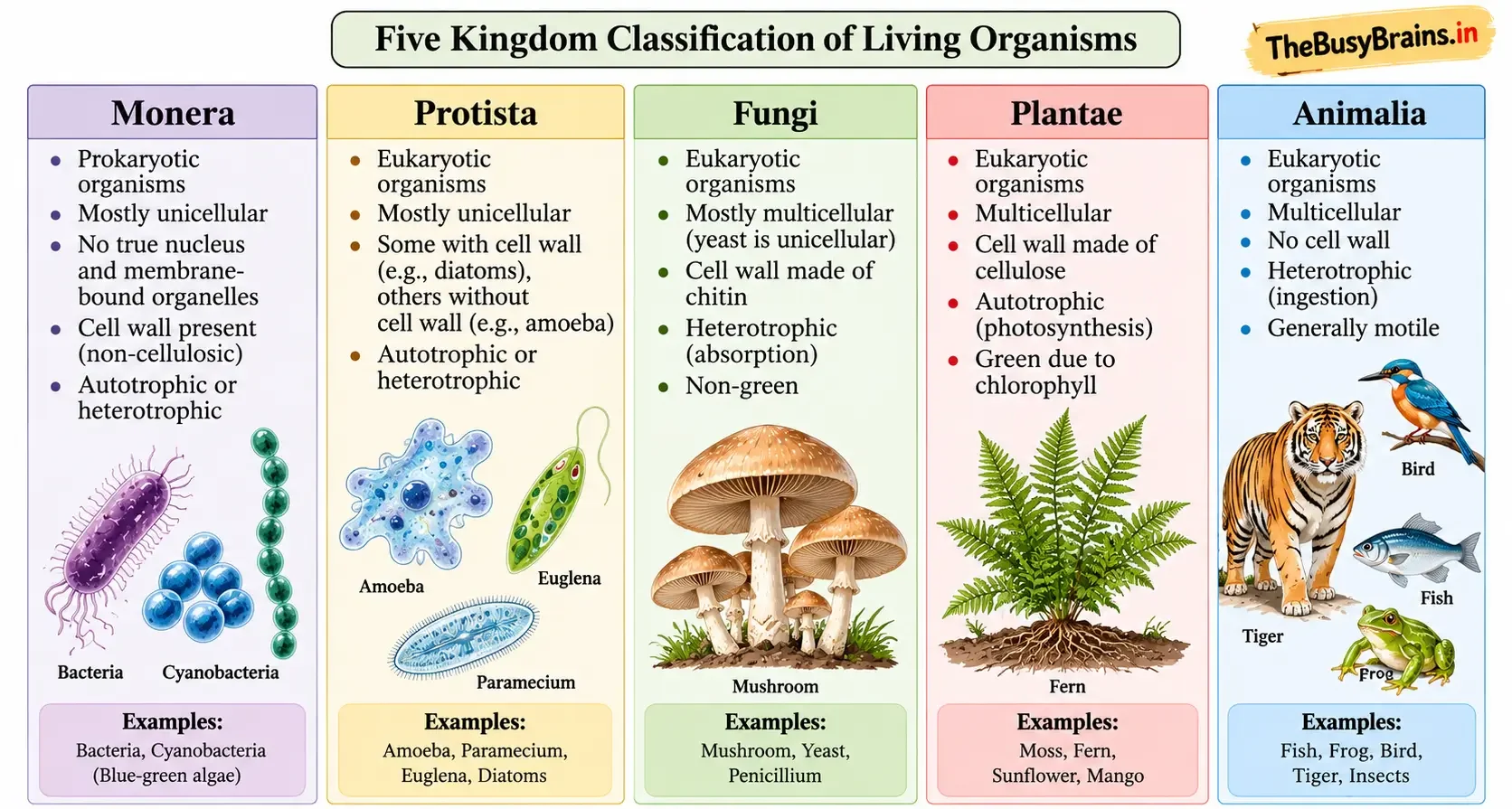
Robert Whittaker proposed a five-kingdom system in 1969. Organisms are grouped by considering features such as cell type, level of organisation, cell structure and mode of nutrition.
Important terms to understand
- Prokaryotic cell: A cell without a true, membrane-bound nucleus.
- Eukaryotic cell: A cell with a well-defined, membrane-bound nucleus.
- Unicellular: An organism made up of a single cell.
- Multicellular: An organism made up of many cells.
- Autotrophic nutrition: The ability to prepare one's own food, commonly through photosynthesis.
- Heterotrophic nutrition: Obtaining food from other organisms or organic matter.
- Cell wall: A supporting outer covering found outside the cell membrane in many organisms.
| Kingdom | Cell type | Organisation | Important feature |
|---|---|---|---|
| Monera | Prokaryotic | Unicellular | Bacteria and cyanobacteria |
| Protista | Eukaryotic | Mostly unicellular | Microscopic organisms with a true nucleus |
| Fungi | Eukaryotic | Mostly multicellular | Heterotrophic; cell wall made of chitin |
| Plantae | Eukaryotic | Multicellular | Autotrophic; cell wall mainly made of cellulose |
| Animalia | Eukaryotic | Multicellular | Heterotrophic; cells lack a cell wall |
Important Questions – Five Kingdoms
- List the five kingdoms proposed by Whittaker.
- State the main criteria used in the five-kingdom classification.
- Differentiate between prokaryotic and eukaryotic cells.
- Differentiate between unicellular and multicellular organisms with examples.
- Why is cell organisation an important basis of classification?
Kingdom Monera – Unicellular Prokaryotes
Monera includes bacteria and cyanobacteria. These organisms are single-celled and prokaryotic. Their cells do not have a true, membrane-bound nucleus.
Characteristics of Monera
- They are unicellular organisms.
- They are prokaryotic and lack a membrane-bound nucleus.
- They occur in soil, water, air, hot springs and even inside the bodies of other organisms.
- Some are harmful and cause diseases, while many are useful.
- Some bacteria help in nutrient cycling and decomposition.
- Certain bacteria can break down pollutants such as oil, pesticides and sewage.
Useful bacteria
Lactobacillus is useful in the preparation of curd. Rhizobium is associated with nitrogen fixation and is found in the root nodules of leguminous plants.
Cyanobacteria
Cyanobacteria are photosynthetic organisms, often called blue-green algae in common usage. They were among the early organisms that released oxygen through photosynthesis.
Bacteria and biogas
Some bacteria present in the gut of ruminants help in the production of biogas from animal dung. The chapter highlights Indian scientist Ram Bux Singh for his contribution to modern biogas technology.
Important Questions – Monera
- Why are bacteria placed in Kingdom Monera?
- Write four characteristics of organisms belonging to Monera.
- How are Lactobacillus and Rhizobium useful to humans?
- What are cyanobacteria? How did they contribute to the development of oxygen in the atmosphere?
- What are stromatolites, and why are they important?
Kingdom Protista – Unicellular Eukaryotes
Protista includes mostly single-celled eukaryotic organisms. Their cells have a true nucleus. They are generally microscopic and are commonly found in water or moist environments.
Characteristics of Protista
- They are mostly unicellular and eukaryotic.
- Some have a cell wall, while others do not.
- Some are autotrophic and others are heterotrophic.
- They may move with the help of structures such as cilia or flagella.
- They form an important part of aquatic food chains.
- Some produce oxygen, while others serve as food for small aquatic animals or act as decomposers.
Examples
- Amoeba: A unicellular organism that moves using pseudopodia.
- Paramecium: A unicellular organism that uses cilia for movement.
- Euglena: Can photosynthesise in light and may show heterotrophic nutrition in the absence of light.
Important Questions – Protista
- Write the main characteristics of Kingdom Protista.
- Why is Amoeba placed in Protista and not Monera?
- Differentiate between Amoeba and Paramecium on the basis of movement.
- How does Protista contribute to aquatic ecosystems?
- Why is Euglena an interesting organism to study while classifying organisms?
Kingdom Fungi – Heterotrophic Organisms
Fungi are eukaryotic organisms that do not prepare their own food. Most fungi are multicellular, although yeast is unicellular. Their cell walls are made of chitin.
Characteristics of fungi
- They are eukaryotic organisms.
- Most are multicellular, but yeast is unicellular.
- Their cell walls contain chitin.
- They do not contain chlorophyll and cannot prepare food through photosynthesis.
- They obtain nutrients by absorption.
- Many grow on dead and decaying organic matter.
- They commonly reproduce through spores and may reproduce sexually or asexually.
- They generally grow well in warm and moist conditions.
Hyphae and mycelium
Many fungi have fine thread-like filaments called hyphae. A network of hyphae is called a mycelium. These structures help fungi absorb nutrients from their surroundings.
Types of nutritional relationships
- Saprophytes: Obtain nutrients from dead and decaying organic matter.
- Parasites: Obtain nutrients from a living host and may cause disease.
- Symbiotic fungi: Live in a mutually beneficial association with another organism.
Examples and uses
- Yeast: A unicellular fungus.
- Aspergillus: A common mould.
- Mushrooms: Multicellular fungi that reproduce through spores.
- Penicillium: Certain species are used in the production of antibiotics.
Lichens – A symbiotic association
Lichens are an association between an alga and a fungus. The algal partner prepares food through photosynthesis, while the fungal partner provides protection. Lichens can also act as natural indicators of air quality because they are sensitive to air pollutants.
Important Questions – Fungi
- Write the main characteristics of Kingdom Fungi.
- What are hyphae and mycelium?
- Why are fungi called decomposers?
- Differentiate between saprophytic and parasitic nutrition.
- Why is yeast placed in Kingdom Fungi even though it is unicellular?
- What are lichens? Explain the relationship between the two partners.
Kingdom Plantae – Multicellular Autotrophs
Plants are multicellular, eukaryotic and generally autotrophic organisms. They prepare their own food through photosynthesis. Their cells have a rigid cell wall mainly made of cellulose.
Plants form the base of most food chains and release oxygen during photosynthesis. The chapter divides Kingdom Plantae into five major groups.
Thallophyta – Simple plant body
Thallophytes are among the simplest plant forms. Their body is called a thallus, which is not differentiated into true roots, stems and leaves. They are mostly found in water or moist environments.
Example: Spirogyra.
Important feature: Their simple body allows direct exchange of water, nutrients and gases with the surroundings.
Bryophyta – The amphibians of the plant kingdom
Bryophytes include mosses and liverworts. They usually grow in moist and shady places.
- They have a more differentiated body than thallophytes.
- They possess root-like structures called rhizoids.
- They do not have specialised vascular tissues for transporting water and food.
- They require water for reproduction.
Examples: Marchantia and moss.
Pteridophyta – Plants with vascular tissues
Pteridophytes include ferns. They have true roots, stems and leaves and possess specialised transport tissues.
- Xylem transports water.
- Phloem transports food.
- They do not produce seeds.
- They still require water for reproduction.
Example: Fern.
Gymnosperms – Naked seeds
Gymnosperms are seed-producing plants in which the seeds are not enclosed within fruits. The seeds are often exposed on cones.
- They are adapted to land environments, including cold and dry regions.
- Many have needle-like or scale-like leaves that reduce water loss.
- They do not require aquatic conditions for fertilisation.
- Their seeds protect the developing embryo and contain stored food.
Examples: Pine and cycads.
Angiosperms – Flowering plants
Angiosperms are flowering plants. They produce flowers, fruits and seeds. They have a well-developed body organisation and are the most diverse plant group on Earth.
- Flowers help in reproduction by attracting pollinators.
- Seeds are enclosed within fruits.
- Fruits help in seed dispersal through animals, birds, wind or water.
- They are adapted to a wide range of environments.
Example: Gulmohar.
Comparison of the five plant groups
| Group | Body organisation | Vascular tissue | Seeds | Example |
|---|---|---|---|---|
| Thallophyta | Simple thallus | Absent | Absent | Spirogyra |
| Bryophyta | Simple body; rhizoids | Absent | Absent | Moss, Marchantia |
| Pteridophyta | True roots, stems and leaves | Present | Absent | Fern |
| Gymnosperms | Well-developed plant body | Present | Naked seeds | Pine |
| Angiosperms | Well-developed flowering plants | Present | Seeds enclosed in fruits | Gulmohar |
Important Questions – Plantae
- Name the five major groups of Kingdom Plantae.
- Differentiate between thallophytes and bryophytes.
- Why are bryophytes called the amphibians of the plant kingdom?
- What are vascular tissues? State the functions of xylem and phloem.
- Why are pteridophytes considered more structurally developed than bryophytes?
- Differentiate between gymnosperms and angiosperms.
- Why are seeds of gymnosperms called naked seeds?
- How do flowers and fruits help angiosperms reproduce and spread?
Kingdom Animalia – Multicellular Heterotrophs
Animals are multicellular and eukaryotic organisms. They depend on other organisms for food. Most animals show locomotion, respond quickly to stimuli and display coordinated behaviour.
One important basis for classifying animals is the presence or absence of a notochord.
On this basis, animals are divided into two broad groups:
- Non-chordata (invertebrates): Animals without a notochord.
- Chordata: Animals that possess a notochord at least at some stage of their life.
Chordates include protochordates and vertebrates.
Invertebrates – Animals without a notochord
Invertebrates show a wide range of body organisation. The chapter describes eight major phyla.
Porifera – Pore-bearing animals
Porifera includes sponges. They are among the simplest multicellular animals.
- They lack true tissues and organs.
- Numerous pores allow water to flow through their bodies.
- Water brings food and oxygen to their cells and carries waste away.
- They are aquatic and generally remain fixed in one place.
Example: Sponge.
Cnidaria – Animals with tissue-level organisation
Cnidarians possess true tissues. Specialised structures such as tentacles help them capture prey.
- They show tissue-level organisation.
- They use tentacles for capturing food.
- They have a single opening that functions for both food intake and waste removal.
- They are found in aquatic environments.
Examples: Hydra, jellyfish and corals.
Platyhelminthes – Flatworms
These animals have flattened bodies and show bilateral symmetry. Their bodies can be divided into two similar halves along one plane.
- They show organ-level organisation.
- Their flattened bodies allow gases to diffuse without specialised respiratory organs.
- They have a single opening for food intake and waste elimination.
- Many are parasitic and may possess hooks and suckers for attachment to a host.
Nematoda – Roundworms
Nematodes have elongated, cylindrical bodies.
- They have two openings: a mouth and an anus.
- They show organ-system-level organisation.
- They are found in soil, water and inside host organisms.
Annelida – Segmented worms
Annelids have cylindrical bodies divided into segments.
- They show organ-system-level organisation.
- Muscles help in locomotion.
- A nerve cord helps in control and coordination.
- Segmentation allows flexibility and better control of movement.
- A body cavity is present.
Example: Earthworm.
Arthropoda – Jointed appendages
Arthropods include insects, crabs and spiders.
- They have segmented bodies.
- They possess jointed appendages.
- A hard external skeleton, called an exoskeleton, protects the body.
- The exoskeleton reduces water loss and supports muscles.
- They are found in land and water environments.
Mollusca – Soft-bodied animals
Molluscs have soft bodies. In many species, a shell provides protection.
- They show organ-system-level organisation.
- The body commonly has a distinct head, muscular foot and hump.
- They are found mainly in aquatic environments, although some live on moist land.
Examples: Snails, squids and octopuses.
Echinodermata – Spiny-skinned animals
Echinoderms are mainly marine animals with a hard internal skeleton made of calcium carbonate.
- They lack a notochord.
- Their internal skeleton provides support and protection.
- They show organ-system-level organisation.
Examples: Starfish and sea urchins.
Comparison of invertebrate phyla
| Phylum | Important identifying feature | Example |
|---|---|---|
| Porifera | Body with pores; no true tissues | Sponge |
| Cnidaria | Tissue-level organisation; tentacles | Hydra, jellyfish |
| Platyhelminthes | Flattened body; bilateral symmetry | Flatworm |
| Nematoda | Cylindrical body; mouth and anus | Roundworm |
| Annelida | Segmented body | Earthworm |
| Arthropoda | Jointed appendages; exoskeleton | Insect, crab, spider |
| Mollusca | Soft body; often protected by shell | Snail, octopus |
| Echinodermata | Calcium carbonate internal skeleton | Starfish |
Important Questions – Invertebrates
- What is the basis for dividing animals into chordates and non-chordates?
- Write two characteristics each of Porifera and Cnidaria.
- Differentiate between Platyhelminthes and Nematoda.
- How does segmentation help an earthworm?
- What is an exoskeleton? Explain its importance in arthropods.
- Differentiate between the skeleton of arthropods and echinoderms.
- Write the characteristic features of Mollusca.
- Arrange the eight invertebrate phyla and give one example of each.
Chordates, Protochordates and Vertebrates
Protochordates
Protochordates possess a notochord at least once during their life. The notochord provides internal support without restricting movement.
Example: Amphioxus.
Vertebrates – Animals with a backbone
Vertebrates possess a vertebral column or backbone. It supports the body and protects important organs such as the brain and spinal cord.
The internal skeletal framework supports larger body size, efficient movement and the development of complex organ systems.
The chapter groups vertebrates into five broad classes based on features such as habitat, body covering and reproduction:
- Fish
- Amphibians
- Reptiles
- Birds
- Mammals
Important Questions – Chordates and Vertebrates
- What is a notochord? State its importance.
- What are protochordates? Give an example.
- What is a vertebral column? Mention two functions.
- Name the five groups of vertebrates.
- Explain how fins, gills, feathers and thick fur help animals survive in their habitats.
- How do mammary glands help in the survival of young mammals?
The Hierarchical Nature of Classification
Biological classification follows a hierarchy. It begins with broad groups and gradually moves towards smaller, more specific groups. Organisms placed in a lower category share more characteristics.
Each lower category is part of the category above it. This arrangement helps scientists identify organisms accurately and understand their relationships.
Example: Classification of a tiger
| Category | Tiger |
|---|---|
| Kingdom | Animalia |
| Phylum | Chordata |
| Sub-phylum | Vertebrata |
| Class | Mammalia |
| Order | Carnivora |
| Family | Felidae |
| Genus | Panthera |
| Species | Panthera tigris |
Important Questions – Classification Hierarchy
- Write the levels of biological classification in the correct order.
- Which category is the most specific in the hierarchy?
- Differentiate between genus and species.
- Why do organisms in lower taxonomic categories share more common features?
- Write the classification of a tiger from kingdom to species.
Scientific Naming – Binomial Nomenclature
Different languages may use different common names for the same organism. This can create confusion when scientists from different parts of the world communicate.
To avoid this problem, scientists use binomial nomenclature, a universal system of naming organisms introduced by Carolus Linnaeus in the 18th century.
In this system, the scientific name has two parts:
- Genus: The first part of the scientific name.
- Species: The second part of the scientific name.
Examples
| Common name | Scientific name | Genus | Species name |
|---|---|---|---|
| Tiger | Panthera tigris | Panthera | tigris |
| Mango | Mangifera indica | Mangifera | indica |
Rules for writing scientific names
- A scientific name consists of two words: genus and species.
- The genus name begins with a capital letter.
- The species name begins with a small letter.
- When printed, the scientific name is written in italics.
- When handwritten, both words are underlined separately.
Incorrect: panthera Tigris
Important Questions – Binomial Nomenclature
- What is binomial nomenclature? Who introduced it?
- Why do scientists use scientific names instead of only common names?
- State the rules for writing scientific names.
- Identify the genus and species in Panthera tigris.
- Write the scientific names of tiger and mango.
The Three-Domain System
The five-kingdom classification was useful, but advances in genetic research revealed further differences among living organisms. Scientists began comparing organisms at the DNA level.
In 1977, Carl Woese proposed the three-domain system based on genetic evidence.
- Bacteria: A major group of prokaryotic organisms.
- Archaea: Another distinct group of prokaryotic organisms.
- Eukarya: Organisms whose cells have a true nucleus.
The three-domain system showed that microscopic life is more diverse than previously understood.
Important Questions – Three Domains
- Who proposed the three-domain system and in which year?
- Name the three domains of life.
- How did genetic studies help scientists improve classification?
- Why do classification systems change with time?
Fossils as Evidence of Life's History
Fossils are preserved remains or traces of plants and animals found in layers of rocks, sand and mud. They provide evidence about organisms that lived in the past.
By studying fossils, scientists can understand how life has changed over millions of years. Generally, older rock layers contain older forms of life, while newer layers contain more recent forms.
Fossils of dinosaurs, early humans and ancient plants help scientists reconstruct the history of life on Earth.
Birbal Sahni
Birbal Sahni was an eminent Indian scientist who studied fossil plants. He founded the Birbal Sahni Institute of Palaeosciences in Lucknow. His work helped connect present-day plants with their ancestors and understand past environments.
Important Questions – Fossils
- What are fossils?
- How do fossils provide evidence about the history of life on Earth?
- What information can scientists obtain by studying different rock layers?
- Who was Birbal Sahni? Mention his contribution to science.
Biodiversity Under Threat
Every species has a role in nature. Plants produce food and oxygen, animals help pollinate flowers and disperse seeds, while microorganisms recycle nutrients.
Major threats to biodiversity
- Deforestation: Destruction of forests removes habitats and food sources.
- Pollution: Contaminated air, water and soil can harm organisms.
- Overuse of resources: Excessive exploitation can reduce species populations.
- Climate change: Changes in temperature and environmental conditions can affect the survival and distribution of species.
- Habitat loss: When habitats disappear, organisms that depend on them may also decline.
Why does the loss of one species matter?
Organisms are connected through food chains, pollination, seed dispersal and nutrient cycling. If one species disappears, other organisms that depend on it may also decline. This can disturb the balance of an ecosystem.
Example: Sangai deer and phumdis
The chapter describes the Sangai, also called the dancing deer, which is endemic to Manipur. It depends on the floating grasslands called phumdis in Loktak Lake, within Keibul Lamjao National Park. The deterioration of these habitats threatens the survival of the deer.
Important Questions – Biodiversity Conservation
- List four human activities that threaten biodiversity.
- How can the disappearance of one species affect other organisms?
- Why is habitat conservation essential for protecting endangered species?
- What are phumdis? Explain their importance for the Sangai deer.
- Suggest measures to protect biodiversity in your local area.
Why Are Viruses Not Included in the Five Kingdoms?
The chapter asks why viruses are not placed in any of Whittaker's five kingdoms. The central issue is that viruses do not have cellular organisation.
- Viruses contain genetic material.
- They are acellular, meaning they are not made up of cells.
- They remain inactive outside a host cell.
- They depend on a host cell to carry out reproduction.
The five-kingdom system classifies cellular forms of life. Since viruses lack cellular organisation, they do not fit neatly into this system.
Important Questions – Viruses
- Why are viruses not included in Whittaker's five-kingdom classification?
- What is meant by the term acellular?
- Why do viruses depend on host cells?
- What do viruses reveal about the limitations of classification systems?
Quick Revision – Exam Time Notes
Use this section for a fast recap before your examination. These are the terms, names and distinctions worth revising carefully.
Key definitions
- Biodiversity: Variety of living organisms on Earth.
- Endemic species: Species naturally restricted to a particular geographical region.
- Biodiversity hotspot: Region rich in endemic species that has experienced significant habitat loss.
- Biological classification: Systematic grouping of organisms based on shared characteristics.
- Prokaryote: Organism whose cells lack a membrane-bound nucleus.
- Eukaryote: Organism whose cells possess a membrane-bound nucleus.
- Hyphae: Fine thread-like filaments found in many fungi.
- Mycelium: Network of fungal hyphae.
- Rhizoids: Root-like structures found in bryophytes.
- Notochord: Flexible rod-shaped supporting structure found in chordates.
- Exoskeleton: Hard external covering that supports and protects an animal.
- Binomial nomenclature: Scientific naming system using genus and species.
- Fossils: Preserved remains or traces of organisms from the past.
Scientists and their contributions
| Scientist | Remember this contribution |
|---|---|
| Aristotle | Grouped animals by habitat and external appearance. |
| Carolus Linnaeus | Two-kingdom system; binomial nomenclature. |
| Ernst Haeckel | Three-kingdom system. |
| Herbert F. Copeland | Four-kingdom system. |
| Robert H. Whittaker | Five-kingdom system (1969). |
| Carl Woese | Three-domain system (1977). |
| Birbal Sahni | Research on fossil plants. |
Five kingdoms at a glance
| Kingdom | One feature to remember | Example |
|---|---|---|
| Monera | Unicellular prokaryotes | Bacteria |
| Protista | Mostly unicellular eukaryotes | Amoeba |
| Fungi | Chitin cell wall; absorption of nutrients | Mushroom |
| Plantae | Multicellular autotrophs; cellulose cell wall | Fern |
| Animalia | Multicellular heterotrophs; no cell wall | Human |
Five plant groups – one-line revision
- Thallophyta: Simple thallus; example – Spirogyra.
- Bryophyta: Need water for reproduction; example – moss.
- Pteridophyta: Vascular tissues but no seeds; example – fern.
- Gymnosperms: Naked seeds; example – pine.
- Angiosperms: Flowers, fruits and seeds enclosed in fruits; example – Gulmohar.
Eight invertebrate phyla – one-line revision
- Porifera: Pores; no true tissues.
- Cnidaria: True tissues and tentacles.
- Platyhelminthes: Flat body; bilateral symmetry.
- Nematoda: Cylindrical body; two openings.
- Annelida: Segmented body.
- Arthropoda: Jointed appendages and exoskeleton.
- Mollusca: Soft body, often with a shell.
- Echinodermata: Marine animals with a calcium carbonate internal skeleton.
Classification hierarchy
Important differences to revise
- Prokaryotic cells do not have a membrane-bound nucleus; eukaryotic cells do.
- Bryophytes lack vascular tissues; pteridophytes possess xylem and phloem.
- Gymnosperm seeds are not enclosed in fruits; angiosperm seeds are enclosed in fruits.
- Invertebrates lack a notochord; chordates possess a notochord at least during one stage of life.
- Exoskeleton is an external supporting covering; an endoskeleton is internal.
- Scientific names have two parts: genus and species.
High-priority exam reminders
- Learn the five kingdoms and the scientists associated with classification systems.
- Practise the differences between all five plant groups.
- Learn one identifying feature and one example for each invertebrate phylum.
- Revise the classification hierarchy using the tiger example.
- Practise writing scientific names with correct capitalisation and italics.
- Understand why viruses do not fit into the five-kingdom classification.
- Prepare examples of biodiversity threats and conservation.
Test Your Understanding of This Chapter
Notes are useful, but solving questions is what helps you check your preparation. Attempt the chapter worksheet and see how well you can apply the concepts.
Attempt Chapter Worksheet →Practise MCQs, short answers and concept-based questions from this chapter.