


Cell: The Building Block of Life is an important chapter in Class 9 Science. It explains how cells form living organisms, how cell structures perform different functions, how materials move across the cell membrane, and how new cells are formed.
These notes include clear explanations, labelled diagrams, important questions after each topic, and quick revision points to help you prepare for examinations.
What Is a Cell?
A cell is the basic structural and functional unit of life. Every living organism is made up of one or more cells. Cells perform essential activities such as obtaining nutrients, releasing energy, removing waste, growing and reproducing.
Some organisms consist of only one cell and are called unicellular organisms. Examples include bacteria and Amoeba. Organisms made up of many cells are called multicellular organisms, such as plants, fish, birds and humans.
In multicellular organisms, similar cells work together to form tissues. Tissues form organs, and organs work together in organ systems.
Important Questions
- What is a cell?
- Differentiate between unicellular and multicellular organisms with examples.
- Arrange these levels of organisation in the correct order: organ, cell, organ system, tissue.
- Why is the cell called the basic structural and functional unit of life?
How Do We Study Cells?
Most cells are too small to be seen clearly with the unaided eye. Scientists use microscopes to observe their structures. Robert Hooke observed a thin slice of cork through a microscope in 1665 and used the term “cells” for the small, box-like compartments he saw.
The ability to distinguish two closely placed points as separate is called resolution. Magnification makes an object appear larger, while resolution determines how clearly its details can be distinguished.
- Light microscope: Uses visible light and lenses to magnify specimens.
- Electron microscope: Uses electrons and can reveal much finer details of cell structures.
- Total magnification: Eyepiece magnification multiplied by objective lens magnification.
Important Questions
- Who observed cells in cork in 1665?
- What is meant by the resolution of a microscope?
- Differentiate between magnification and resolution.
- Calculate the total magnification when the eyepiece is 10× and the objective lens is 40×.
Structure of a Cell
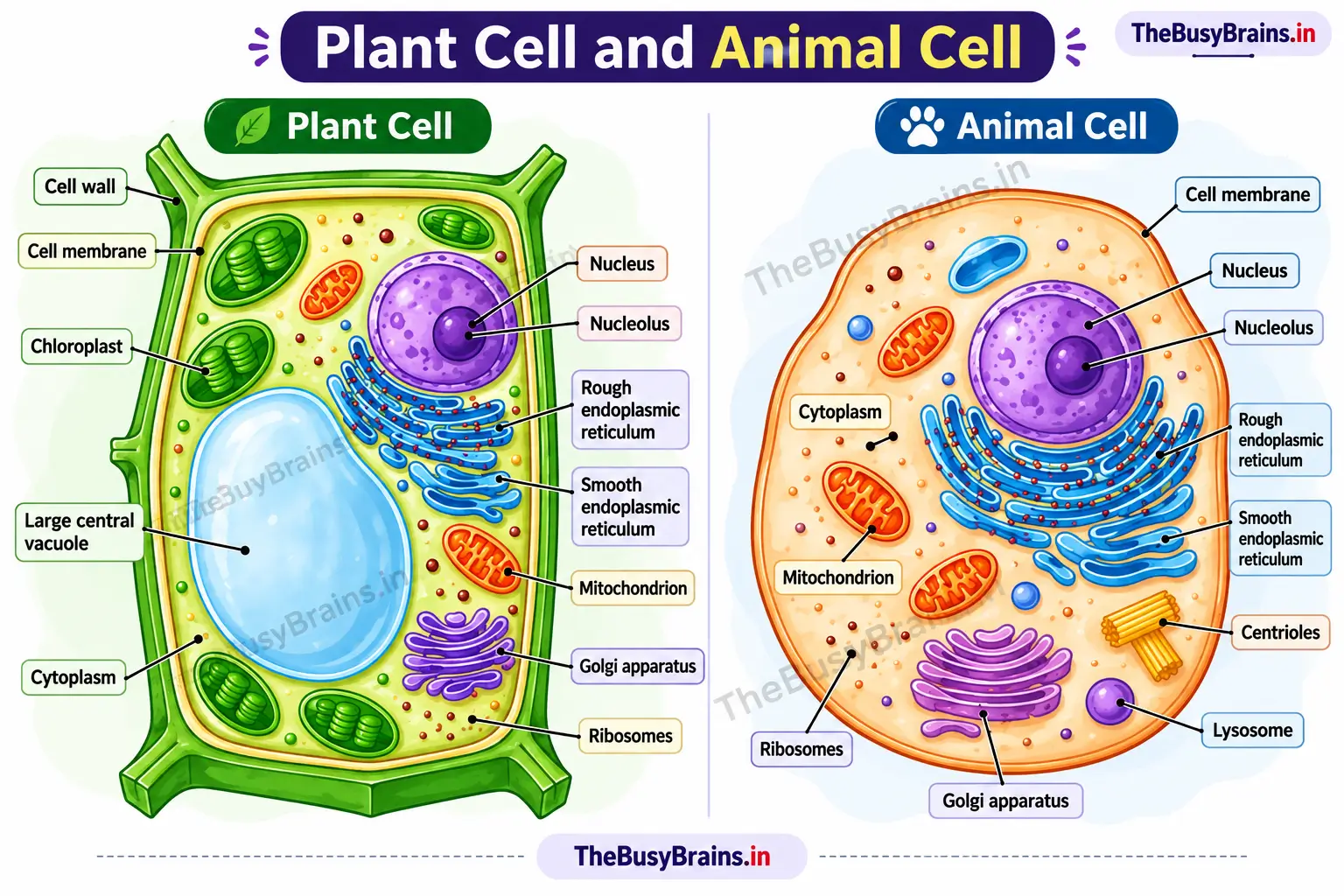
Although cells vary in shape, size and function, most cells have a cell membrane, cytoplasm and genetic material. Eukaryotic cells also contain a well-defined nucleus and membrane-bound organelles. Plant and animal cells are eukaryotic cells.
Cell Membrane — The Boundary of the Cell
The cell membrane, also called the plasma membrane, is a thin boundary that surrounds the cell and separates its contents from the surroundings. It is selectively permeable, meaning it allows certain substances to pass through while restricting others.
The membrane is mainly made of lipids and proteins. Its structure is flexible, allowing the cell to interact with its environment and regulate the movement of substances into and out of the cell.
Diffusion
Diffusion is the movement of particles from a region of higher concentration to a region of lower concentration. It helps substances such as oxygen and carbon dioxide move across cell membranes.
Osmosis
Osmosis is the movement of water through a selectively permeable membrane from a region of higher water concentration to a region of lower water concentration.
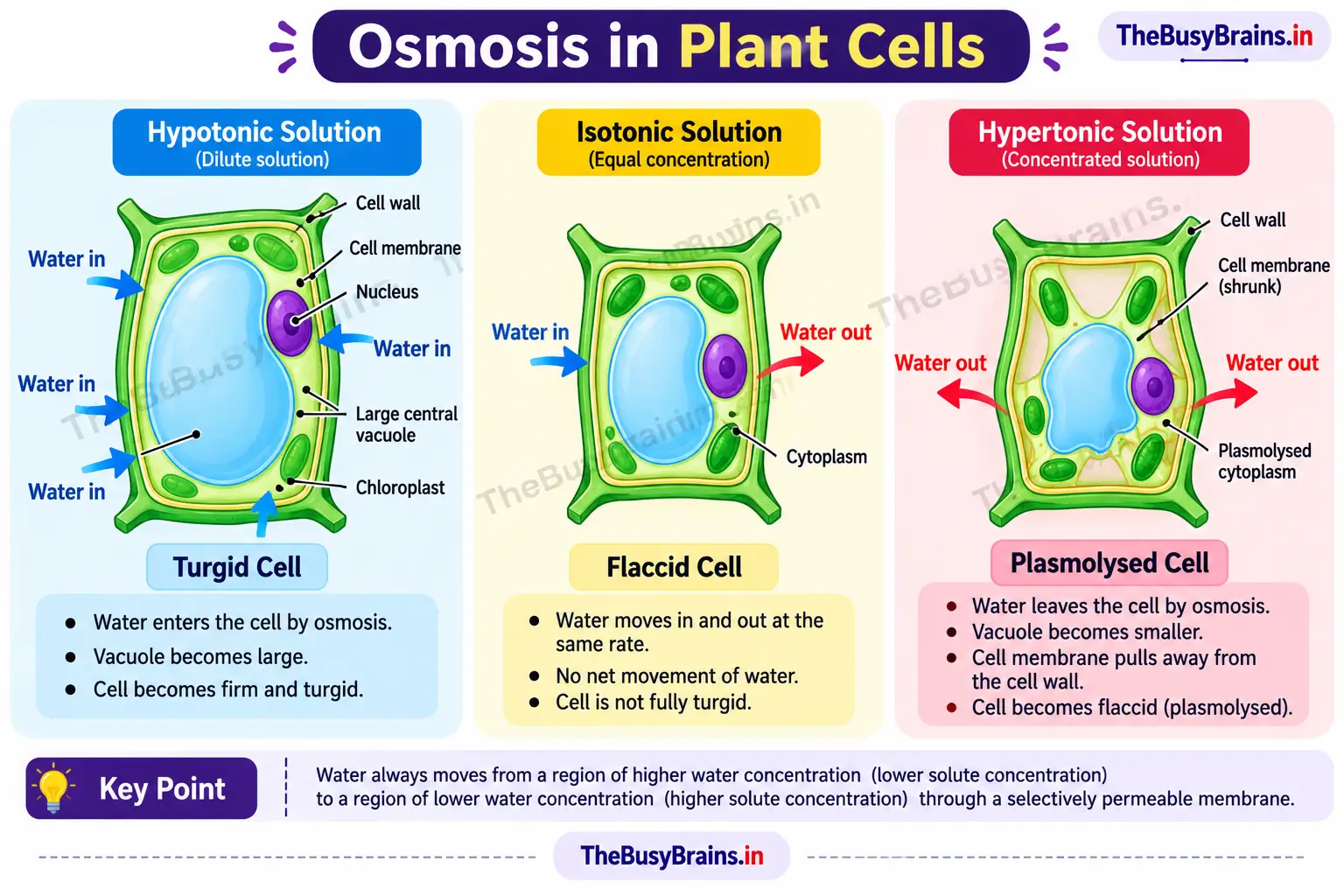
Water movement depends on the concentration of solutes on the two sides of the membrane. In a dilute solution, water may enter a cell; in a concentrated solution, water may leave it.
What Happens to Plant Cells in Different Solutions?
- Hypotonic solution: Water enters the plant cell. The vacuole expands and the cell becomes firm or turgid.
- Isotonic solution: Water moves in and out at approximately the same rate, so there is no net movement of water.
- Hypertonic solution: Water leaves the cell. The cytoplasm shrinks, and the cell membrane may pull away from the cell wall. This is called plasmolysis.
In the potato experiment, a piece kept in plain water may swell, while a piece placed in a concentrated salt or sugar solution may shrink. This happens because water moves across the cell membranes by osmosis.
Important Questions
- What is a selectively permeable membrane?
- Define diffusion and osmosis.
- What happens when a plant cell is placed in a hypertonic solution?
- Why does a potato piece swell in plain water and shrink in concentrated salt solution?
- Differentiate between hypotonic, isotonic and hypertonic solutions.
Cell Wall — Support and Protection
The cell wall is a rigid outer layer found outside the cell membrane in plant cells. Plant cell walls are mainly made of cellulose. Cell walls are also found in fungi and bacteria, although their composition differs.
The cell wall provides shape, support and protection. It also helps plant cells withstand the pressure that develops when water enters them. Unlike the cell membrane, the cell wall is generally permeable to many substances.
Important Questions
- What is the main material in a plant cell wall?
- State two functions of the cell wall.
- Differentiate between the cell wall and the cell membrane.
Prokaryotic and Eukaryotic Cells
Cells are broadly classified into prokaryotic and eukaryotic cells based on their internal organisation, especially the presence or absence of a well-defined nucleus.
Prokaryotic Cells
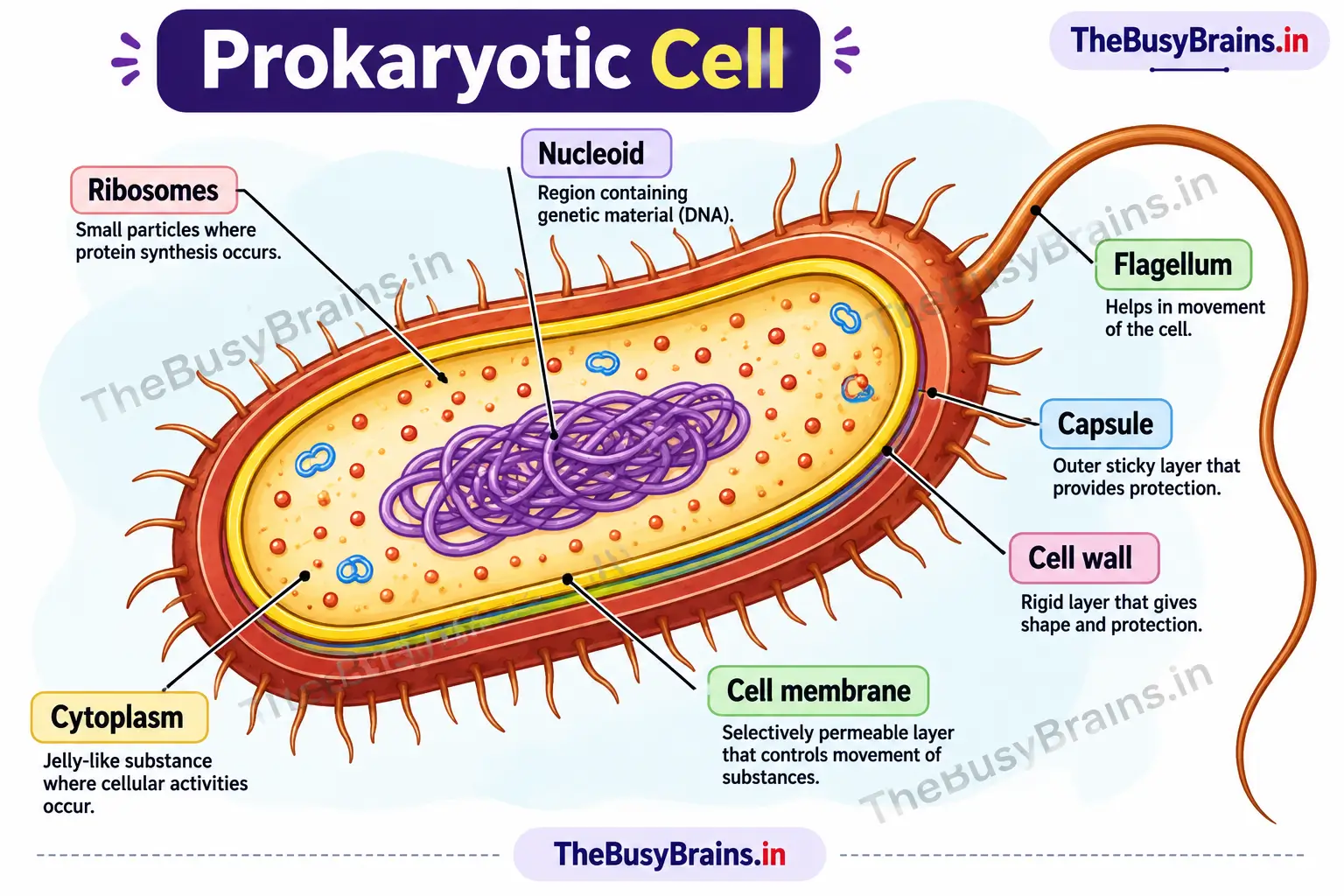
Prokaryotic cells do not have a well-defined, membrane-bound nucleus. Their genetic material is present in a region called the nucleoid. They also lack membrane-bound organelles such as mitochondria and the Golgi apparatus.
Bacteria are examples of prokaryotic organisms. Many prokaryotic cells have a cell membrane, cytoplasm, ribosomes and a cell wall. Some also have a capsule, pili or a flagellum.
Eukaryotic Cells
Eukaryotic cells have a well-defined nucleus surrounded by a nuclear membrane. They contain membrane-bound organelles that perform specialised functions. Plant cells, animal cells, fungi and many unicellular organisms have eukaryotic cells.
| Feature | Prokaryotic Cell | Eukaryotic Cell |
|---|---|---|
| Nucleus | No well-defined, membrane-bound nucleus | Well-defined, membrane-bound nucleus |
| Genetic material | Located in the nucleoid region | Primarily contained within the nucleus |
| Membrane-bound organelles | Absent | Present |
| Examples | Bacteria | Plants and animals |
Important Questions
- What is a nucleoid?
- Give two differences between prokaryotic and eukaryotic cells.
- Why are bacteria classified as prokaryotes?
- Name two structures found in many prokaryotic cells that help them survive or function.
Nucleus — The Control Centre
The nucleus contains most of the cell's genetic material and helps regulate cellular activities. It is surrounded by a nuclear envelope containing pores through which materials can move between the nucleus and cytoplasm.
- Nuclear envelope: Surrounds and separates the nucleus from the cytoplasm.
- Nuclear pores: Allow the movement of selected substances across the nuclear envelope.
- Nucleolus: Involved in the production of ribosomal components.
- Chromosomes: Structures made of DNA and associated proteins.
- Genes: Segments of DNA that carry information for functional products and inherited characteristics.
When a cell is not dividing, much of its DNA exists as a less condensed material called chromatin. During cell division, chromatin becomes more condensed and chromosomes become easier to observe.
Mature human red blood cells lack a nucleus. This allows more space for haemoglobin, which carries oxygen.
Important Questions
- State the functions of the nucleus.
- What are chromosomes and genes?
- What is the role of the nuclear pores?
- Why do mature human red blood cells lack a nucleus?
Cell Organelles and Their Functions
Cell organelles are specialised structures that perform particular functions. Their activities work together to keep the cell alive and functioning.
Ribosomes — Protein Synthesis
Ribosomes are tiny structures that make proteins. They may be found freely in the cytoplasm or attached to the rough endoplasmic reticulum.
Endoplasmic Reticulum — A Network Inside the Cell
The endoplasmic reticulum (ER) is a network of membranes involved in making and transporting substances.
- Rough endoplasmic reticulum (RER): Has ribosomes attached to its surface and is involved in protein synthesis and processing.
- Smooth endoplasmic reticulum (SER): Lacks attached ribosomes and helps synthesise lipids. In some cells, it also participates in hormone production and other specialised functions.
Golgi Apparatus — Modification and Packaging
The Golgi apparatus modifies, sorts and packages proteins and lipids received from the endoplasmic reticulum. It packs materials into vesicles for transport, secretion or other cellular functions.
Lysosomes — Breakdown of Waste
Lysosomes are membrane-bound sacs containing digestive enzymes. They break down unwanted substances and damaged cell components, allowing materials to be recycled.
Mitochondria — Energy Release
Mitochondria are the main sites of aerobic cellular respiration in eukaryotic cells. They help release energy from food molecules and make ATP, which supplies energy for many cellular activities.
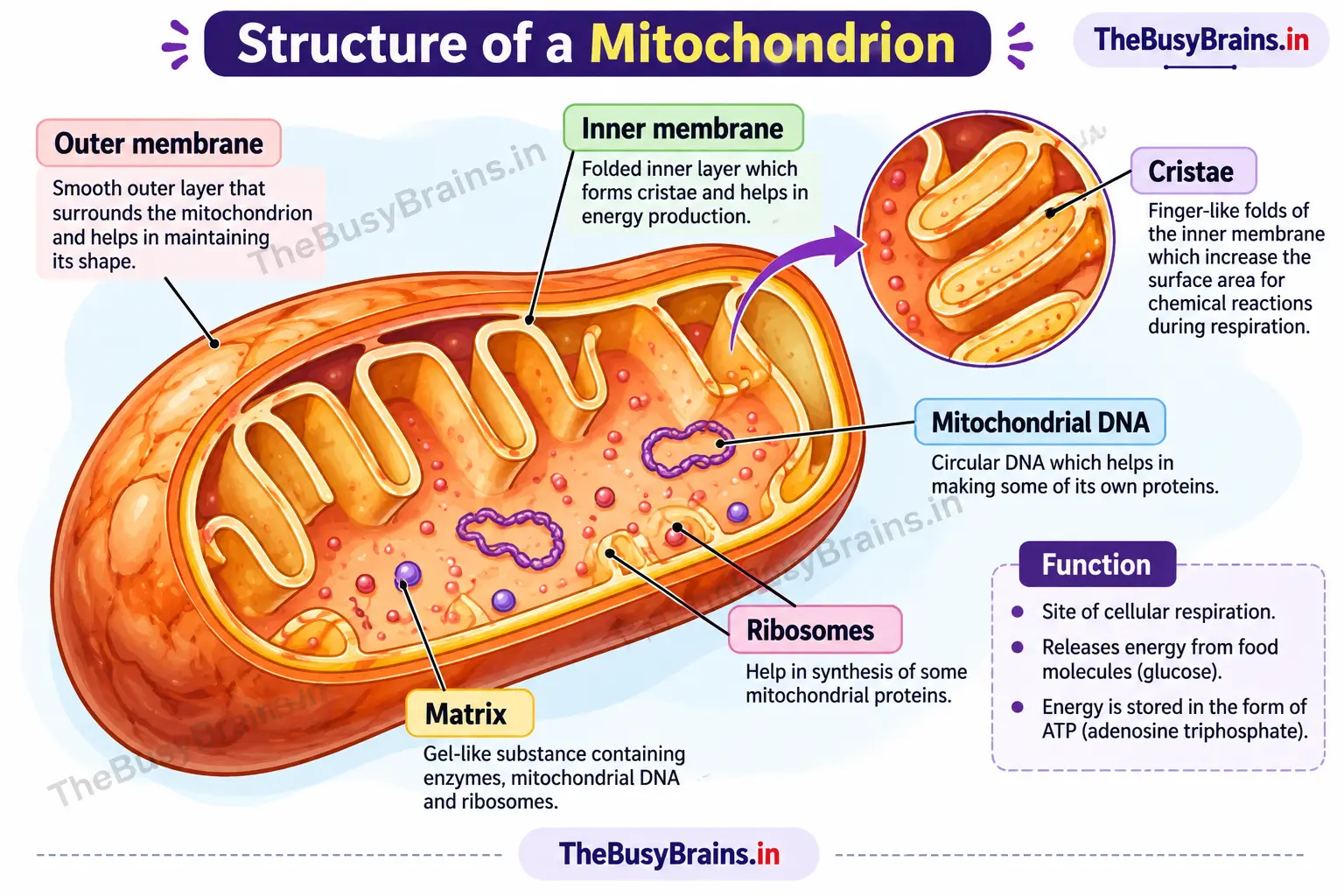
The inner membrane of a mitochondrion forms folds called cristae, which increase the surface area available for reactions involved in ATP production. The internal fluid-filled region is called the matrix.
Mitochondria contain their own DNA and ribosomes and can make some of their own proteins.
Plastids — Food Production, Colour and Storage
Plastids are found in plant cells and some other photosynthetic eukaryotes. They perform functions related to photosynthesis, colour and food storage.
- Chloroplasts: Contain chlorophyll and are the sites of photosynthesis.
- Chromoplasts: Contain pigments that contribute to the colours of many flowers and fruits.
- Leucoplasts: Generally lack pigments and help store food such as starch, oils or proteins.
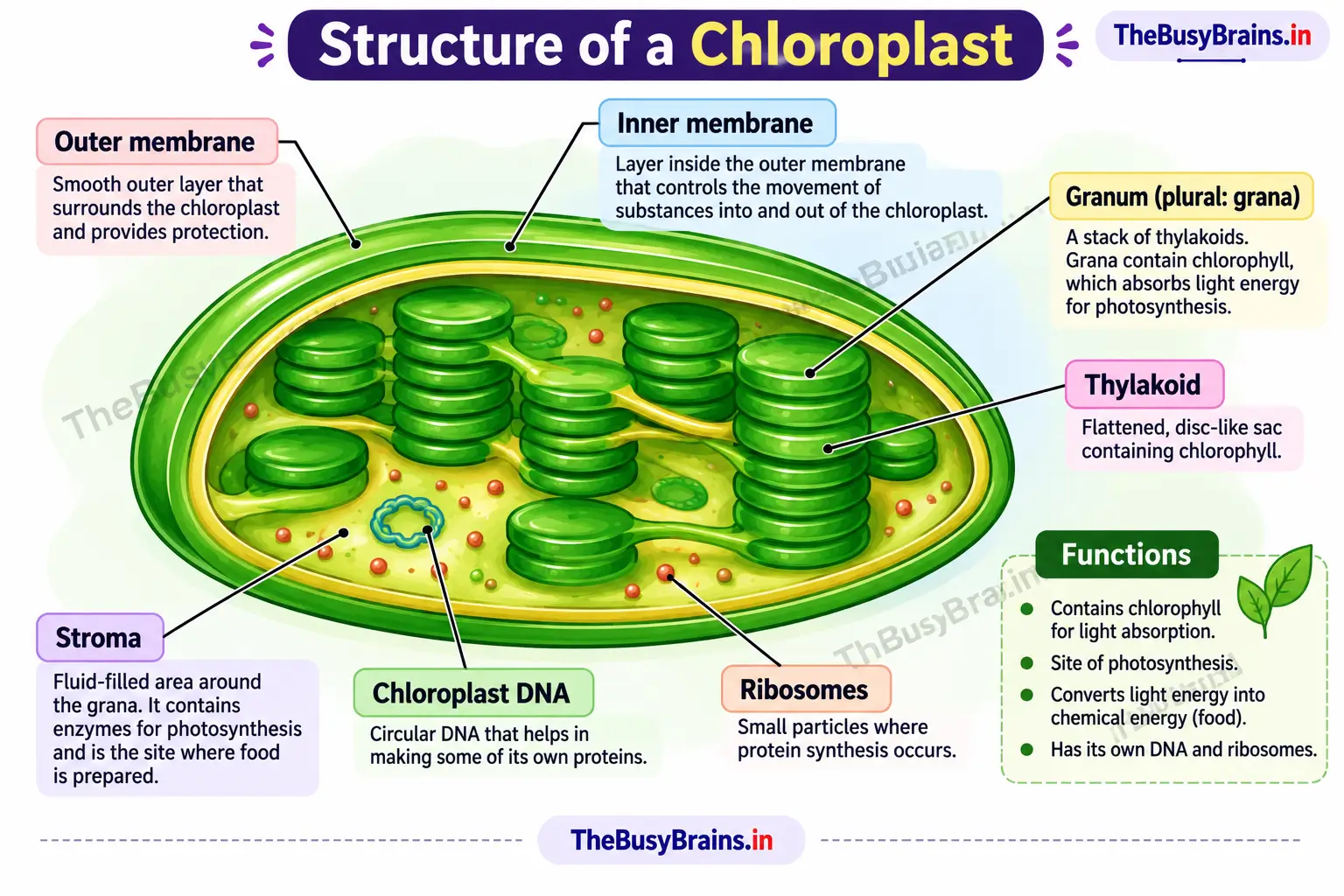
Inside chloroplasts, flattened membrane sacs called thylakoids contain chlorophyll. Stacks of thylakoids are called grana, and the fluid-filled region surrounding them is called the stroma.
Chloroplasts contain their own DNA and ribosomes and can make some of their own proteins. Photosynthesis converts light energy into chemical energy stored in organic molecules.
Vacuoles — Storage and Support
Vacuoles store materials such as water, minerals, sugars and waste products. Mature plant cells usually have a large central vacuole filled with cell sap. Water in the vacuole helps maintain internal pressure, keeping plant cells firm.
Animal cells may also contain vacuoles or other small storage compartments, but these are generally not as large as the central vacuole of a mature plant cell.
| Cell Organelle | Main Function |
|---|---|
| Nucleus | Stores most genetic material and helps regulate cell activities. |
| Ribosomes | Protein synthesis. |
| Rough ER | Protein synthesis and processing. |
| Smooth ER | Lipid synthesis and other specialised functions. |
| Golgi apparatus | Modifies, sorts and packages proteins and lipids. |
| Lysosomes | Break down unwanted materials and damaged components. |
| Mitochondria | Cellular respiration and ATP production. |
| Chloroplasts | Photosynthesis. |
| Vacuoles | Storage and, in plant cells, maintenance of firmness. |
Important Questions
- Why are mitochondria associated with energy production?
- What are cristae and matrix?
- Differentiate between rough and smooth endoplasmic reticulum.
- What are the functions of the Golgi apparatus and lysosomes?
- Differentiate between chloroplasts, chromoplasts and leucoplasts.
- What are grana, thylakoids and stroma?
- Why does a mature plant cell usually have a large central vacuole?
- Name two organelles that contain their own DNA.
Cell Division — Mitosis and Meiosis
Cell division produces new cells. It is essential for growth, repair, replacement of damaged or worn-out cells, and reproduction. Two important types of cell division are mitosis and meiosis.
Mitosis
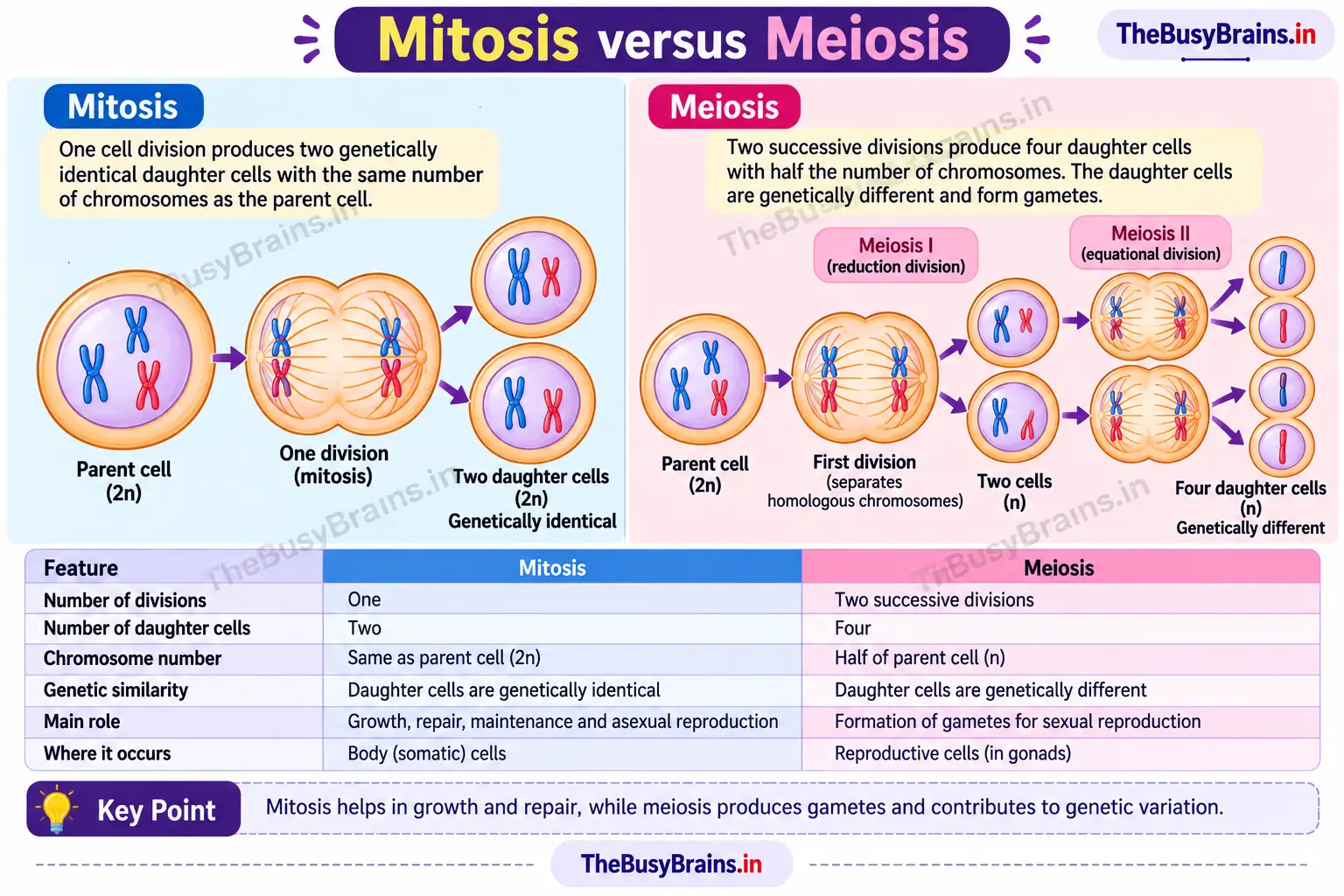
Mitosis is a type of cell division in which one parent cell produces two daughter cells that are genetically very similar to the parent cell and normally have the same chromosome number. It supports growth, repair and cell replacement.
Meiosis
Meiosis involves two successive divisions and usually produces four haploid cells from one diploid starting cell. The chromosome number is reduced by half. In animals, meiosis is involved in the formation of cells that give rise to gametes. It also contributes to genetic variation.
| Feature | Mitosis | Meiosis |
|---|---|---|
| Number of divisions | One | Two successive divisions |
| Usual number of daughter cells | Two | Four |
| Chromosome number | Usually the same as the parent cell | Reduced to half |
| Genetic similarity | Daughter cells are generally genetically identical to each other | Daughter cells are genetically varied |
| Main role | Growth, repair and cell replacement | Formation of haploid cells for sexual reproduction |
Important Questions
- What is cell division?
- Differentiate between mitosis and meiosis.
- Why is mitosis important for growth and repair?
- Why must the chromosome number be reduced during meiosis?
- How does meiosis contribute to genetic variation?
Cell Theory — The Unifying Principle of Biology
Cell theory explains the basic organisation of living organisms. The work of Matthias Schleiden, Theodor Schwann and Rudolf Virchow contributed to its development.
- Matthias Schleiden (1838): Reported that plants are made up of cells.
- Theodor Schwann (1839): Concluded that animals are also made up of cells.
- Rudolf Virchow (1855): Stated that new cells arise from pre-existing cells.
The classical cell theory states that all living organisms consist of one or more cells, the cell is the basic unit of structure and function, and all cells arise from pre-existing cells.
Cell Growth, Death and Control
Cells grow and divide in a controlled manner. In many animal cells, contact with neighbouring cells can inhibit further division. This is called contact inhibition. Loss of normal growth controls can contribute to uncontrolled cell division and tumour formation.
Programmed cell death is a controlled process through which cells that are no longer needed, or that are damaged, are removed. It also plays a role in normal development, including the removal of cells between developing fingers.
Important Questions
- State the three main points of classical cell theory.
- What contributions did Schleiden, Schwann and Virchow make to cell theory?
- What is contact inhibition?
- Why is controlled cell death important for an organism?
Quick Revision — Cell: The Building Block of Life
Practise the Chapter with a Worksheet
Test your understanding of cell structure, organelles, osmosis and cell division with the Class 9 Science worksheet.
Practise the Worksheet →Ready to Test Your Knowledge?
Practise important questions from Cell: The Building Block of Life with our Class 9 Science worksheet.
Open the Worksheet →Revise the concepts and practise before your exam.
Class 9 Science Cell Worksheet With Answers | NCERT-Based Questions - The Busy Brains
[…] Class 9 Science — Cell: The Building Block of Life Notes → SubjectScience — Biology Suggested time60 minutes Maximum marks40 marks General Instructions […]