



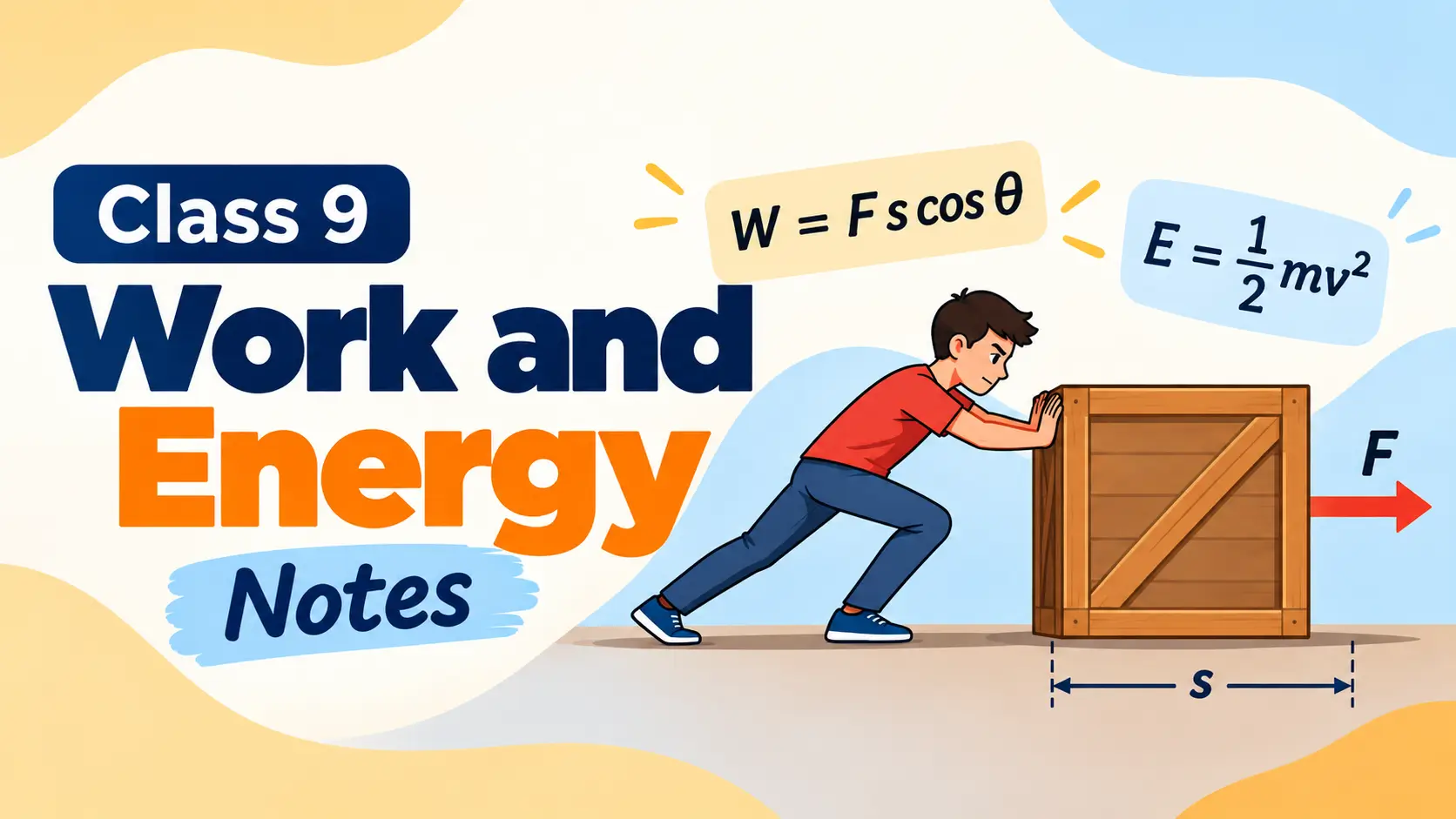
Class 9 Work and Energy Notes – Complete NCERT Revision
Are you looking for Class 9 Work and Energy Notes that explain every important concept in simple language? These comprehensive CBSE Class 9 Science Work and Energy revision notes will help you understand the scientific meaning of work, types of work, kinetic energy, potential energy, the law of conservation of energy, power and the commercial unit of electrical energy.
The chapter introduces the relationship between force, displacement, work and energy. Students learn how moving objects possess kinetic energy, how objects at a height store gravitational potential energy and how energy transforms from one form into another.
These NCERT Class 9 Work and Energy notes with formulas and diagrams include the derivation of kinetic energy, gravitational potential energy, the work–energy theorem, solved numericals and important conceptual questions.
Whether you are preparing for a Class 9 Science unit test, school examination, periodic assessment or annual examination, these notes will help you revise important definitions, SI units, equations and numerical concepts effectively.
Class 9 Work and Energy Notes
Complete Chapter Notes with Formulas, Diagrams, Derivations, Solved Numericals and Important Questions
Understand every important concept of Work and Energy with clear explanations, visual diagrams, quick revision points and exam-focused practice.
1. What Is Work in Physics?
In everyday life, we use the word work for activities that require effort. However, the scientific meaning of work is different.
Conditions Necessary for Work
- A force must act on the object.
- The object must undergo displacement.
- The force must have a component along the displacement.
Examples of Work
- Lifting a book from the floor to a table.
- Pulling a trolley so that it moves.
- Pushing a box across the floor.
- Gravity doing work on a falling object.
2. Work Done by a Force
When a constant force acts in the direction of displacement, work done is equal to the product of force and displacement.
SI unit of work: Joule (J).
One joule of work is done when a force of one newton produces a displacement of one metre in its direction.
Work is a scalar quantity.
Work Done When Force Acts at an Angle
If the force makes an angle θ with displacement, the general equation for constant force is:
For θ = 0°, the force and displacement are in the same direction, so W = Fs.
For θ = 90°, work done is zero.
3. Positive, Negative and Zero Work
Positive Work
Force and displacement act in the same direction.
Example: A person pushing a trolley forward.
W > 0
Negative Work
Force and displacement act in opposite directions.
Example: Friction acting on a sliding box.
W < 0
Zero Work
Displacement is zero, or force is perpendicular to displacement.
Example: Holding a stationary bag.
W = 0
Same direction → Positive work
Opposite direction → Negative work
Perpendicular force → Zero work
4. What Is Energy?
The SI unit of energy is the joule (J).
Energy exists in different forms, including mechanical, thermal, chemical, electrical, light and sound energy.
Mechanical Energy
Mechanical energy is associated with the motion and position or configuration of an object.
Kinetic Energy
Energy due to motion.
Examples: moving car, rolling ball, flowing water.
Potential Energy
Energy due to position or configuration.
Examples: raised stone, stretched spring, water stored at a height.
5. Kinetic Energy – Formula and Derivation
The energy possessed by an object because of its motion is called kinetic energy.
Derivation of Kinetic Energy
Consider an object of mass m moving with initial velocity u. A constant net force F accelerates it to velocity v through displacement s.
According to Newton's second law:
Work done by the net force:
Using the equation of motion:
Therefore:
Substituting:
Hence:
If the object starts from rest, u = 0:
Wnet = ΔK.E.
Factors Affecting Kinetic Energy
- Kinetic energy is directly proportional to mass.
- Kinetic energy is directly proportional to the square of speed.
- If mass doubles, kinetic energy doubles at constant speed.
- If speed doubles, kinetic energy becomes four times.
- If speed triples, kinetic energy becomes nine times.
6. Gravitational Potential Energy
The energy possessed by an object due to its position in a gravitational field is called gravitational potential energy.
Derivation of Gravitational Potential Energy
Consider an object of mass m raised slowly through a vertical height h near Earth's surface.
The gravitational force acting downward is:
The work done by the lifting force against gravity is:
Substituting F = mg:
This work increases the object's gravitational potential energy.
Here, h is measured relative to the chosen reference level, where potential energy is taken as zero.
7. Transformation and Conservation of Energy
Transformation of Energy
The conversion of energy from one form into another is called energy transformation.
| Example | Energy Transformation |
|---|---|
| Falling stone | Potential → Kinetic |
| Electric fan | Electrical → Mechanical + Thermal + Sound |
| Electric bulb | Electrical → Light + Thermal |
| Hydroelectric station | Gravitational Potential → Kinetic → Electrical |
| Thermal power station | Chemical → Thermal → Mechanical → Electrical |
| Photosynthesis | Light → Chemical |
Law of Conservation of Energy
Conservation of Energy During Free Fall
When an object falls freely under gravity, neglecting air resistance, its gravitational potential energy decreases and its kinetic energy increases.
8. Power – Definition, Formula and SI Unit
Power is the rate of doing work or the rate at which energy is transferred.
SI unit: Watt (W).
One watt is the power when one joule of work is done in one second.
Average Power
Other useful units:
- 1 kW = 1000 W
- 1 MW = 10⁶ W
9. Commercial Unit of Electrical Energy
The commercial unit of electrical energy is the kilowatt-hour (kWh).
One kilowatt-hour is the energy consumed by a 1 kW appliance operating for one hour.
kW = unit of power
kWh = unit of energy
10. Class 9 Work and Energy Solved Numericals
These solved Work and Energy numerical questions demonstrate the correct method of writing given values, formula, substitution, calculation and SI units.
Numerical 1: Work Done
Question: A force of 25 N moves a box through 4 m in the direction of force. Calculate the work done.
Given: F = 25 N, s = 4 m
Formula: W = Fs
Solution: W = 25 × 4
Numerical 2: Kinetic Energy
Question: Calculate the kinetic energy of a 4 kg object moving at 3 m/s.
Given: m = 4 kg, v = 3 m/s
Formula: K.E. = ½mv²
Solution: ½ × 4 × 3²
Numerical 3: Potential Energy
Question: A 5 kg object is raised to a height of 4 m. Calculate its increase in potential energy. Take g = 10 m/s².
Given: m = 5 kg, h = 4 m, g = 10 m/s²
Formula: P.E. = mgh
Solution: 5 × 10 × 4
Numerical 4: Power
Question: A machine does 1200 J of work in 20 seconds. Calculate its average power.
Given: W = 1200 J, t = 20 s
Formula: P = W/t
Solution: 1200/20
Numerical 5: Electrical Energy
Question: A 2 kW heater runs for 3 hours. Find the electrical energy consumed.
Formula: Energy = Power × Time
Solution: 2 kW × 3 h
In joules:
Given → Formula → Substitution → Calculation → Unit
11. Class 9 Work and Energy Important Formulas
| Concept | Formula | Unit |
|---|---|---|
| Work | W = Fs (same direction) | J |
| Work at angle | W = Fs cos θ | J |
| Work against gravity | W = mgh | J |
| Kinetic energy | K.E. = ½mv² | J |
| Gravitational potential energy | P.E. = mgh | J |
| Mechanical energy | ME = KE + PE | J |
| Net work–energy theorem | Wnet = ΔKE | J |
| Average power | P = W/t | W |
| Watt | 1 W = 1 J/s | W |
| Kilowatt | 1 kW = 1000 W | kW |
| Electrical energy | E = Pt | J or kWh |
| Kilowatt-hour | 1 kWh = 3.6 × 10⁶ J | kWh |
12. Common Mistakes in Work and Energy
- Work is not always positive. It can be positive, negative or zero.
- Force alone is not enough. Displacement in the appropriate direction is required.
- Kinetic energy depends on v², not v.
- mgh is gravitational potential energy, not the formula for every kind of potential energy.
- Net work equals change in kinetic energy. Do not confuse net work with the work of one force.
- kWh measures energy, not power.
- Mechanical energy is not always conserved. Friction and air resistance can transform mechanical energy into other forms.
- Always convert units before substituting into an SI-based formula.
13. Important Work and Energy Questions for Class 9
Test your understanding with these Class 9 Work and Energy important questions. Try answering before opening the solutions.
Q1. Define one joule of work.
Q2. Why is work done zero when a person pushes a stationary wall?
Q3. What happens to kinetic energy when speed doubles?
Q4. State the law of conservation of energy.
Q5. What is the SI unit of power?
Q6. Calculate work done by a force of 10 N through 6 m in its direction.
Q7. Why does a falling stone gain kinetic energy?
Q8. What is the difference between kW and kWh?
14. Frequently Asked Questions – Class 9 Work and Energy
What are the main topics in Class 9 Work and Energy?
Important topics include work, positive and negative work, kinetic energy, potential energy, conservation of energy, power and commercial energy units.
What is the formula for work in Class 9?
When force and displacement are in the same direction, W = F × s. For a constant force acting at an angle, W = Fs cos θ.
What is the formula for kinetic energy?
Kinetic energy is calculated using KE = ½mv², where m is mass and v is speed.
What is the formula for potential energy?
Gravitational potential energy near Earth's surface is PE = mgh.
How can I prepare Work and Energy numericals?
Learn the formulas, understand the meaning of each quantity, convert values into appropriate units and practise questions involving work, KE, PE and power.
Why is 1 kWh equal to 3.6 × 10⁶ joules?
Because 1 kW = 1000 W and 1 hour = 3600 seconds, so 1000 × 3600 = 3,600,000 J.
15. One-Minute Work and Energy Revision
Work: Force × displacement in the same direction.
Kinetic Energy: Energy due to motion.
Potential Energy: Energy due to position or configuration.
Conservation of Energy: Total energy remains constant in an isolated system.
Power: Rate of doing work.
Commercial Energy Unit: kWh.
To score well in Class 9 Science, understand the concepts instead of memorising formulas alone. Practise derivations, numerical questions, diagrams and application-based problems regularly.
Practise Class 9 Work and Energy Questions
Finished revising the chapter? Test your preparation with our Class 9 Work and Energy Worksheet containing chapter-based practice questions.
Get Work and Energy Worksheet →Subscribe to Our YouTube Channel
Want more Class 9 Science explanations, solved numericals, NCERT questions and exam revision videos?
Subscribe to our YouTube channel for educational videos and step-by-step solutions.
▶ Subscribe on YouTube
Class-9-work-and-energy-worksheet - The Busy Brains
[…] Class 9 Work and Energy Notes […]