



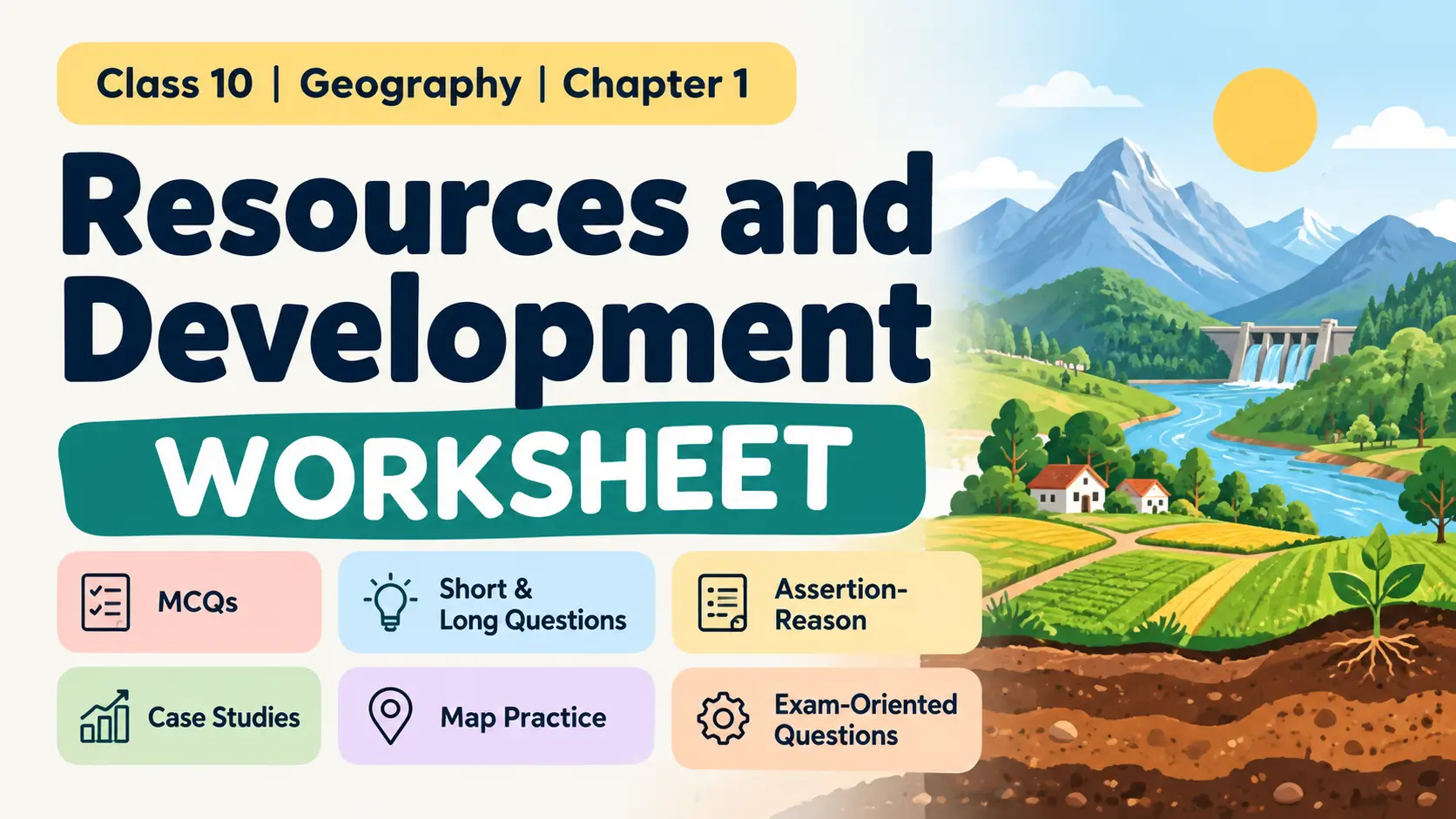
Class 10 Resources and Development: Important Questions
Looking for Class 10 Geography Chapter 1 important questions? This NCERT-style worksheet from The Busy Brains is designed to help students prepare for CBSE Social Science examinations. It covers the major concepts from Resources and Development in Contemporary India–II, including resource classification, sustainable development, resource planning in India, land use, land degradation, soil types, soil erosion and soil conservation.
Practise these NCERT-style questions for Class 10 Geography to revise definitions, explain geographical processes, compare concepts and apply your knowledge to case-based situations. The worksheet includes MCQs, assertion–reason questions, short-answer questions, long-answer questions, competency-based questions and map practice.
Important: These questions are intended for exam-oriented revision. They are not guaranteed predictions of the questions that will appear in the actual board examination.
Resources and Development
Chapter 1 | NCERT-Style Important Questions & Exam Practice Worksheet
Revise key concepts, practise board-style questions and strengthen your Geography exam preparation.
Multiple-Choice Questions (MCQs)
1. Which of the following best defines a resource?
2. Which classification is based on the origin of resources?
3. Which of the following is a non-renewable resource?
4. Which is an example of a community-owned resource?
5. The Rio de Janeiro Earth Summit was held in:
6. Which of the following is a major step in resource planning?
7. Which state is rich in solar and wind energy but deficient in water resources?
8. Which activity is a major cause of land degradation in Punjab, Haryana and western Uttar Pradesh?
9. Which soil is widespread in the northern plains of India?
10. Which soil is well known for its moisture-retaining capacity and suitability for cotton?
11. Which soil develops due to intense leaching under heavy rainfall?
12. Deep channels formed by running water in clayey soil are associated with:
Assertion–Reason Questions
13. Assertion (A): Resource planning is essential in India. Reason (R): Resources are unevenly distributed across different regions.
14. Assertion (A): Mere availability of resources guarantees regional development. Reason (R): Technology and institutions also influence resource development.
15. Assertion (A): Black soil is suitable for cotton cultivation. Reason (R): Black soil has a high capacity to retain moisture.
16. Assertion (A): Contour ploughing helps reduce soil erosion on slopes. Reason (R): It slows down the flow of water along a slope.
Very Short-Answer Questions
17. Define a resource. Mention the conditions that make something a resource.
18. What is sustainable development?
19. What is Agenda 21? State its main objective.
20. What is resource conservation?
21. Differentiate between current fallow land and other than current fallow land.
22. Define net sown area and gross cropped area.
23. What is soil erosion? Name one human activity that accelerates it.
24. What are Bangar and Khadar?
Short-Answer Questions
25. Classify resources on the basis of origin, exhaustibility, ownership and status of development. Give examples.
26. Explain three problems caused by the indiscriminate use of resources.
27. Describe the three major stages of resource planning in India.
28. Why can a resource-rich region remain economically backward? Explain with examples.
29. Explain three physical and human factors that determine land-use patterns.
30. Explain three causes of land degradation in India, giving regional examples.
31. Describe the characteristics of alluvial soil and explain its agricultural importance.
32. Differentiate between Bangar and Khadar on the basis of age and fertility.
33. State three characteristics of black soil. Why is it called black cotton soil?
34. Distinguish between sheet erosion and gully erosion.
35. Explain three methods of soil conservation suitable for hilly or arid areas.
Long-Answer Questions
36. “Resource planning is essential for sustainable development.” Justify the statement.
37. Explain the land-use pattern in India. Why has the area under forests not increased sufficiently?
38. How have technological and economic development increased resource consumption? Explain the problems caused by overuse.
39. Describe the major soil types of India and explain the characteristics of any four.
40. Explain the causes of soil erosion and describe methods of soil conservation.
Case-Based and Competency Questions
Case Study 1: Uneven Distribution of Resources
India has regions with different resource endowments. Jharkhand, Chhattisgarh and Madhya Pradesh are rich in minerals and coal. Rajasthan has strong solar and wind energy potential but faces water scarcity. Arunachal Pradesh has abundant water resources but lacks adequate infrastructure.
41(a). Why is resource planning important for India? (1)
41(b). State one resource advantage and one challenge faced by Rajasthan. (1)
41(c). Why does resource availability alone not guarantee economic development? (2)
Case Study 2: Land Degradation
Continuous use of land without conservation measures can degrade its quality. Overgrazing, mining and improper disposal of industrial waste damage land. In parts of Punjab, Haryana and western Uttar Pradesh, over-irrigation can cause waterlogging and increase soil salinity and alkalinity.
42(a). State one effect of over-irrigation on soil. (1)
42(b). Name one other human activity that causes land degradation. (1)
42(c). Suggest two measures to reduce land degradation. (2)
Case Study 3: Soil and Agriculture
Alluvial soil is widespread in the northern plains and in the deltas of major eastern coastal rivers. It contains varying proportions of sand, silt and clay. Older alluvium is called Bangar, while newer alluvium is called Khadar. Black soil is clayey and has a high capacity to retain moisture.
43(a). Which soil is widespread in the northern plains? (1)
43(b). Which is newer: Bangar or Khadar? (1)
43(c). Explain how a property of black soil supports cotton cultivation. (2)
Case Study 4: Soil Erosion
Deforestation, overgrazing, construction and mining can accelerate soil erosion. Running water may cut deep channels, while water flowing as a sheet can remove topsoil. Conservation practices include contour ploughing, terrace cultivation, strip cropping and shelter belts.
44(a). What is the removal of topsoil by water flowing over a large area called? (1)
44(b). How do shelter belts help conserve soil? (1)
44(c). Explain two soil conservation methods suitable for slopes. (2)
Application-Based Questions
45. Differentiate between renewable and non-renewable resources with examples.
46. Differentiate between potential resources and developed resources.
47. A village faces falling groundwater levels and soil erosion. Suggest a practical resource conservation plan involving community participation.
48. A farmer ploughs straight up and down a hill slope. Explain why this may increase soil erosion and suggest a better method.
49. Why is land considered a finite resource? Suggest two ways to use it sustainably.
50. “Resource conservation is both an environmental and a social concern.” Explain.
Map, Diagram and Visual-Based Questions
51. Locate and label Maharashtra, a state associated with extensive black soil.
52. Mark the northern plains where alluvial soils are widespread.
53. Locate Rajasthan and state one feature of its resource endowment.
54. Draw a soil profile and label topsoil, subsoil, substratum and unweathered parent bedrock.
55. Draw or describe gully erosion and state one consequence for cultivation.
56. Refer to the land-use charts in the NCERT chapter. Write two observations about changes between 1960–61 and 2019–20 and one reason why forest area has not increased sufficiently.
Rapid Revision: Important Keywords
Resource, biotic, abiotic, renewable resources, non-renewable resources, individual resources, community resources, national resources, international resources, potential resources, developed resources, stock, reserves, sustainable development, Agenda 21, resource planning, resource conservation, net sown area, gross cropped area, fallow land, land degradation, alluvial soil, Bangar, Khadar, Regur, leaching, soil erosion, gully erosion, sheet erosion, contour ploughing, terrace cultivation, strip cropping and shelter belts.
Self-Assessment Checklist
☐ I can classify resources with examples.
☐ I can explain sustainable development and resource planning.
☐ I can describe land-use categories and causes of land degradation.
☐ I can compare the major soil types of India.
☐ I can explain soil erosion and methods of soil conservation.
This worksheet is based on the supplied NCERT chapter, including its text, examples and visual material. Answers are not included so students can practise independently.
Board Exams Are Coming!
Revise smarter. Feel more confident.
Short on time before your Board Exams? Explore our Social Science Quick Revision Notes to revise important concepts, key points and exam-ready topics.
Explore Quick Revision Notes →