

Journey Inside the Atom – Class 9 Science Notes
Chapter Overview
Everything around us, from the air we breathe to the books we read and the devices we use, is made up of matter. Matter, in turn, consists of tiny particles called atoms. Although atoms are too small to be seen with the naked eye, their structure explains many of the properties of materials.
In this chapter, we explore how scientists discovered the particles inside atoms, how atomic models developed, and how atomic number, mass number, electronic configuration, valency and isotopes help us understand the behaviour of elements.
Understanding the Basic Idea of an Atom
An atom is the basic building block of an element. All matter is made up of atoms, either individually or combined with other atoms to form molecules and compounds.
For a long time, scientists believed that atoms were indivisible. Later experiments revealed that atoms contain even smaller particles called subatomic particles.
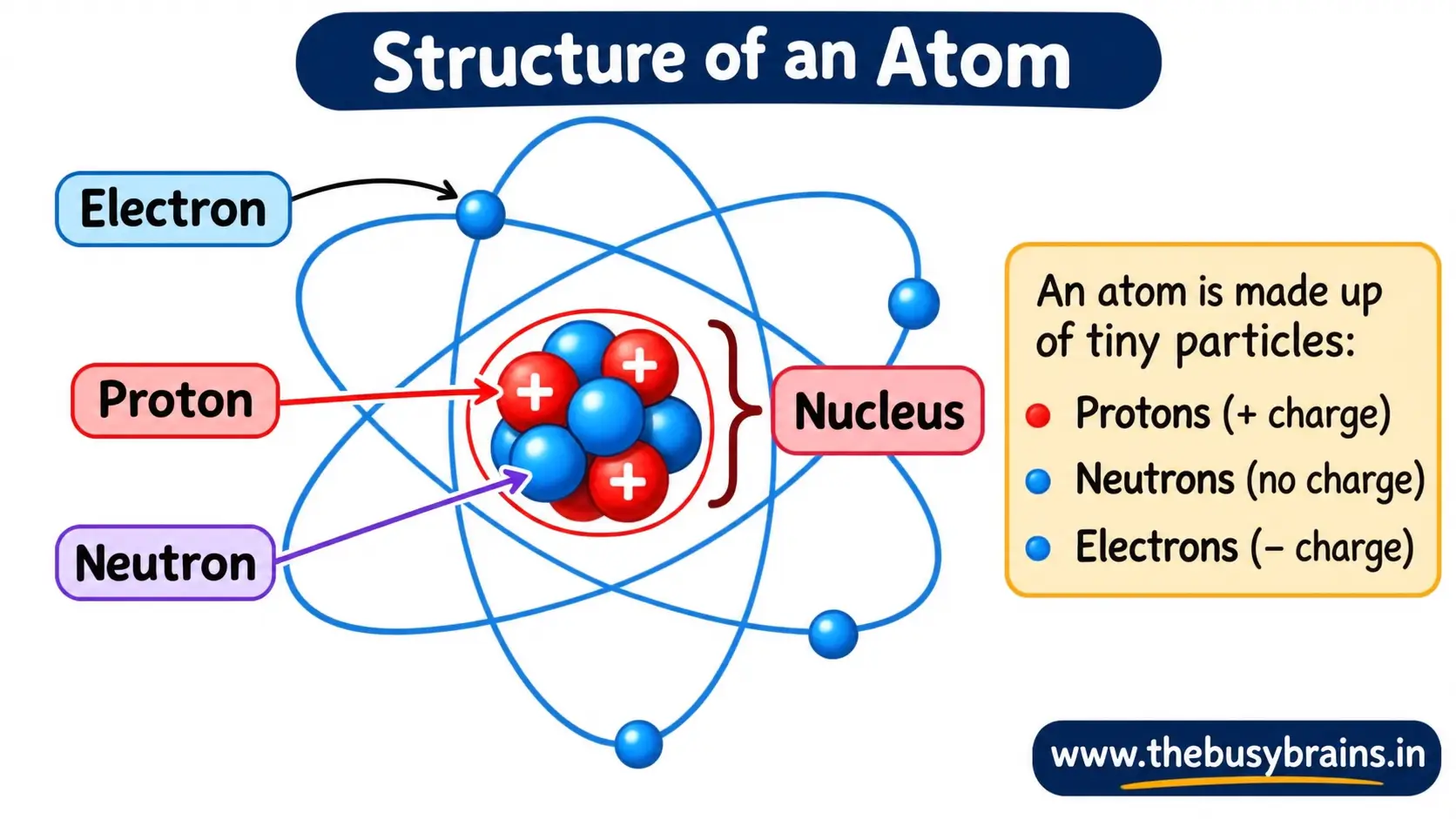
The three main subatomic particles are:
- Electrons: Negatively charged particles present outside the nucleus.
- Protons: Positively charged particles present inside the nucleus.
- Neutrons: Electrically neutral particles present inside the nucleus of almost all atoms.
An ordinary atom is electrically neutral because its total positive charge is equal to its total negative charge.
- What is an atom?
- Name the three main subatomic particles and state their charges.
- Why is an atom electrically neutral?
- Where are protons, neutrons and electrons located in an atom?
Rediscovering the Roots of Atomic Theory
The idea that matter is made up of tiny particles is very old. Ancient Indian and Greek thinkers independently considered whether matter could be divided endlessly or whether there was a smallest possible particle.
Acharya Kanada
Acharya Kanada, an ancient Indian philosopher, proposed that if matter were divided repeatedly, a stage would eventually be reached where it could no longer be divided. He called these smallest particles parmanus.
His ideas are recorded in the Sanskrit text Vaisheshika Sutras. According to his explanation, parmanus could combine to form dyads (groups of two) and triads (groups of three), which eventually gave rise to the material world.
Leucippus and Democritus
Greek philosophers Leucippus and Democritus also suggested that matter consisted of indivisible particles. They used the word atomos, meaning indivisible.
John Dalton's Atomic Theory
In 1808, John Dalton proposed an atomic theory based on the scientific experiments of his time. He suggested that:
- All matter is made up of tiny particles called atoms.
- Atoms were considered indivisible and could not be broken into smaller parts.
- Atoms were regarded as the fundamental building blocks of matter.
Dalton's theory was the first scientific description of the atomic nature of matter. However, later discoveries showed that atoms are divisible and contain smaller particles.
- Who was Acharya Kanada? What name did he give to the smallest particles of matter?
- What is the meaning of the Greek word atomos?
- Describe the contribution of Leucippus and Democritus to atomic theory.
- State the main idea of Dalton's atomic theory.
- How was Dalton's theory different from the earlier philosophical ideas about atoms?
Development of Atomic Models
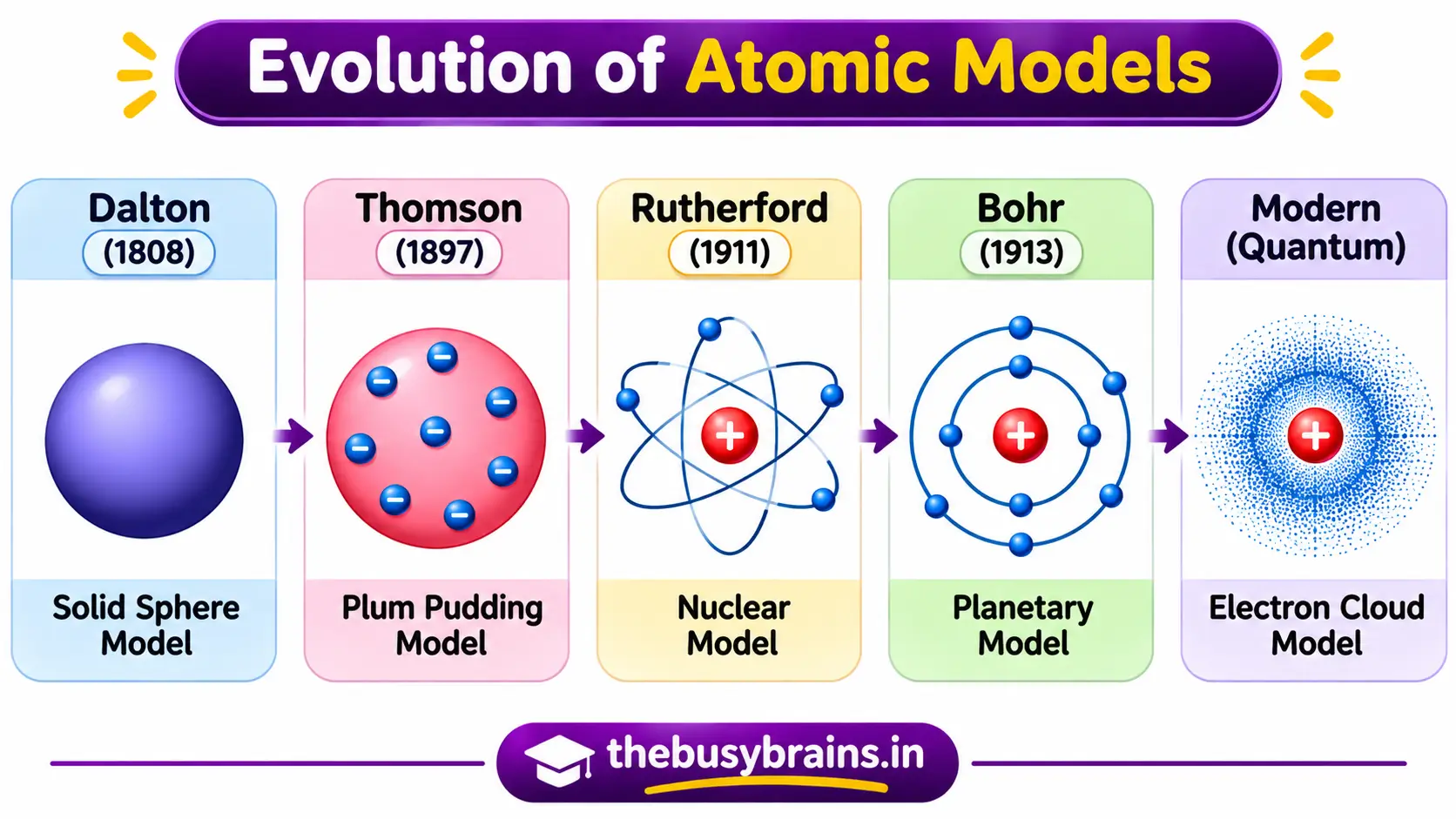
Scientists could not directly observe the internal structure of an atom. Instead, they performed experiments and proposed models to explain their observations.
Whenever new experimental evidence contradicted an existing model, scientists modified their understanding. This is why atomic models changed over time.
Discovery of the Electron – J. J. Thomson
In 1897, J. J. Thomson studied the conduction of electricity through gases at very low pressure using a discharge tube.
He observed rays travelling from the negatively charged cathode towards the positively charged anode. These rays were called cathode rays.
By studying their behaviour in electric and magnetic fields, Thomson concluded that cathode rays consisted of negatively charged particles. These particles were later named electrons.
His experiments established that:
- Electrons carry a negative charge.
- They have a much smaller mass than atoms.
- Cathode rays are made up of electrons.
- The nature of cathode rays does not depend on the gas used or the material of the cathode.
- Electrons are present in atoms of all elements.
Its relative charge is taken as −1.
Thomson's Model of the Atom
After discovering electrons, Thomson faced an important question: if atoms contain negatively charged electrons, why are atoms electrically neutral?
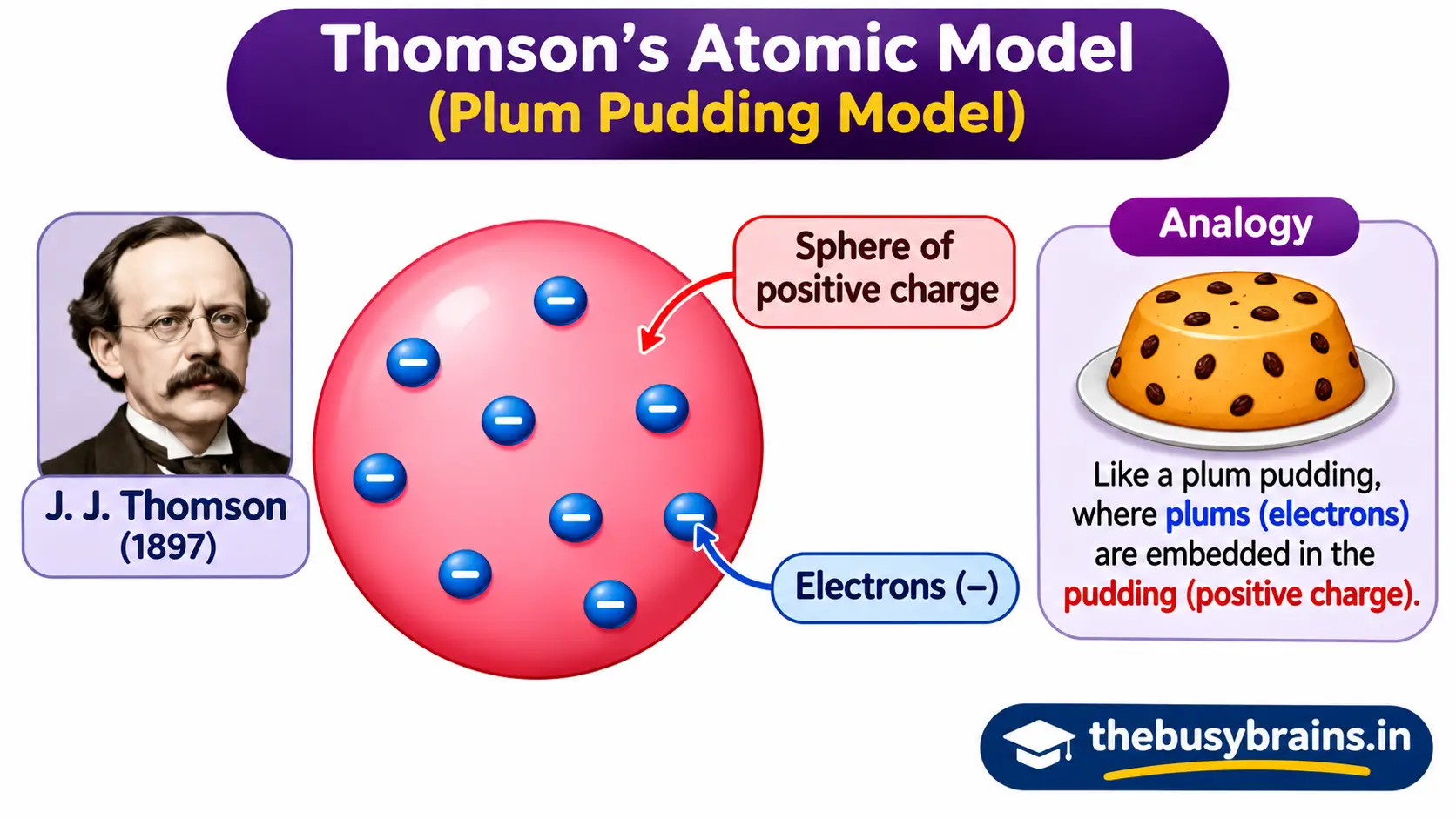
He proposed that an atom is a sphere of positive charge with negatively charged electrons embedded throughout it.
This model is commonly known as the plum pudding model. A watermelon is another useful comparison: the red pulp represents the positively charged matter, while the seeds represent the electrons.
According to Thomson, the positive and negative charges balance each other, making the atom electrically neutral.
- Who discovered the electron and in which year?
- What are cathode rays? How were they produced?
- Why did Thomson propose a positively charged sphere?
- Explain Thomson's atomic model with the help of the plum pudding or watermelon analogy.
- Why is Thomson's model also called the plum pudding model?
- How did Thomson establish that electrons are present in all atoms?
Rutherford's Gold Foil Experiment
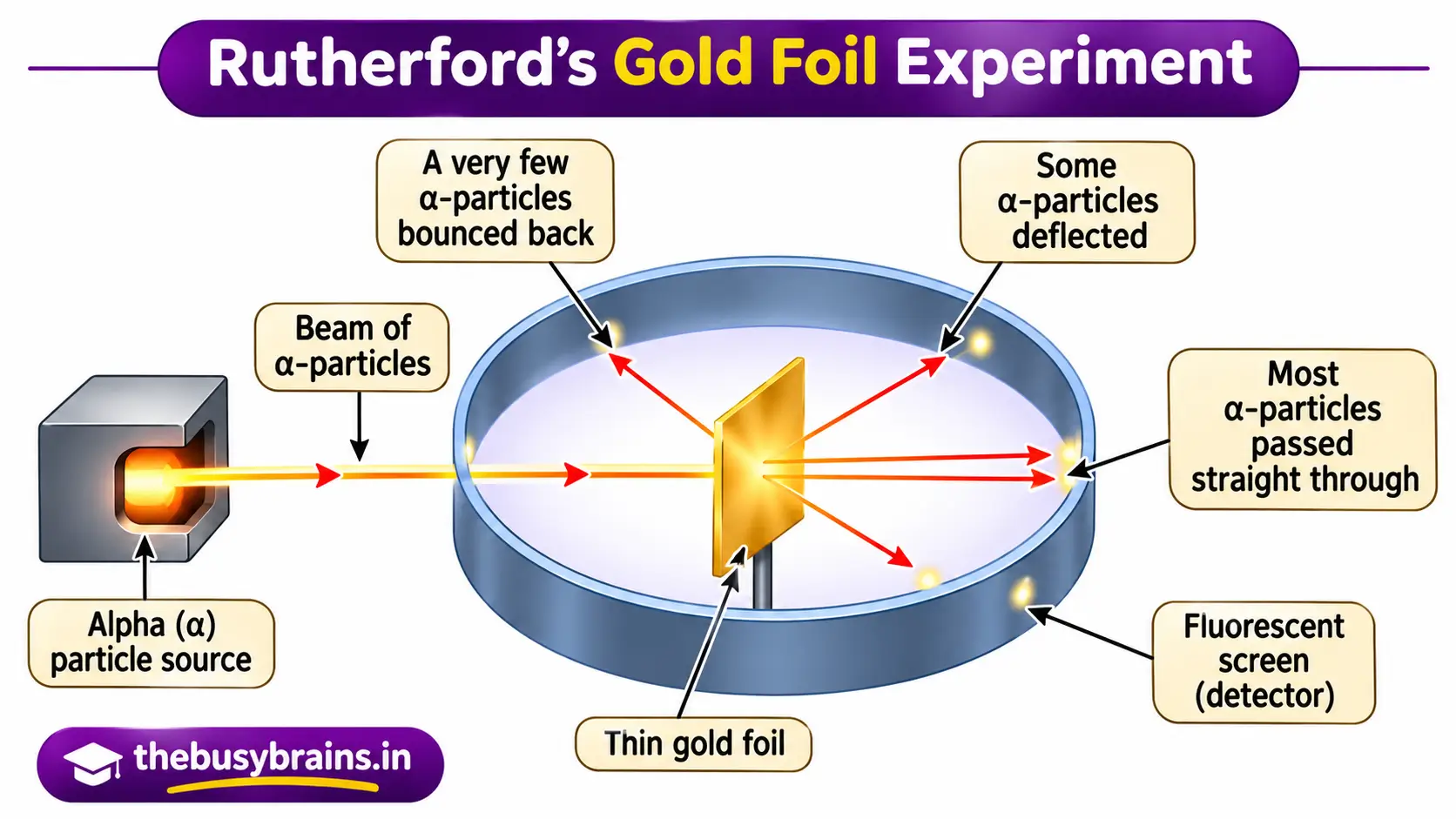
In 1911, Ernest Rutherford, with the help of Geiger and Marsden, tested Thomson's atomic model through an experiment using a very thin sheet of gold foil.
A narrow beam of positively charged alpha (α) particles was directed towards the gold foil. Alpha particles are positively charged particles emitted by certain radioactive elements.
Observations
- Most alpha particles passed straight through the gold foil without any deflection.
- Some alpha particles were deflected through small or large angles.
- A very small number of alpha particles bounced back towards the source.
The change in the direction of a particle from its original path is called scattering. Therefore, this experiment is also known as the alpha-ray scattering experiment.
Conclusions Drawn by Rutherford
Most of the atom is empty space. Since most alpha particles passed straight through the foil, Rutherford concluded that most of the volume of an atom contains empty space.
Positive charge is concentrated in a small region. The deflection of positively charged alpha particles showed that the positive charge is not spread uniformly throughout the atom. It is concentrated in a tiny central region called the nucleus.
The nucleus is dense and massive. The few particles that bounced back indicated that the nucleus is extremely dense and contains most of the atom's mass.
Electrons revolve around the nucleus. Rutherford proposed that electrons move around the positively charged nucleus.
Size of the Atom and Its Nucleus
Rutherford estimated that the diameter of an atom is approximately 10−10 m, whereas the diameter of its nucleus is approximately 10−15 m.
Diameter of nucleus ≈ 10−15 m
The nucleus is therefore about 100,000 times smaller in diameter than the atom.
- Describe Rutherford's gold foil experiment and its observations.
- Why did most alpha particles pass through the gold foil without deflection?
- What did the deflection of a few alpha particles indicate?
- Why did some alpha particles bounce back?
- What conclusions did Rutherford draw about the structure of an atom?
- Why is most of an atom considered empty space?
- Differentiate between Thomson's model and Rutherford's model.
Rutherford's Atomic Model and Its Limitation
Based on the gold foil experiment, Rutherford proposed the nuclear or planetary model of the atom.
According to this model:
- An atom contains a tiny, dense nucleus at its centre.
- The nucleus contains all the positive charge and most of the mass of the atom.
- Electrons revolve around the nucleus.
- Most of the space inside an atom is empty.
Why Did Rutherford's Model Fail to Explain Atomic Stability?
According to classical physics, a charged particle moving in a circular path is accelerating because its direction of motion continuously changes.
An electron revolving around the nucleus is therefore an accelerating charged particle. It should continuously lose energy while moving around the nucleus.
If the electron loses energy, its orbit should gradually shrink. Eventually, it would spiral towards the nucleus and fall into it.
However, atoms are stable and do not collapse. Since Rutherford's model could not explain this stability, scientists needed another model.
- Explain Rutherford's planetary model of an atom.
- What is the major limitation of Rutherford's atomic model?
- Why should a revolving electron lose energy according to classical physics?
- Why would the continuous loss of energy make an atom unstable?
- How did Rutherford's model differ from the actual behaviour of stable atoms?
Discovery of the Proton
Rutherford established that the nucleus carries a positive charge. This positive charge is due to positively charged particles called protons.
Protons are much heavier than electrons and carry a charge equal in magnitude but opposite in sign to that of an electron.
For an electrically neutral atom, the number of protons must equal the number of electrons.
For example:
| Atom | Protons | Electrons | Net charge |
|---|---|---|---|
| Helium | 2 | 2 | 0 |
| Sodium | 11 | 11 | 0 |
| Hydrogen | 1 | 1 | 0 |
- What are protons? Where are they located?
- Compare the charge of a proton with that of an electron.
- How many protons and electrons are present in a neutral sodium atom?
- Why must the number of protons equal the number of electrons in a neutral atom?
Bohr's Model of the Atom
In 1913, Niels Bohr proposed a new atomic model to explain why atoms are stable. He modified Rutherford's model by introducing the concept of fixed energy levels.
According to Bohr:
- Electrons revolve around the nucleus in fixed circular paths called orbits, shells or stationary states.
- Each shell has a definite amount of energy. Hence, shells are also called energy levels.
- Electrons can exist only in these permitted energy levels and not in between them.
- Electrons do not lose energy while moving in a fixed stationary shell.
- Energy increases as the distance of a shell from the nucleus increases.
- Electrons can move from one energy level to another by absorbing or releasing a fixed amount of energy.
Naming of Energy Levels
The shells are represented by the letters K, L, M, N and so on. They can also be represented by the principal quantum numbers n = 1, 2, 3, 4 and so on.
| Shell | Energy level (n) | Position |
|---|---|---|
| K | 1 | Closest to the nucleus |
| L | 2 | Second shell |
| M | 3 | Third shell |
| N | 4 | Fourth shell |
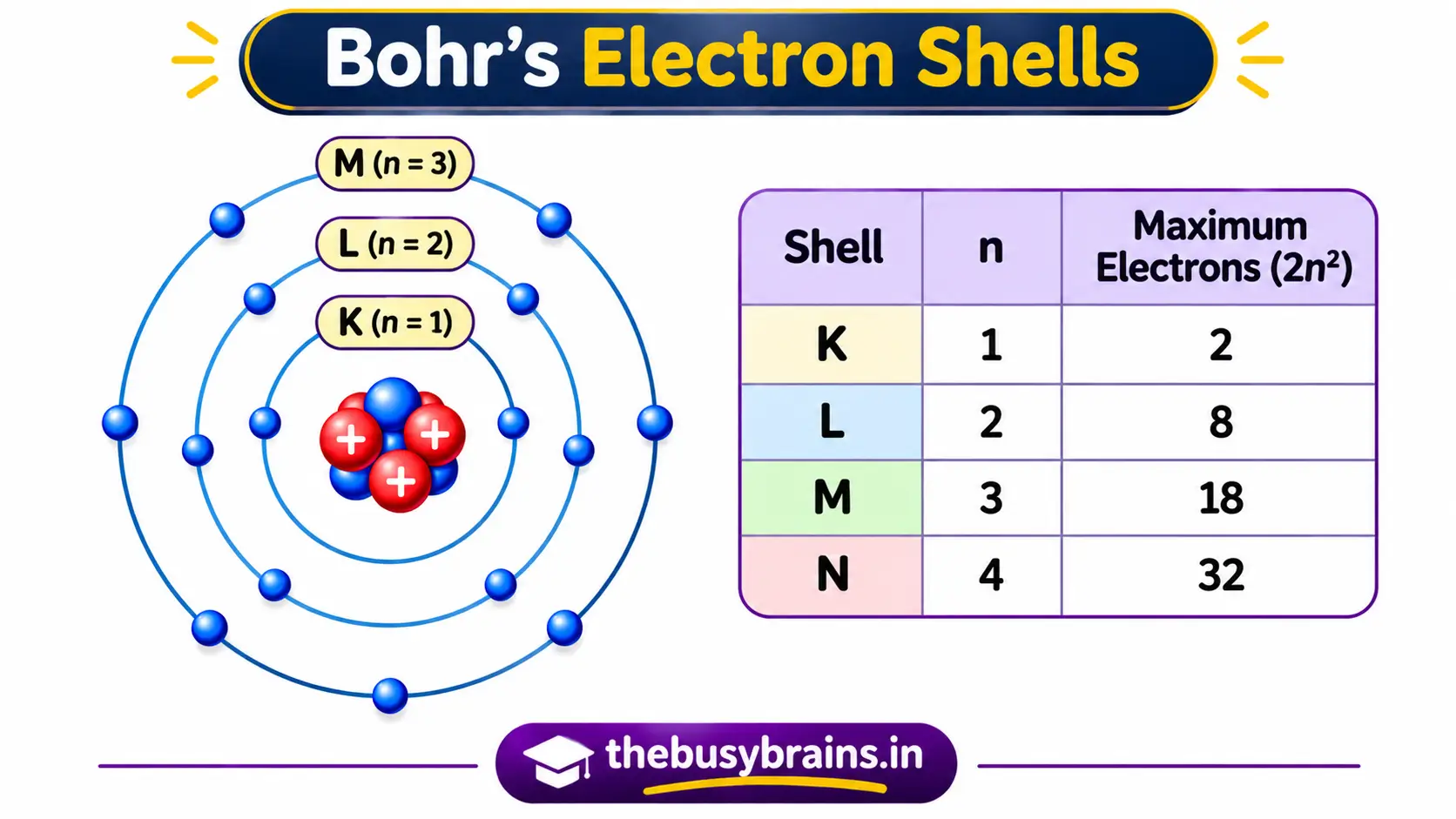
The K-shell has the least energy. The energy of electrons increases as we move towards the outer shells.
How Does Bohr's Model Explain Atomic Stability?
Bohr suggested that electrons moving in permitted stationary states do not continuously lose energy. Therefore, they do not spiral into the nucleus. This explained why atoms can remain stable.
Bohr's model successfully explained several observations, although it was later found to have limitations. The modern quantum mechanical model provides a more complete explanation of atomic structure.
- Who proposed Bohr's atomic model and in which year?
- What are stationary states or energy levels?
- Why are Bohr's shells also called energy levels?
- Arrange the K, L, M and N shells in increasing order of energy.
- How does Bohr's model explain the stability of an atom?
- What happens when an electron absorbs or releases energy?
- Differentiate between Rutherford's and Bohr's atomic models.
Discovery of the Neutron
Scientists noticed that the mass of an atom could not be explained by considering only its protons. For example, a helium atom has two protons, but its mass is approximately four times that of a hydrogen atom.
This suggested that another particle must be present inside the nucleus, contributing to the mass without adding any electrical charge.
In 1932, James Chadwick discovered a new subatomic particle called the neutron.
Important characteristics of neutrons:
- Neutrons have no electrical charge.
- Their mass is nearly equal to that of a proton.
- They are present in the nucleus of atoms, except ordinary hydrogen (protium).
- They contribute significantly to the mass of an atom.
Why Are Neutrons Important?
Protons carry positive charges and repel one another. Neutrons help provide nuclear stability through the nuclear force that binds particles within the nucleus.
Heavier atoms generally require more neutrons to help hold their nuclei together.
Comparison of Subatomic Particles
| Particle | Symbol | Relative charge | Location |
|---|---|---|---|
| Electron | e− | −1 | Outside nucleus |
| Proton | p+ | +1 | Inside nucleus |
| Neutron | n0 | 0 | Inside nucleus |
- Who discovered the neutron and in which year?
- Why was the discovery of the neutron necessary for explaining atomic mass?
- Why are neutrons called neutral particles?
- Compare electrons, protons and neutrons on the basis of charge, symbol and location.
- How do neutrons contribute to the stability of the nucleus?
Symbols of Elements
Scientists use symbols to represent elements instead of writing their complete names every time. Standard symbols make scientific communication easier across different countries and languages.
John Dalton introduced pictorial symbols for elements in 1803. Later, in 1813, Jöns Jacob Berzelius suggested using letters derived from element names, including their Latin names.
Today, the International Union of Pure and Applied Chemistry (IUPAC) approves the names and symbols of chemical elements.
Rules for Writing Chemical Symbols
- A symbol generally consists of one or two letters.
- The first letter is always written in capital form.
- The second letter, if present, is always written in lowercase.
- Some symbols are derived from Latin, Greek or German names.
Examples of Chemical Symbols
| Element | Symbol | Origin or explanation |
|---|---|---|
| Hydrogen | H | First letter |
| Aluminium | Al | First two letters |
| Chlorine | Cl | First and another letter |
| Sodium | Na | Latin: Natrium |
| Iron | Fe | Latin: Ferrum |
| Gold | Au | Latin: Aurum |
| Silver | Ag | Latin: Argentum |
| Potassium | K | Latin: Kalium |
| Copper | Cu | Latin: Cuprum |
| Mercury | Hg | Greek: Hydrargyros |
| Lead | Pb | Latin: Plumbum |
| Tungsten | W | German: Wolfram |
Remember that Co represents cobalt, whereas CO represents carbon monoxide. The use of capital and lowercase letters is important.
- Who introduced the first pictorial symbols for elements?
- What contribution did Berzelius make to chemical symbols?
- State the rules for writing the symbols of elements.
- Why is the symbol of sodium Na and not S?
- Write the symbols of iron, gold, silver, potassium, copper and lead.
- Differentiate between Co and CO.
Atomic Number
The number of protons present in the nucleus of an atom is called its atomic number. It is represented by the letter Z.
The atomic number identifies an element. Every element has a unique atomic number.
For a neutral atom:
For example:
- Hydrogen has one proton, so its atomic number is 1.
- Helium has two protons, so its atomic number is 2.
- Sodium has eleven protons, so its atomic number is 11.
Even if the number of neutrons changes, the identity of an element remains the same as long as its number of protons does not change.
- Define atomic number. Which letter represents it?
- Why is atomic number called the identity of an element?
- An atom contains 17 protons. Find its atomic number and number of electrons if it is neutral.
- Can two atoms of the same element have different numbers of neutrons? Explain.
Mass Number
The total number of protons and neutrons present in the nucleus of an atom is called its mass number. It is represented by A.
Protons and neutrons together are called nucleons because both are present inside the nucleus.
Since the mass of an electron is extremely small compared with that of a proton or neutron, its mass is generally ignored when calculating the mass number.
Calculating the Number of Neutrons
Examples
Hydrogen: 1 proton and 0 neutrons.
Mass number = 1 + 0 = 1.
Helium: 2 protons and 2 neutrons.
Mass number = 2 + 2 = 4.
Lithium: 3 protons and 4 neutrons.
Mass number = 3 + 4 = 7.
Numerical Example
An atom has an atomic number of 17 and a mass number of 35. Calculate its number of protons, electrons and neutrons.
Solution:
Number of protons = Atomic number = 17.
Number of electrons = 17, because the atom is neutral.
Number of neutrons = 35 − 17 = 18.
Answer: Protons = 17, electrons = 17 and neutrons = 18.
Standard Representation of an Atom
An element is represented using its chemical symbol, mass number and atomic number. The mass number is written at the upper left, while the atomic number is written at the lower left.
Here, X represents the element, A is the mass number and Z is the atomic number.
For example, carbon-12 is written as 126C.
- Define mass number. Why are protons and neutrons together called nucleons?
- Write the formula for calculating the number of neutrons.
- An atom has an atomic number of 26 and a mass number of 56. Calculate its protons, electrons and neutrons.
- An atom contains 20 protons and has a mass number of 41. Find its number of neutrons.
- An atom contains 18 neutrons and has an atomic number of 17. Calculate its mass number.
- Explain the standard representation of an atom using a suitable example.
Distribution of Electrons in Different Energy Levels
According to Bohr and Bury, electrons are arranged in different shells around the nucleus. The distribution of electrons among these shells is called the electronic configuration.
Electrons are filled in shells beginning with the one closest to the nucleus. The chart below gives the shell-wise electron arrangement of the first 18 elements.
Rules for Electronic Configuration
Maximum number of electrons in a shell: The maximum number of electrons that can be accommodated in a shell is calculated using the formula 2n², where n represents the shell number.
| Shell | n | Calculation | Maximum capacity |
|---|---|---|---|
| K | 1 | 2 × 1² | 2 |
| L | 2 | 2 × 2² | 8 |
| M | 3 | 2 × 3² | 18 |
| N | 4 | 2 × 4² | 32 |
Outermost shell limitation: The outermost shell can accommodate a maximum of eight electrons under the Bohr-Bury rules used in this chapter. The first shell can hold a maximum of two electrons.
Stepwise filling: Electrons fill the inner shells first. The L-shell begins filling after the K-shell is complete, and subsequent shells fill in order.
Electronic Configuration of the First Eighteen Elements
Worked Examples
Example: Magnesium (Atomic number 12)
Magnesium has 12 electrons. The K-shell receives 2, the L-shell receives 8 and the remaining 2 electrons enter the M-shell.
Electronic configuration = 2, 8, 2.
Example: Chlorine (Atomic number 17)
Chlorine has 17 electrons. Its electronic configuration is 2, 8, 7.
- What is electronic configuration?
- State the Bohr-Bury rules for the distribution of electrons.
- Calculate the maximum number of electrons in the K, L, M and N shells.
- Write the electronic configurations of elements with atomic numbers 12, 15 and 18.
- How many electrons are present in the outermost shell of carbon, oxygen and chlorine?
- Explain the electronic configuration of magnesium.
- Why must electrons be filled in the inner shells before the outer shells?
Valency – Combining Capacity of an Atom
Atoms combine with other atoms to form molecules and compounds. The combining capacity of an atom is called its valency.
To understand valency, we first need to understand the outermost shell of an atom.
Valence Shell and Valence Electrons
The outermost shell containing electrons is known as the valence shell. The electrons present in this shell are called valence electrons.
The valence electrons play an important role in determining the chemical behaviour and combining capacity of an element.
Octet and Stability
Atoms with eight electrons in their outermost shell are said to have a complete octet. Helium is an exception because its first shell is complete with just two electrons.
Atoms with complete outermost shells are generally stable and less reactive. Atoms with incomplete outermost shells tend to gain, lose or share electrons to achieve a stable electronic configuration.
How Is Valency Determined?
- Atoms with fewer than four valence electrons generally lose electrons to attain a stable configuration.
- Atoms with more than four valence electrons generally gain electrons.
- Atoms with four valence electrons, such as carbon, commonly share electrons.
- Atoms with a complete outermost shell generally have zero valency.
| Element | Electronic configuration | Valence electrons | Valency |
|---|---|---|---|
| Hydrogen | 1 | 1 | 1 |
| Helium | 2 | 2 | 0 |
| Carbon | 2, 4 | 4 | 4 |
| Oxygen | 2, 6 | 6 | 2 |
| Sodium | 2, 8, 1 | 1 | 1 |
| Magnesium | 2, 8, 2 | 2 | 2 |
| Chlorine | 2, 8, 7 | 7 | 1 |
| Neon | 2, 8 | 8 | 0 |
Examples to Understand Valency
Sodium: Its electronic configuration is 2, 8, 1. It can lose one electron to achieve a stable configuration. Therefore, its valency is 1.
Oxygen: Its electronic configuration is 2, 6. It needs two additional electrons to complete its octet. Therefore, its valency is 2.
Carbon: Its electronic configuration is 2, 4. It can share four electrons with other atoms to complete its octet. Therefore, its valency is 4.
Water: In H2O, one oxygen atom combines with two hydrogen atoms. Thus, oxygen has a combining capacity of two.
- Define valency and valence electrons.
- What is a valence shell?
- What is meant by a complete octet?
- Why are noble gases generally unreactive?
- Explain why sodium has a valency of 1.
- Why is the valency of oxygen 2 and carbon 4?
- Find the valency of elements having electronic configurations 2, 8, 3; 2, 8, 6 and 2, 8, 7.
- Differentiate between valence electrons and valency.
Isotopes
Dalton suggested that all atoms of the same element were identical and had the same mass. Later discoveries showed that this was not always correct.
Scientists found that atoms of the same element can have the same number of protons but different numbers of neutrons. As a result, their mass numbers are different.
Such atoms are called isotopes.
Isotopes of Hydrogen
Hydrogen occurs naturally in three isotopic forms.
| Isotope | Name | Protons | Neutrons |
|---|---|---|---|
| 11H | Protium | 1 | 0 |
| 21H | Deuterium | 1 | 1 |
| 31H | Tritium | 1 | 2 |
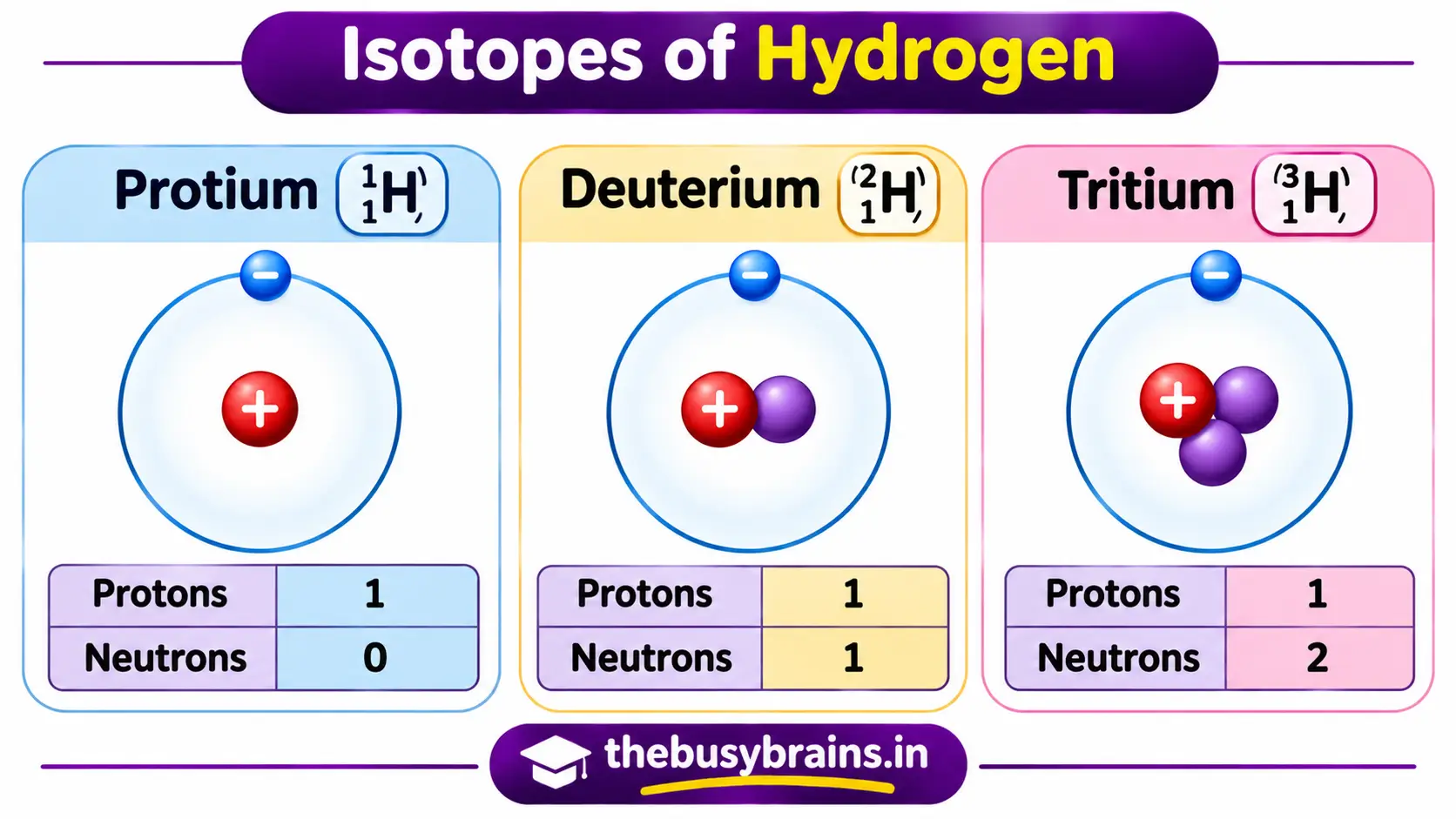
All three isotopes contain one proton and, in their neutral form, one electron. Their neutron numbers and mass numbers differ.
Isotopes of Carbon
Carbon also has different isotopes, including carbon-12, carbon-13 and carbon-14.
- Carbon-12 contains 6 protons and 6 neutrons.
- Carbon-13 contains 6 protons and 7 neutrons.
- Carbon-14 contains 6 protons and 8 neutrons.
Properties of Isotopes
Isotopes of an element have similar chemical properties because they have the same atomic number and the same electronic configuration.
However, their physical properties can differ because their masses are different.
Uses of Isotopes
- Uranium-235: Used as fuel in nuclear reactors for generating electricity.
- Cobalt-60: Used in radiation treatment for cancer.
- Iodine-131: Used in the treatment of certain thyroid disorders, including goitre and thyroid cancer.
- Carbon-14: Used in archaeology and geology to estimate the age of ancient organic materials and artefacts.
- Define isotopes with an example.
- Why do isotopes have the same atomic number but different mass numbers?
- Write the names of the three isotopes of hydrogen.
- Why do isotopes have similar chemical properties?
- Differentiate between the physical and chemical properties of isotopes.
- State two uses of radioactive isotopes.
- Calculate the number of neutrons in carbon-12, carbon-13 and carbon-14.
Average Atomic Mass
Many elements occur naturally as mixtures of different isotopes. These isotopes may not be present in equal amounts.
The average atomic mass of an element is calculated by taking the masses of its naturally occurring isotopes into account, along with their relative abundances.
Simple Average and Weighted Average
A simple average treats all isotopes as if they occur in equal quantities. However, this does not accurately represent the actual composition of a natural element when isotope abundances are different.
A weighted average considers the percentage abundance of each isotope.
When abundance is expressed as a percentage:
Solved Example: Chlorine
Chlorine has two naturally occurring isotopes:
- Chlorine-35: 75% abundance.
- Chlorine-37: 25% abundance.
Using the weighted average formula:
Average atomic mass = (35 × 75/100) + (37 × 25/100)
= 26.25 + 9.25
= 35.5 u
Therefore, the average atomic mass of chlorine is 35.5 u.
This does not mean that an individual chlorine atom has a mass of exactly 35.5 u. It is the weighted average of the naturally occurring isotopes.
Practice Example: Bromine
Bromine has two isotopes: bromine-79 with 49.7% abundance and bromine-81 with 50.3% abundance.
Average atomic mass = (79 × 49.7/100) + (81 × 50.3/100).
= 39.263 + 40.743
= 80.006 u (approximately 80.0 u).
- What is average atomic mass?
- Why is the weighted average more accurate than a simple average?
- Calculate the average atomic mass of chlorine when chlorine-35 has 75% abundance and chlorine-37 has 25% abundance.
- Calculate the average atomic mass of bromine using its isotopic abundances of 49.7% and 50.3%.
- Does an individual chlorine atom have a mass of 35.5 u? Explain.
Isobars
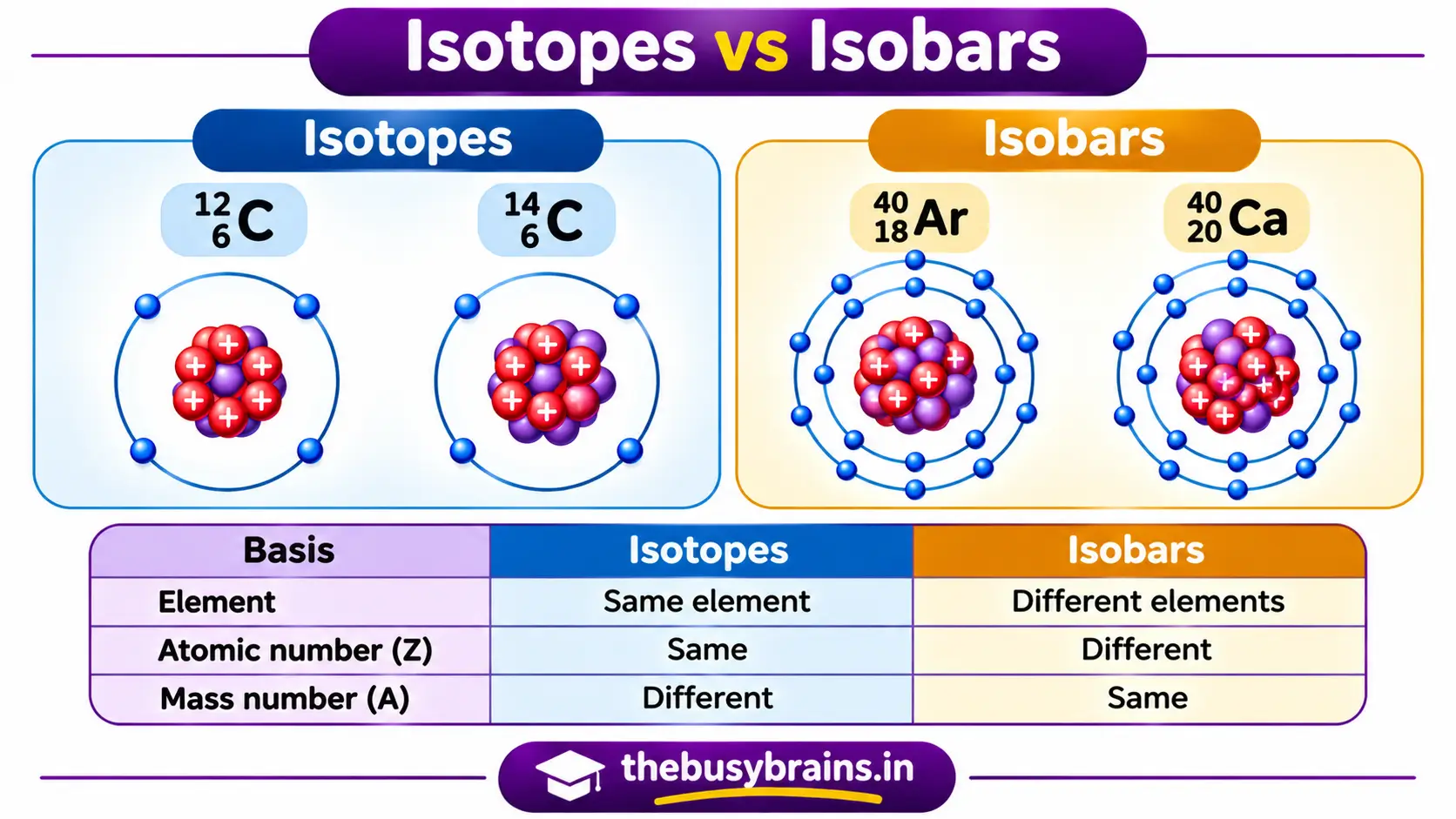
Atoms of different elements can sometimes have the same mass number but different atomic numbers. Such atoms are known as isobars.
Examples of Isobars
Calcium, potassium and argon can each have atoms with a mass number of 40.
| Element | Atomic number | Mass number |
|---|---|---|
| Argon | 18 | 40 |
| Potassium | 19 | 40 |
| Calcium | 20 | 40 |
These atoms have different atomic numbers, so they belong to different elements, even though their mass numbers are the same.
Difference Between Isotopes and Isobars
| Basis | Isotopes | Isobars |
|---|---|---|
| Element | Same element | Different elements |
| Atomic number | Same | Different |
| Mass number | Different | Same |
| Example | Carbon-12 and Carbon-14 | Argon-40 and Calcium-40 |
- Define isobars with an example.
- Why do isobars belong to different elements?
- Differentiate between isotopes and isobars.
- Are argon-40 and calcium-40 isotopes or isobars? Give a reason.
- Two atoms have the same mass number but different atomic numbers. What is their relationship?
Evolution of Atomic Models – A Quick Comparison
| Scientist | Year | Main contribution |
|---|---|---|
| John Dalton | 1808 | Atom considered an indivisible particle. |
| J. J. Thomson | 1897 | Discovered the electron and proposed the plum pudding model. |
| Ernest Rutherford | 1911 | Proposed the nuclear model of the atom. |
| Niels Bohr | 1913 | Introduced fixed energy levels or shells. |
| James Chadwick | 1932 | Discovered the neutron. |
Later developments led to the quantum mechanical model. In the modern understanding, electrons are described using regions of probability called electron clouds rather than exact fixed circular paths.
- Arrange Dalton's, Thomson's, Rutherford's and Bohr's models in chronological order.
- Which scientist discovered the electron, proton and neutron?
- Why were atomic models modified as new experiments were conducted?
- What is the basic difference between Bohr's model and the modern quantum mechanical model?
Quick Revision – Journey Inside the Atom
Important Definitions
- Atom: The basic building block of an element.
- Electron: Negatively charged subatomic particle.
- Proton: Positively charged particle present in the nucleus.
- Neutron: Neutral particle present in the nucleus.
- Nucleus: Dense central region of an atom containing protons and neutrons.
- Atomic number: Number of protons in the nucleus.
- Mass number: Total number of protons and neutrons.
- Electronic configuration: Distribution of electrons in different shells.
- Valency: Combining capacity of an atom.
- Isotopes: Atoms of the same element with different mass numbers.
- Isobars: Atoms of different elements with the same mass number.
Important Formulae
Atomic number:
Z = Number of protons
For a neutral atom:
Number of protons = Number of electrons
Mass number:
A = Number of protons + Number of neutrons
Number of neutrons:
Neutrons = Mass number − Atomic number
Maximum electrons in a shell:
2n²
Average atomic mass:
Σ (Isotopic mass × Fractional abundance)
Scientists and Their Discoveries
| Scientist | Remember |
|---|---|
| Acharya Kanada | Parmanu |
| John Dalton | Atomic theory |
| J. J. Thomson | Electron |
| Ernest Rutherford | Nuclear model |
| Niels Bohr | Fixed energy levels |
| James Chadwick | Neutron |
Facts to Remember Before the Examination
- An atom is mostly empty space.
- The nucleus is extremely small, dense and positively charged.
- Almost all the mass of an atom is concentrated in the nucleus.
- Electrons have a relative charge of −1, protons +1 and neutrons 0.
- The K-shell can hold a maximum of 2 electrons.
- The L-shell can hold a maximum of 8 electrons.
- The maximum number of electrons in a shell is calculated using 2n².
- The outermost shell has a maximum capacity of 8 electrons under the rules studied in this chapter.
- Isotopes have the same atomic number but different mass numbers.
- Isobars have the same mass number but different atomic numbers.
- Carbon-14 is used for dating ancient organic materials.
- Uranium-235 is used as nuclear reactor fuel.
Important Differences to Revise
- Proton vs neutron: positive charge versus no charge.
- Atomic number vs mass number: number of protons versus total nucleons.
- Valence electrons vs valency: outermost electrons versus combining capacity.
- Isotopes vs isobars: same element with different mass numbers versus different elements with the same mass number.
- Thomson vs Rutherford: positive sphere with embedded electrons versus a small central nucleus.
- Rutherford vs Bohr: no explanation of atomic stability versus fixed energy levels that explain stability.
Have You Completed Your Chapter Revision?
Now check how well you have understood the chapter. Attempt the complete practice worksheet and test your knowledge through examination-style questions.
Attempt Chapter Worksheet →Practise MCQs, conceptual questions and numerical problems to prepare for your examination.