


“`html
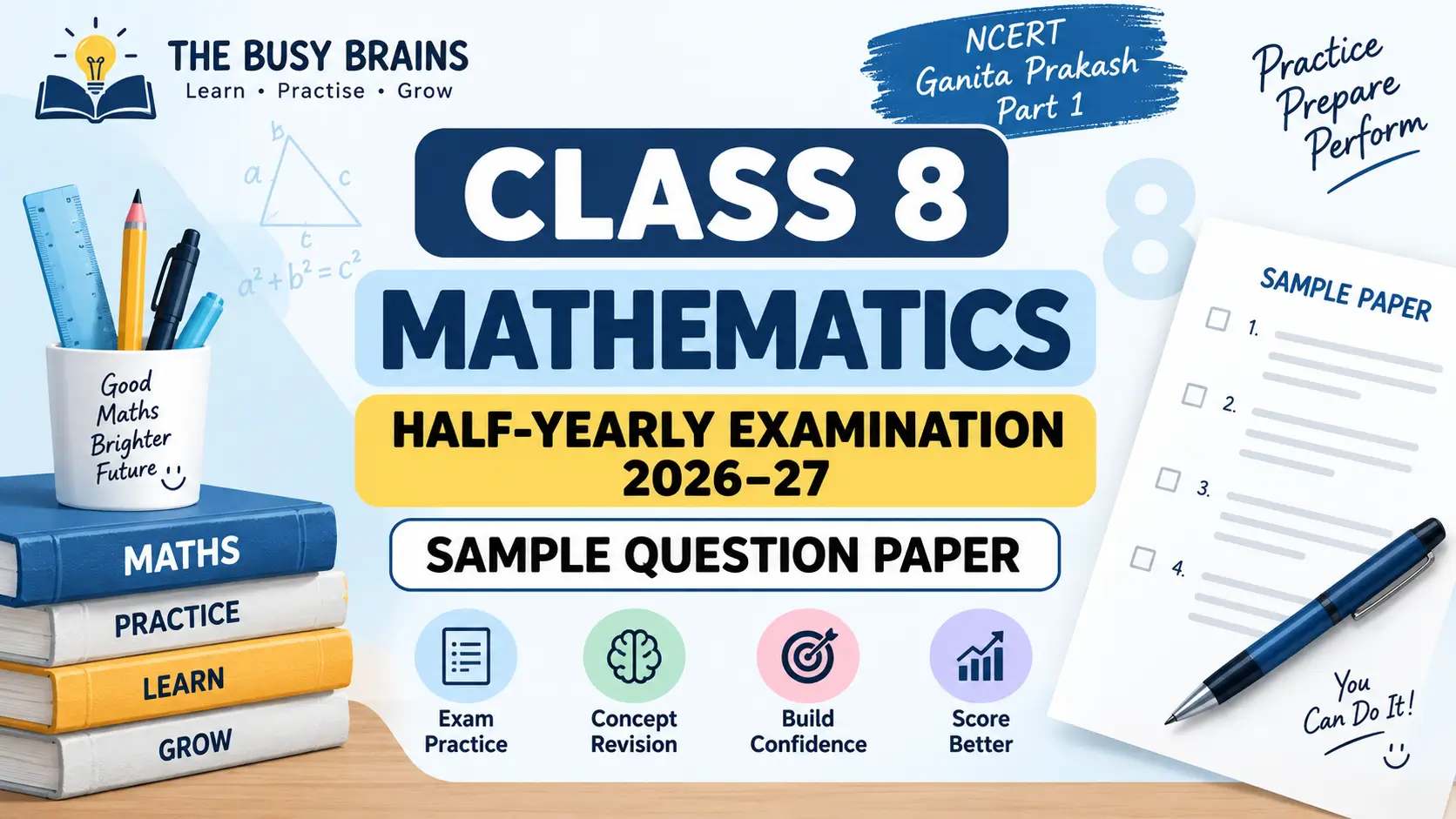
Class 8 Maths Half-Yearly Sample Question Paper 2026–27
Preparing for the Class 8 Maths Half-Yearly Examination 2026–27? This Class 8 Maths Half-Yearly Sample Question Paper is a useful practice resource for students who want to revise important concepts and improve their exam preparation.
Based on NCERT Ganita Prakash Part 1, this sample question paper includes Assertion and Reason questions, MCQs, Very Short Answer Questions, Long Answer and Application-Based Questions, Case Study and Competency-Based Questions, and Super HOTS.
Students can use this Class 8 Mathematics Sample Paper for revision, homework, classroom practice and self-assessment before the exam.
CLASS VIII – MATHEMATICS
HALF-YEARLY EXAMINATION 2026–27
NCERT – GANITA PRAKASH PART 1
Time: 3 Hours
Maximum Marks: 80
General Instructions
- All questions are compulsory unless an internal choice is given.
- Show all necessary steps and mathematical reasoning.
- Calculators are not permitted.
- Draw neat and labelled figures wherever required.
- Read each question carefully.
- Marks are indicated against each question.
- For Assertion–Reason questions, select the correct option from the four choices given.
SECTION A – ASSERTION & REASON
Choose the correct option:
A. Both A and R are true, and R is the correct explanation of A.
B. Both A and R are true, but R is not the correct explanation of A.
C. A is true, but R is false.
D. A is false, but R is true.
Assertion (A): 1728 is a perfect cube.
Reason (R): 1728 = 12³.
Assertion (A): 5⁷ / 5³ = 5⁴.
Reason (R): When powers with the same non-zero base are divided, their exponents are subtracted.
Assertion (A): The Gumulgul number system uses grouping by 2.
Reason (R): Numbers can be represented using combinations of 2 and 1.
Assertion (A): The Mesopotamian number system is based on 60.
Reason (R): Its place values involve successive powers of 60.
Assertion (A): Every square is a rectangle.
Reason (R): A square has four right angles, which is one of the defining properties of a rectangle.
Assertion (A): Every number divisible by 6 is divisible by both 2 and 3.
Reason (R): 6 = 2 × 3 and 2 and 3 are relatively prime.
Assertion (A): 98 × 25 = 2450.
Reason (R): 98 × 25 = (100 − 2) × 25.
Assertion (A): If two quantities are directly proportional, the ratio of corresponding values remains constant.
Reason (R): In direct proportion, both quantities increase or decrease in the same ratio.
SECTION B – MULTIPLE CHOICE QUESTIONS
The smallest number by which 540 must be multiplied to make it a perfect square is:
a) 5 b) 10 c) 15 d) 30
Simplify: (2⁹ × 2⁴) / 2⁶
a) 2⁵ b) 2⁶ c) 2⁷ d) 2⁸
Which of the following number systems uses base 60?
a) Egyptian b) Roman c) Mesopotamian d) Gumulgul
Which of the following is correctly matched?
a) Gumulgul — grouping by 10
b) Egyptian — powers of 10
c) Mesopotamian — base 5
d) Roman — positional place-value system
Which system is associated with zongs and hengs?
a) Mayan b) Egyptian c) Chinese rod numerals d) Roman
A quadrilateral has angles: (2x + 10)°, (3x − 20)°, (x + 30)°, 4x°. The value of x is:
a) 30° b) 35° c) 40° d) 45°
Which number is divisible by 11?
a) 1234 b) 1331 c) 1456 d) 1523
If 5 notebooks cost ₹175, the cost of 13 notebooks at the same rate is:
a) ₹425 b) ₹435 c) ₹455 d) ₹475
SECTION C – VERY SHORT ANSWER QUESTIONS
Find the smallest number that must be added to 999 to make it a perfect square.
Simplify: (3⁸ × 3⁵) / 3⁶. Write your answer as a single power.
A number system uses grouping by 2. Express the following in terms of 2s and 1s:
a) 5 b) 6
Write the following in Roman numerals:
a) 94 b) 149
A number system has landmark numbers: 1, 5, 25, 125, 625, …
a) Identify its base.
b) Write the next landmark number.
The four angles of a quadrilateral are: 2x°, 3x°, 4x°, 3x°. Find x.
Without performing long division, determine whether 7,326 is divisible by:
a) 2 b) 3 c) 9
Give reasons.
Calculate using the distributive property: 99 × 48.
SECTION D – LONG ANSWER / APPLICATION
31.
A school has 1,296 square tiles.
a) Show that 1,296 is a perfect square.
b) How many tiles will be placed in each row if they are arranged as a square?
c) Find the next perfect square after 1,296.
d) How many additional tiles are required to make the next perfect square?
32.
Simplify: (2⁸ × 4³) / 8²
a) Express 4 as a power of 2.
b) Express 8 as a power of 2.
c) Apply the laws of exponents.
d) Express the final answer as a single power of 2.
33.
Study the following descriptions:
System A: Counts mainly in groups of 2 and has number names based on combinations of 2 and 1.
System B: Uses symbols associated with powers of 10.
System C: Uses base 60 and place value.
System D: Uses dots, bars and a shell-like symbol and is associated with an almost base-20 system.
System E: Uses rods arranged vertically and horizontally to indicate place value.
System F: Uses ten digits, including 0, in a decimal place-value system.
Answer the following:
a) Identify Systems A, B and C.
b) Identify Systems D and E.
c) Identify System F.
d) Which of these systems is our modern decimal place-value system?
34.
ABCD is a parallelogram. ∠A = (3x + 10)° and ∠B = (5x − 30)°.
a) Find x.
b) Find all four angles.
c) Explain why ∠A + ∠B = 180°.
d) Verify that the sum of the four angles is 360°.
SECTION E – CASE STUDY / COMPETENCY-BASED
35.
A student studies the following sequence of ideas:
a) What is meant by one-to-one correspondence in counting?
b) How does grouping make counting large collections easier?
c) What is a base-n number system?
d) Explain how place value and zero make the Hindu number system efficient.
36.
A car travels 180 km using 12 litres of petrol under similar conditions.
a) Find the distance travelled per litre.
b) How far will the car travel using 20 litres?
c) How much petrol will be required to travel 450 km?
d) Explain why distance travelled and petrol used are directly proportional under the given conditions.
SECTION F – SUPER HOTS
37.
A civilisation uses a number system with landmark numbers:
1, 4, 16, 64, 256, …
a) Identify the base.
b) Write the next two landmark numbers.
c) Express 90 in this base system.
d) Write the corresponding place values.
e) How is this system different from the decimal system?
f) State one advantage of a place-value system.
38.
A square and a rectangle have the same perimeter.
The side of the square is 12 cm and the length of the rectangle is 16 cm.
a) Find the perimeter of the square.
b) Find the breadth of the rectangle.
c) Find the area of the square.
d) Find the area of the rectangle.
e) Which figure has the greater area?
f) Find the difference between their areas.
Follow The Busy Brains on YouTube
For more Class 4 to Class 8 sample papers, Maths, Science, SST,
English practice papers, worksheets and exam preparation videos,
subscribe to The Busy Brains.
The Busy Brains Tuition Classes
Learn • Practise • Grow
“`