



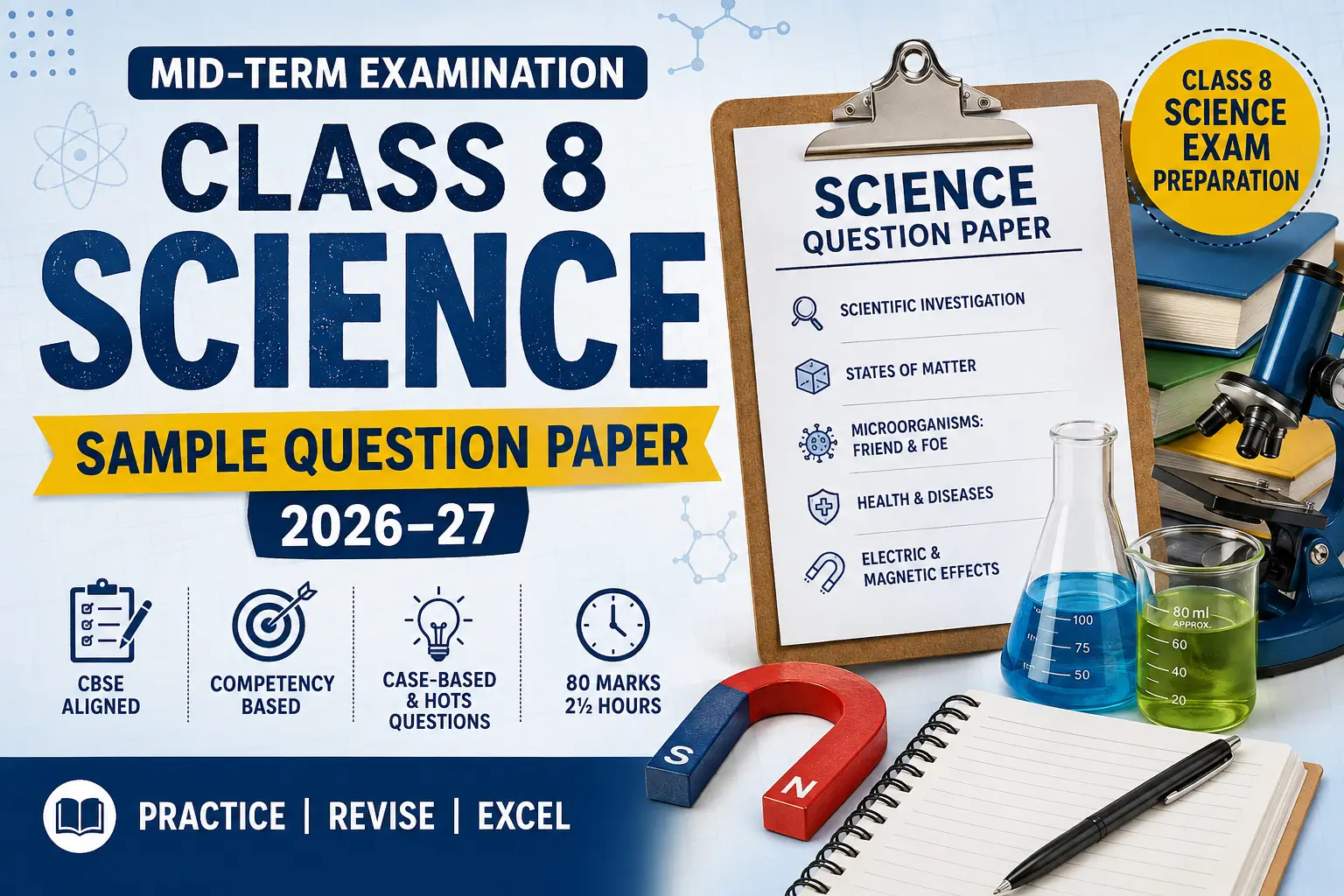
Class 8 Science Mid-Term Exam Sample Paper 2026–27
Preparing for the Class 8 Science Mid-Term Examination 2026–27? This carefully designed sample question paper is useful for students preparing for their school examinations and teachers looking for a CBSE-aligned Class 8 Science practice paper.
Understand Distributive Properties with Examples
The paper covers important concepts from Scientific Investigation, States of Matter, Microorganisms: Friend and Foe, Health and Diseases, and Electric and Magnetic Effects. It includes MCQs, Fill in the Blanks, Assertion-Reason questions, Very Short Answer Questions, Short Answer Questions, Long Answer Questions, Case-Based Questions, Application-Based Questions and HOTS questions.
This Class 8 Science sample paper follows an examination-oriented structure with a total of 80 marks and a time limit of 2½ hours. Students can use it as a mid-term revision worksheet, practice test, or mock examination paper.
Key Features of This Class 8 Science Sample Paper
- Class 8 Science Mid-Term Examination 2026–27
- Maximum Marks: 80
- Time: 2½ Hours
- Objective-type MCQs and Assertion-Reason questions
- Competency-based and application-based questions
- Case-based questions
- HOTS questions
- Questions based on important Science concepts
- Suitable for CBSE/NCERT-oriented preparation
- Useful for revision, classroom assessment and mock tests
MID-TERM EXAMINATION – 2026–27
CLASS: VIII
SUBJECT: SCIENCE
Maximum Marks: 80 | Time: 2½ Hours
General Instructions
- Read all questions carefully before answering.
- All questions are compulsory.
- Attempt each section according to the marks allotted.
- Write answers clearly and neatly.
- Show all necessary reasoning wherever required.
SECTION A – OBJECTIVE TYPE QUESTIONS (20 × 1 = 20 Marks)
a) Changing several variables
b) Changing only one variable while keeping other conditions constant
c) Ignoring observations
d) Avoiding records
a) Earth’s shadow
b) Changing relative positions of Sun, Earth and Moon
c) Moon’s rotation only
d) Temperature changes
a) It disappears
b) It melts
c) Sugar particles occupy spaces between water particles
d) Water destroys it
a) Liquid
b) Gas
c) Solid
d) Vapour
a) Gas
b) Liquid
c) Solid
d) Plasma
a) Bacterium
b) Virus
c) Protozoan
d) Fungus
a) Housefly
b) Mosquito
c) Food
d) Droplets
a) Measles
b) Cholera
c) Diabetes
d) Malaria
a) Bacteria
b) Viruses
c) Bacterial pathogens
d) Bacterial diseases
a) Yeast
b) Mosquito
c) Housefly
d) Earthworm
a) Solid
b) Liquid
c) Gas
d) Ice
a) Solid
b) Liquid
c) Gas
d) Ice
Assertion-Reason Questions
Reason: This helps identify the factor responsible for the observed change.
Reason: Animal cells require a rigid outer layer for support.
Reason: Common cold is generally caused by viruses, whereas antibiotics act against bacteria.
Reason: Gas particles have large spaces between them.
a) Both A and R are true and R correctly explains A
b) Both A and R are true but R does not explain A
c) A is true but R is false
d) A is false but R is true
SECTION B – VERY SHORT ANSWER QUESTIONS (6 × 2 = 12 Marks)
SECTION C – SHORT ANSWER QUESTIONS (6 × 3 = 18 Marks)
a) Liquids can flow but solids generally cannot.
b) Gases have neither fixed shape nor fixed volume.
c) Gases are easily compressed.
SECTION D – LONG ANSWER QUESTIONS (3 × 5 = 15 Marks)
Describe the interparticle spacing in solids, liquids and gases. Explain how it affects their shape, volume, compressibility and movement of particles.
a) What are microorganisms?
b) Name two groups of microorganisms.
c) Explain one useful role of microorganisms.
d) Explain one harmful effect of microorganisms.
e) Why should antibiotics not be used unnecessarily?
A student wants to find out whether sunlight affects plant growth.
a) Frame a scientific question.
b) State a hypothesis.
c) Identify the independent variable.
d) State two variables to keep constant.
e) Mention two observations/measurements to record.
SECTION E – CASE-BASED / APPLICATION-BASED & HOTS QUESTIONS (3 × 5 = 15 Marks)
A student observes:
Ice – fixed shape
Water – takes the shape of its container
Steam – spreads everywhere
a) Identify the state of each. (1)
b) Compare the particle arrangement in each state. (2)
c) Which has maximum particle movement? (1)
d) Which has strongest interparticle attraction? (1)
Riya investigates whether water temperature affects the time taken by sugar to dissolve. She uses cold, room-temperature and warm water and keeps the amounts of sugar and water the same.
a) What is the independent variable? (1)
b) State two constants. (2)
c) What observation should be recorded? (1)
d) Why should the experiment be repeated? (1)
A student connects a cell, bulb and switch in a circuit. In another activity, the student places iron filings around a bar magnet.
a) The bulb does not glow when the switch is open. Explain why. (1)
b) Why are connecting wires made of conducting materials? (1)
c) What do the patterns formed by iron filings around a bar magnet represent? (1)
d) Where is the magnetic field strongest around a bar magnet? (1)
e) What would you observe if a magnetic compass is brought near the bar magnet? (1)
End of Question Paper
Subscribe to The Busy Brains on YouTube for more educational videos, worksheets and exam preparation resources.
Need the Answer Sheet or PDF?
Comment below and let us know! We will share the answer sheet and PDF of this question paper.