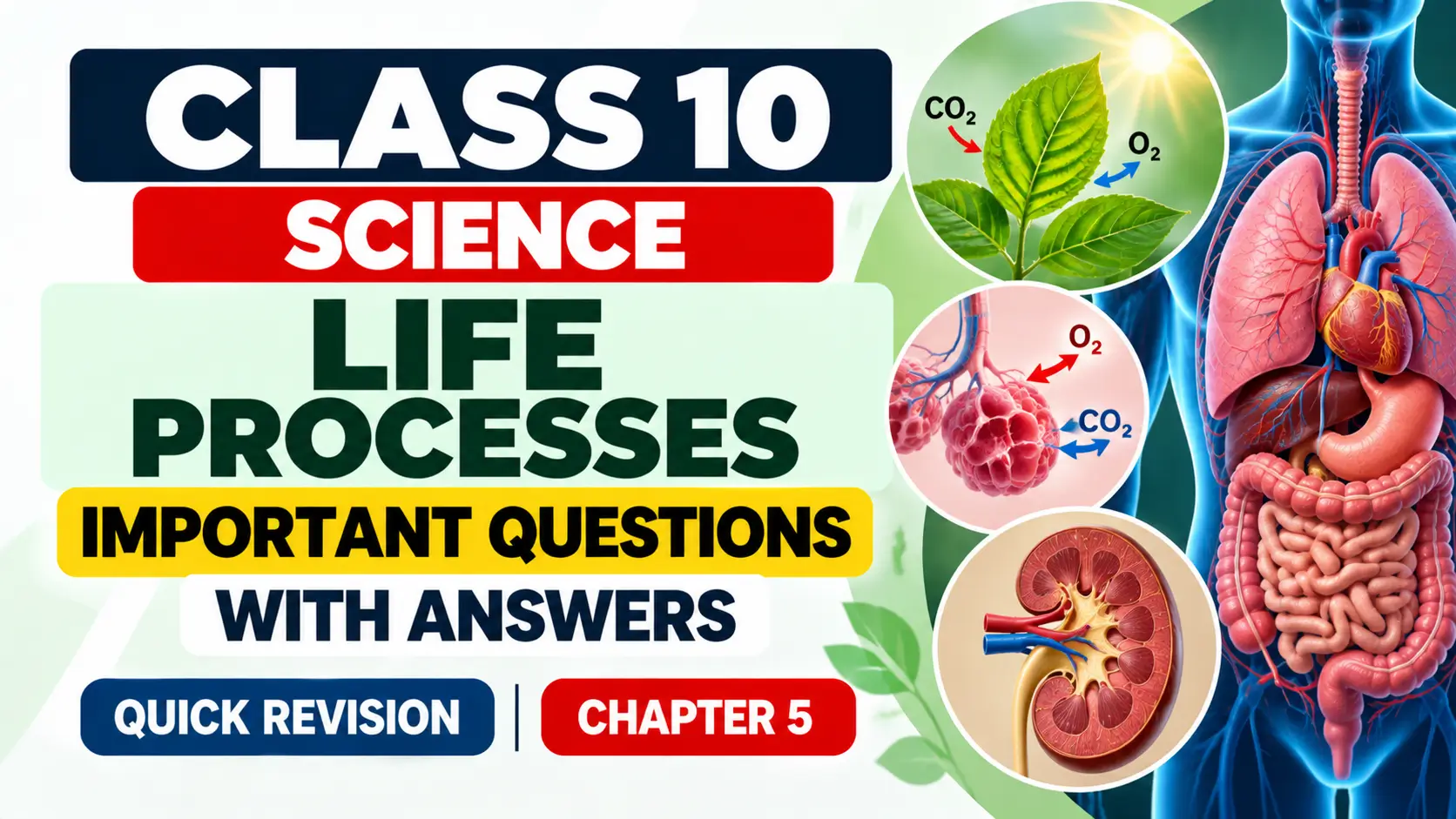
Class 10 Life Processes Important Questions with Answers
are designed to help students revise one of the most important chapters
of CBSE Class 10 Science Biology. This chapter explains the
essential life processes that help living organisms maintain
their bodies, including nutrition, respiration, transportation and
excretion.
These Class 10 Science Life Processes notes and questions
cover autotrophic and heterotrophic nutrition, photosynthesis,
human digestion, aerobic and anaerobic respiration, ATP, human respiratory
system, alveoli, blood circulation, double circulation, heart, blood
vessels, xylem, phloem, transpiration, translocation, human excretory
system, nephron and dialysis.
Use this page for Class 10 Pre-Board preparation, CBSE Board Exam
revision, NCERT-based questions, important diagrams, MCQs and case-based
questions. The questions are organised topic-wise so that students
can revise the chapter systematically.
MUST DO
Photosynthesis, human digestion, respiration, heart,
double circulation, xylem, phloem, nephron.
VERY IMPORTANT
Alveoli, ATP, blood vessels, transpiration,
translocation, excretion and dialysis.
PRACTICE
Diagrams, comparisons, NCERT questions,
MCQs and case-based questions.
1. Life Processes – Important Questions
Q1. What are life processes?
The processes which together perform the maintenance functions
of living organisms are called life processes.
These include nutrition, respiration, transportation of materials
and excretion of waste products.
Q2. Why is visible movement not enough to define life?
A living organism may not show visible movement at all times.
Plants may not show visible movement and sleeping animals may
also appear still. However, movements at the molecular level
continue inside living organisms. Therefore, visible movement
alone cannot be used as the defining characteristic of life.
Q3. Why do living organisms need maintenance processes?
Living organisms have highly organised structures. Environmental
effects can cause these structures to break down over time.
Therefore, organisms need continuous processes to repair and
maintain their structures.
Q4. Why is energy required for maintenance of living organisms?
Energy is required for the maintenance and repair of structures
inside living organisms. The energy comes from outside the body
through food and is converted into a form that cells can use.
Q5. Why is diffusion insufficient to meet the oxygen requirements
of multicellular organisms like humans?
In multicellular organisms, all cells are not in direct contact
with the surrounding environment. As the body becomes larger
and more complex, simple diffusion cannot supply oxygen
efficiently to all cells. Therefore, specialised respiratory and
transport systems are required.
Q6. What are the major processes essential for maintaining life?
The major life processes discussed in this chapter are:
nutrition, respiration, transportation and excretion.
2. Nutrition – Important Questions and Answers
Q7. What is nutrition?
Nutrition is the process through which organisms obtain food
from outside and use it as a source of energy and materials
required for growth, development and maintenance.
Q8. What are autotrophs?
Organisms that use simple inorganic substances such as
carbon dioxide and water to prepare their own food are called
autotrophs. Green plants and some bacteria are examples.
Q9. What are heterotrophs?
Organisms that obtain complex food substances from other
organisms are called heterotrophs. Animals and fungi
are examples of heterotrophic organisms.
Q10. Differentiate between autotrophic and heterotrophic nutrition.
Autotrophic Nutrition
Heterotrophic Nutrition
Organisms prepare their own food.
Organisms obtain food from other organisms.
Uses simple inorganic substances such as carbon dioxide and water.
Uses complex food substances.
Photosynthesis is an important example.
Animals and fungi show heterotrophic nutrition.
Q11. Why do heterotrophs depend directly or indirectly on autotrophs?
Autotrophs prepare organic food using inorganic raw materials.
Heterotrophs depend on these food materials directly by consuming
plants or indirectly through food chains.
3. Photosynthesis – Important Questions
Q12. What is photosynthesis?
Photosynthesis is the process by which autotrophs take in
carbon dioxide and water and convert them into carbohydrates
in the presence of sunlight and chlorophyll.
Q13. What are the three main events involved in photosynthesis?
The three important events are:
Absorption of light energy by chlorophyll.
Conversion of light energy into chemical energy and splitting of water molecules into hydrogen and oxygen.
Reduction of carbon dioxide to carbohydrates.
Q14. What is the role of chlorophyll in photosynthesis?
Chlorophyll absorbs light energy required for photosynthesis.
The absorbed light energy is converted into chemical energy
during the process.
Q15. Where does a plant obtain carbon dioxide for photosynthesis?
Plants obtain carbon dioxide from the atmosphere through
tiny pores called stomata present mainly on the
surface of leaves.
Q16. What are stomata?
Stomata are tiny pores present on the surface of leaves through
which gaseous exchange takes place. Their opening and closing
are controlled by guard cells.
Q17. How do guard cells control the opening and closing of stomata?
When water flows into the guard cells, they swell and cause
the stomatal pore to open. When the guard cells shrink, the
pore closes.
Q18. What raw materials are required by plants for photosynthesis?
The major raw materials required are carbon dioxide and
water. Sunlight provides energy and chlorophyll absorbs
the light energy.
Q19. Where do plants obtain water and minerals?
Water and minerals are absorbed from the soil through the roots.
Minerals include substances such as nitrogen, phosphorus,
iron and magnesium.
Q20. Why is nitrogen important for plants?
Nitrogen is an essential element used in the synthesis of
proteins and other compounds required by plants.
⭐ MUST PRACTISE:
The variegated leaf experiment, iodine starch test and experiment
showing that carbon dioxide is necessary for photosynthesis are
important activity-based concepts from the chapter.
4. Nutrition in Human Beings – Digestive System
Q21. What is the alimentary canal?
The alimentary canal is a long tube extending from the
mouth to the anus. Different regions of the canal
are specialised for different functions in digestion.
Q22. What is the role of saliva in digestion?
Saliva moistens food and contains the enzyme
salivary amylase, which breaks down starch,
a complex molecule, into simple sugar.
Q23. What is peristalsis?
Peristalsis refers to the rhythmic contraction of muscles
in the lining of the alimentary canal that pushes food forward
through the digestive tract.
Q24. What is the role of hydrochloric acid in the stomach?
Hydrochloric acid creates an acidic medium in the stomach
which facilitates the action of the enzyme pepsin. The mucus
secreted by the stomach protects its inner lining from the acid.
Q25. What is the function of pepsin?
Pepsin is a protein-digesting enzyme released by the gastric
glands in the stomach.
Q26. What happens to food in the small intestine?
The small intestine is the site of the complete digestion
of carbohydrates, proteins and fats. It receives secretions
from the liver and pancreas. Digested food is then absorbed
through the walls of the small intestine.
Q27. What is the role of bile juice in digestion?
Bile juice from the liver helps make the acidic food coming
from the stomach alkaline. Bile salts also break large fat
globules into smaller globules, increasing the efficiency
of enzyme action.
Q28. What is the function of pancreatic juice?
Pancreatic juice contains enzymes such as
trypsin for digesting proteins and
lipase for breaking down emulsified fats.
Villi are numerous finger-like projections present on the
inner lining of the small intestine. They increase the surface
area for absorption of digested food. The villi are richly
supplied with blood vessels which transport absorbed nutrients
to the cells of the body.
Q30. Why is the small intestine suitable for absorption of digested food?
The small intestine has a large surface area due to its
extensive length and numerous villi. The villi contain
blood vessels which help transport the absorbed food to
different parts of the body.
Q31. How are fats digested in the human body?
Bile salts break large fat globules into smaller globules,
increasing the efficiency of enzyme action. Pancreatic lipase
then helps break down the emulsified fats. The final products
include fatty acids and glycerol.
Q32. What happens to unabsorbed food?
Unabsorbed food passes into the large intestine, where water
is absorbed. The remaining material is removed from the body
through the anus.
5. Respiration – Important Questions and Answers
Q33. What is respiration?
Respiration is the process in which food molecules are broken
down to release energy required for cellular activities.
The process of respiration may be aerobic or anaerobic.
Q34. What is the first step in the breakdown of glucose?
The first step is the breakdown of glucose, a six-carbon
molecule, into a three-carbon molecule called
pyruvate. This process takes place in the
cytoplasm.
Glucose (6-carbon)
→ Pyruvate (3-carbon)
Q35. What is aerobic respiration?
Aerobic respiration is the breakdown of pyruvate in the
presence of oxygen. It takes place in the mitochondria and
produces carbon dioxide, water and energy.
Q36. What is anaerobic respiration?
Anaerobic respiration is a pathway of respiration that does
not involve oxygen. In yeast, pyruvate may be converted into
ethanol and carbon dioxide.
Q37. What happens to pyruvate during respiration?
Depending on the organism and oxygen availability, pyruvate
may be broken down in different ways. In the presence of oxygen,
it produces carbon dioxide and water. In yeast, it produces
ethanol and carbon dioxide. In muscle cells during lack of
oxygen, it may be converted into lactic acid.
Q38. Why do cramps occur in muscles during sudden physical activity?
During sudden activity, when there is a lack of oxygen in
muscle cells, pyruvate may be converted into lactic acid.
The build-up of lactic acid in muscles causes cramps.
Q39. What is ATP?
ATP stands for adenosine triphosphate. It is
described in the chapter as the energy currency for most
cellular processes. Energy released during respiration is
used to synthesise ATP.
Q40. Differentiate between aerobic and anaerobic respiration.
Aerobic Respiration
Anaerobic Respiration
Occurs in the presence of oxygen.
Does not involve oxygen.
Produces carbon dioxide and water.
Products depend on the pathway; yeast produces ethanol and carbon dioxide.
Releases much more energy.
Releases less energy than aerobic respiration.
Q41. Why is respiration necessary for living organisms?
Respiration releases energy from food. This energy is used
for various cellular activities and maintenance functions
of the organism.
6. Human Respiratory System – Important Questions
Q42. Why do terrestrial organisms have an advantage over aquatic
organisms in obtaining oxygen?
Terrestrial organisms obtain oxygen from the atmosphere,
where oxygen is available in a much greater amount than the
dissolved oxygen available in water. Aquatic organisms therefore
need to breathe at a much faster rate.
Q43. How do fishes obtain oxygen?
Fishes take water through their mouths and force it over their
gills. Dissolved oxygen from the water is absorbed by the blood
through the gills.
Q44. How does air enter the human respiratory system?
Air enters through the nostrils. Fine hairs and mucus help
filter the air. It then passes through the throat and air
passages into the lungs.
Q45. What are alveoli?
Alveoli are balloon-like structures at the ends of the
respiratory passages in the lungs. They provide a large,
thin surface for exchange of gases and are surrounded by
an extensive network of blood vessels.
Q46. How are lungs designed to maximise gas exchange?
The lungs contain numerous alveoli which provide a large
surface area. Their walls are thin and are surrounded by
a network of blood vessels. This arrangement makes exchange
of oxygen and carbon dioxide efficient.
Q47. What happens during inhalation?
During inhalation, the ribs are lifted and the diaphragm
flattens. The chest cavity becomes larger, causing air to
be drawn into the lungs and fill the expanded alveoli.
Q48. How is oxygen transported in human beings?
Oxygen is taken up by blood in the blood vessels surrounding
the alveoli. In human beings, haemoglobin present in red
blood corpuscles has a high affinity for oxygen and helps
transport it to body tissues.
Q49. How is carbon dioxide transported in human beings?
Carbon dioxide is more soluble in water than oxygen and is
therefore transported mostly in dissolved form in the blood.
7. Transportation in Human Beings
Q50. What is the function of the circulatory system in humans?
The circulatory system transports materials such as food,
oxygen, carbon dioxide and excretory products. It consists
of the heart, blood and blood vessels.
Q51. What are the components of the transport system in human beings?
The major components are:
Heart – acts as the pumping organ.
Blood – transports various substances.
Blood vessels – form the network through which blood flows.
Q52. Why does the human heart have different chambers?
The chambers help prevent oxygen-rich blood from mixing with
carbon dioxide-rich blood and allow efficient circulation
of oxygenated and deoxygenated blood.
Q53. Name the four chambers of the human heart.
The four chambers are:
right atrium, right ventricle, left atrium and
left ventricle.
Q54. Why are the walls of ventricles thicker than those of atria?
Ventricles pump blood into various organs or to the lungs,
so they need to generate greater pressure. Therefore, their
muscular walls are thicker than those of the atria.
Q55. What is double circulation?
In double circulation, blood passes through the heart twice
during one complete cycle. One circuit carries blood between
the heart and lungs, while the other carries blood between
the heart and the rest of the body.
Q56. Why is separation of oxygenated and deoxygenated blood
useful in mammals and birds?
Separation prevents mixing of oxygenated and deoxygenated
blood and allows efficient supply of oxygen to the body.
This is useful for animals such as birds and mammals that
have high energy needs.
Q57. Differentiate between arteries and veins.
Arteries
Veins
Carry blood away from the heart.
Bring blood back to the heart.
Have thick, elastic walls.
Have thinner walls and valves.
Blood flows under higher pressure.
Blood flows under lower pressure.
Q58. What are capillaries?
Capillaries are the smallest blood vessels. Their walls are
one-cell thick and allow exchange of materials between blood
and surrounding cells.
Q59. What is the role of platelets?
Platelets help plug leaks in blood vessels by helping blood
clot at points of injury.
Q60. What is lymph?
Lymph or tissue fluid is formed from fluid that escapes
through pores in capillary walls into intercellular spaces.
It is similar to blood plasma but is colourless and contains
less protein. It helps drain excess fluid and transports
absorbed fats from the intestine.
Q61. What is blood pressure?
The force exerted by blood against the walls of blood vessels
is called blood pressure. The chapter gives the normal
systolic pressure as about 120 mm Hg and
diastolic pressure as about 80 mm Hg.
8. Transportation in Plants
Q62. Why is a transport system necessary in large plants?
In large plants, the distance between roots and leaves can
be considerable. Simple diffusion is not sufficient to move
water, minerals and food to all parts. Therefore, a specialised
transport system is required.
Xylem transports water and minerals obtained
from the soil to different parts of the plant.
Q65. What is the function of phloem?
Phloem transports products of photosynthesis from leaves
to other parts of the plant. It also transports amino acids
and other substances.
Q66. What is transpiration?
The loss of water in the form of water vapour from the aerial
parts of a plant is called transpiration.
Q67. What is the role of transpiration in plants?
Transpiration helps in the absorption and upward movement
of water and minerals from roots to leaves. It also helps
in temperature regulation.
Q68. What is transpiration pull?
Evaporation of water molecules from leaf cells creates a
suction that pulls water upward through the xylem from the
roots. This is referred to as the transpiration pull.
Q69. What is translocation?
The transport of soluble products of photosynthesis from
leaves to other parts of a plant through the phloem is
called translocation.
Q70. How does translocation in phloem take place?
Translocation uses energy from ATP. Sucrose and other materials
are transferred into phloem tissue, increasing osmotic pressure.
Water then enters the tissue and the resulting pressure helps
move materials to tissues where pressure is lower.
⭐ Remember:Xylem → Water + Minerals Phloem → Food + Other substances Transpiration → Water loss as vapour Translocation → Transport of soluble food products
9. Excretion – Human Excretory System
Q71. What is excretion?
Excretion is the biological process involved in the removal
of harmful metabolic wastes from the body.
Q72. Name the main organs of the human excretory system.
The human excretory system includes:
A pair of kidneys
A pair of ureters
Urinary bladder
Urethra
Q73. What is the function of kidneys?
Kidneys filter the blood and remove nitrogenous wastes such
as urea or uric acid. They also help regulate the amount of
water reabsorbed from the filtrate.
Q74. What is a nephron?
A nephron is the basic filtration unit of the kidney.
Each kidney contains a large number of nephrons packed
closely together.
Q75. Describe the structure and functioning of a nephron.
A nephron contains a cluster of thin-walled blood capillaries
associated with the cup-shaped end of a coiled tube called
Bowman's capsule. The capsule collects the
filtrate. As the filtrate moves along the tubule, substances
such as glucose, amino acids, salts and a major amount of
water are selectively reabsorbed. The remaining urine enters
the ureter and is eventually stored in the urinary bladder.
Q76. How is urine produced?
Urine formation involves filtration of blood in the kidney
followed by selective reabsorption of useful substances
and water. The remaining waste-containing fluid forms urine.
Q77. How is the amount of urine produced regulated?
The amount of water reabsorbed by the kidney depends on the
amount of excess water present in the body and the amount
of dissolved waste that needs to be excreted.
Q78. What is dialysis?
Dialysis is a process in which an artificial kidney removes
nitrogenous waste products from the blood. The patient's blood
passes through tubes with a semipermeable lining, allowing
waste products to move into the dialysing fluid.
Q79. Why is an artificial kidney required?
When kidney function is reduced or the kidneys fail, poisonous
wastes may accumulate in the body. An artificial kidney can
remove nitrogenous waste products from the blood through
dialysis.
Q80. How do plants get rid of waste materials?
Plants use several strategies. Waste may be stored in
cell vacuoles, stored in leaves that later fall, stored as
resins and gums, or released into the surrounding soil.
Excess water can be removed through transpiration.
10. Important Diagram Questions – Life Processes
Diagram Q1. Draw and label the human alimentary canal.
Important labels: Mouth, Oesophagus, Stomach, Liver,
Pancreas, Small Intestine, Large Intestine, Rectum and Anus.
Diagram Q2. Draw and label the human respiratory system.
Important labels: Nasal passage, Pharynx, Larynx, Trachea,
Bronchi, Bronchioles, Lungs, Alveoli and Diaphragm.
Diagram Q3. Draw and label the human heart.
Practise the four chambers and major blood vessels shown
in the NCERT schematic diagram.
Diagram Q4. Draw the pathway of double circulation.
Body → Right Side of Heart → Lungs → Left Side of Heart → Body
Diagram Q5. Draw and label the structure of a nephron.
Important labels: Glomerulus, Bowman's capsule, Tubule,
Blood capillaries and collecting/urine pathway as represented
in the NCERT figure.
Diagram Q6. Draw the transport of water during transpiration.
Show roots, xylem, stem, leaves, stomata and the upward
movement of water.
Diagram Q7. Draw a stomatal pore.
Label guard cells, stomatal pore and chloroplasts.
Practise both open and closed stomatal conditions.
Diagram Q8. Draw the breakdown of glucose through different pathways.
Start with glucose → pyruvate and show aerobic respiration,
anaerobic respiration in yeast and lactic acid formation
in muscle cells.
🎯 Board Exam Tip:
Practise diagrams with labels. Do not merely memorise the names
of the diagrams. Be able to identify the function of the labelled
parts as well.
11. NCERT-Based Board Questions
The following questions are especially useful for board-style
revision because they are based on the question sets and exercise
themes included in the uploaded NCERT chapter. :chatgpt-content-reference{index="2"}
Q81. Why is diffusion insufficient in humans but sufficient for
some unicellular organisms?
In unicellular organisms, the entire cell surface is in contact
with the environment, so materials can move by diffusion.
In multicellular organisms, many cells are far from the external
environment, so specialised transport systems are required.
Q82. Explain why plants need transport systems even though they
do not move from place to place.
Plants have roots that absorb water and minerals while leaves
prepare food. In large plants, the distances between these
regions may be considerable. Therefore, xylem and phloem
transport materials between different parts of the plant.
Q83. Why is the separation of oxygenated and deoxygenated blood
important in mammals?
It prevents mixing of the two types of blood and ensures that
oxygen-rich blood is efficiently supplied to body tissues.
This supports the high energy requirements of mammals.
Q84. Compare alveoli in lungs and nephrons in kidneys with respect
to their structure and function.
Both are specialised structures that provide efficient exchange
or filtration because of their specialised design.
Alveoli have thin walls and a rich blood supply for exchange
of oxygen and carbon dioxide. Nephrons filter blood and
selectively reabsorb useful substances while forming urine.
Q85. What would happen if haemoglobin were deficient in the body?
Haemoglobin helps transport oxygen in the blood. A deficiency
would reduce the oxygen-carrying capacity of the blood and
therefore affect the efficient supply of oxygen to body tissues.
Q86. Why does the small intestine have a large surface area?
The large surface area allows efficient absorption of digested
food. Numerous villi increase the available surface for absorption.
Q87. What are the differences between xylem and phloem?
Xylem
Phloem
Transports water and minerals.
Transports products of photosynthesis and other substances.
Forms a water-conducting system.
Forms a food-conducting system.
Water movement is associated with root pressure and transpiration pull.
Translocation uses energy from ATP.
Q88. What are the necessary conditions for autotrophic nutrition?
The chapter describes the requirement of
carbon dioxide, water, sunlight and chlorophyll
for photosynthesis.
Q89. What is the importance of ATP in cellular activities?
ATP acts as an energy currency for cellular processes.
Energy stored in ATP can be used for activities such as
muscle contraction, protein synthesis and conduction of
nervous impulses.
Digestive enzymes act as biological catalysts and break down
complex food molecules into simpler substances that can be
absorbed through the alimentary canal.
12. Important MCQs – Class 10 Life Processes
Q91. Which tissue transports water in plants?
A. Phloem
B. Xylem
C. Epidermis
D. Cortex
Answer: B. Xylem
Q92. Which organ is responsible for filtering nitrogenous waste from blood?
A. Heart
B. Lungs
C. Kidneys
D. Stomach
Answer: C. Kidneys
Q93. The first breakdown product of glucose is:
A. Ethanol
B. Pyruvate
C. Lactic acid
D. Carbon dioxide
Answer: B. Pyruvate
Q94. Which structure increases the surface area for absorption in the small intestine?
A. Alveoli
B. Villi
C. Nephrons
D. Platelets
Answer: B. Villi
Q95. Which pigment absorbs light energy during photosynthesis?
A. Haemoglobin
B. Chlorophyll
C. Melanin
D. Keratin
Answer: B. Chlorophyll
Q96. Which blood vessels have one-cell-thick walls?
A. Arteries
B. Veins
C. Capillaries
D. Aorta
Answer: C. Capillaries
Q97. Which process helps in upward movement of water in plants?
A. Digestion
B. Transpiration
C. Fermentation
D. Excretion
Answer: B. Transpiration
Q98. The energy currency of most cellular processes is:
A. DNA
B. ATP
C. RNA
D. Glucose
Answer: B. ATP
Q99. Which organ stores urine?
A. Kidney
B. Ureter
C. Urinary bladder
D. Urethra
Answer: C. Urinary bladder
Q100. Which process transports soluble products of photosynthesis?
A. Transpiration
B. Translocation
C. Respiration
D. Diffusion
Answer: B. Translocation
Q101. The basic filtration unit of the kidney is:
A. Alveolus
B. Nephron
C. Villus
D. Neuron
Answer: B. Nephron
Q102. Which enzyme present in saliva acts on starch?
A. Pepsin
B. Lipase
C. Salivary amylase
D. Trypsin
Answer: C. Salivary amylase
Q103. Which part of the heart pumps oxygenated blood to the body?
A. Right atrium
B. Right ventricle
C. Left atrium
D. Left ventricle
Answer: D. Left ventricle
Q104. Which structure is responsible for gaseous exchange in the lungs?
A. Trachea
B. Alveoli
C. Diaphragm
D. Bronchi
Answer: B. Alveoli
Q105. Which of the following is an anaerobic pathway in yeast?
A. Glucose → carbon dioxide + water
B. Pyruvate → ethanol + carbon dioxide
C. Glucose → oxygen
D. Pyruvate → only water
Answer: B. Pyruvate → ethanol + carbon dioxide
13. Case-Based Questions – Life Processes
Case Study 1 – Photosynthesis
A student kept a variegated plant in darkness for some time
and then exposed it to sunlight. A leaf was tested with iodine
after the experiment.
(a) Why was the plant kept in darkness?
To use up the starch already stored in the leaves.
(b) Which substance is tested using iodine?
Starch.
(c) What does the experiment demonstrate?
It demonstrates the role of chlorophyll in photosynthesis
and the formation of starch in photosynthetic areas.
Case Study 2 – Respiration
During vigorous physical activity, a person may experience
muscle cramps because the muscles do not receive sufficient
oxygen for the normal aerobic pathway.
(a) What happens to pyruvate when oxygen is insufficient in muscle cells?
Pyruvate may be converted into lactic acid.
(b) What causes the cramps?
The build-up of lactic acid in the muscles causes cramps.
Case Study 3 – Human Circulation
The human heart has four chambers and keeps oxygenated and
deoxygenated blood separated.
(a) Why is separation important?
It prevents mixing and allows efficient supply of oxygen
to body tissues.
(b) Which chamber pumps oxygenated blood to the body?
The left ventricle.
(c) What is double circulation?
Blood passes through the heart twice during one complete
circulation cycle.
Case Study 4 – Transportation in Plants
A tall plant continuously absorbs water from the soil and
transports it towards the leaves. Water is lost from the
aerial parts of the plant as water vapour.
(a) Which tissue transports water?
Xylem.
(b) What is the loss of water vapour called?
Transpiration.
(c) What helps pull water upward?
Transpiration creates a suction or transpiration pull that
helps move water upward through xylem.
Case Study 5 – Excretion
A person's kidneys are unable to perform their filtration
function effectively. Nitrogenous wastes begin to accumulate
in the blood.
(a) Which organs normally remove nitrogenous wastes?
The kidneys.
(b) What is the basic filtration unit of the kidney?
Nephron.
(c) Which treatment can remove nitrogenous wastes from blood
when kidneys fail?
Dialysis using an artificial kidney.
14. Life Processes – Quick Revision Table
Concept
Quick Revision
Life Processes
Nutrition, respiration, transportation and excretion.
Autotrophs
Prepare food from simple inorganic substances.
Photosynthesis
Uses carbon dioxide and water in presence of sunlight and chlorophyll.
Stomata
Sites of gaseous exchange; controlled by guard cells.
Villi
Increase surface area for absorption in small intestine.
Aerobic Respiration
Uses oxygen and releases more energy.
Anaerobic Respiration
Does not involve oxygen.
ATP
Energy currency for most cellular processes.
Alveoli
Sites of gaseous exchange in lungs.
Heart
Pumps blood throughout the body.
Double Circulation
Blood passes through the heart twice in one complete cycle.
Xylem
Transports water and minerals.
Phloem
Transports products of photosynthesis and other substances.
Transpiration
Loss of water vapour from aerial parts of plants.
Translocation
Transport of soluble products of photosynthesis through phloem.
Nephron
Basic filtration unit of the kidney.
Dialysis
Artificial removal of nitrogenous wastes from blood.
✅ Class 10 Board Exam Final Checklist
✔ I can define life processes.
✔ I can explain autotrophic and heterotrophic nutrition.
✔ I can explain photosynthesis and its requirements.
✔ I can explain the role of stomata and guard cells.
✔ I can explain digestion in humans.
✔ I can explain the role of saliva, HCl, bile and digestive enzymes.
✔ I can explain villi and absorption.
✔ I can differentiate aerobic and anaerobic respiration.
✔ I can explain ATP.
✔ I can draw and label the human respiratory system.
✔ I can explain the structure and function of alveoli.
✔ I can explain double circulation.
✔ I can differentiate arteries, veins and capillaries.
✔ I can explain xylem and phloem.
✔ I can explain transpiration and transpiration pull.
✔ I can explain translocation.
✔ I can draw and label the human excretory system.
✔ I can explain the structure and functioning of a nephron.
✔ I can explain dialysis.
✔ I have practised NCERT-based MCQs and case-based questions.
15. Exam Strategy for Life Processes
1. Learn processes as flowcharts.
For example: Glucose → Pyruvate → Aerobic/Anaerobic pathway.
2. Practise diagrams.
Human alimentary canal, respiratory system, heart,
nephron, stomata and plant transport diagrams deserve
special attention.
3. Memorise comparisons.
Aerobic vs anaerobic respiration, arteries vs veins,
xylem vs phloem and autotrophic vs heterotrophic nutrition
are excellent revision topics.
4. Use scientific keywords.
Use terms such as chlorophyll, stomata, villi, alveoli,
haemoglobin, double circulation, transpiration pull,
translocation, nephron and dialysis.
🎯 Ready for Your Class 10 Science Exam?
Revise Life Processes, practise important questions,
solve MCQs and strengthen your NCERT concepts before
your Pre-Board and Board Exams.
Don't stop with these important questions!
Practice with our collection of
Class 10 Question Papers, Practice Papers,
Worksheets & Board Exam Resources.