Preparing for the Class 10 Science Board Exam or
Pre-Board Exam? This comprehensive collection of
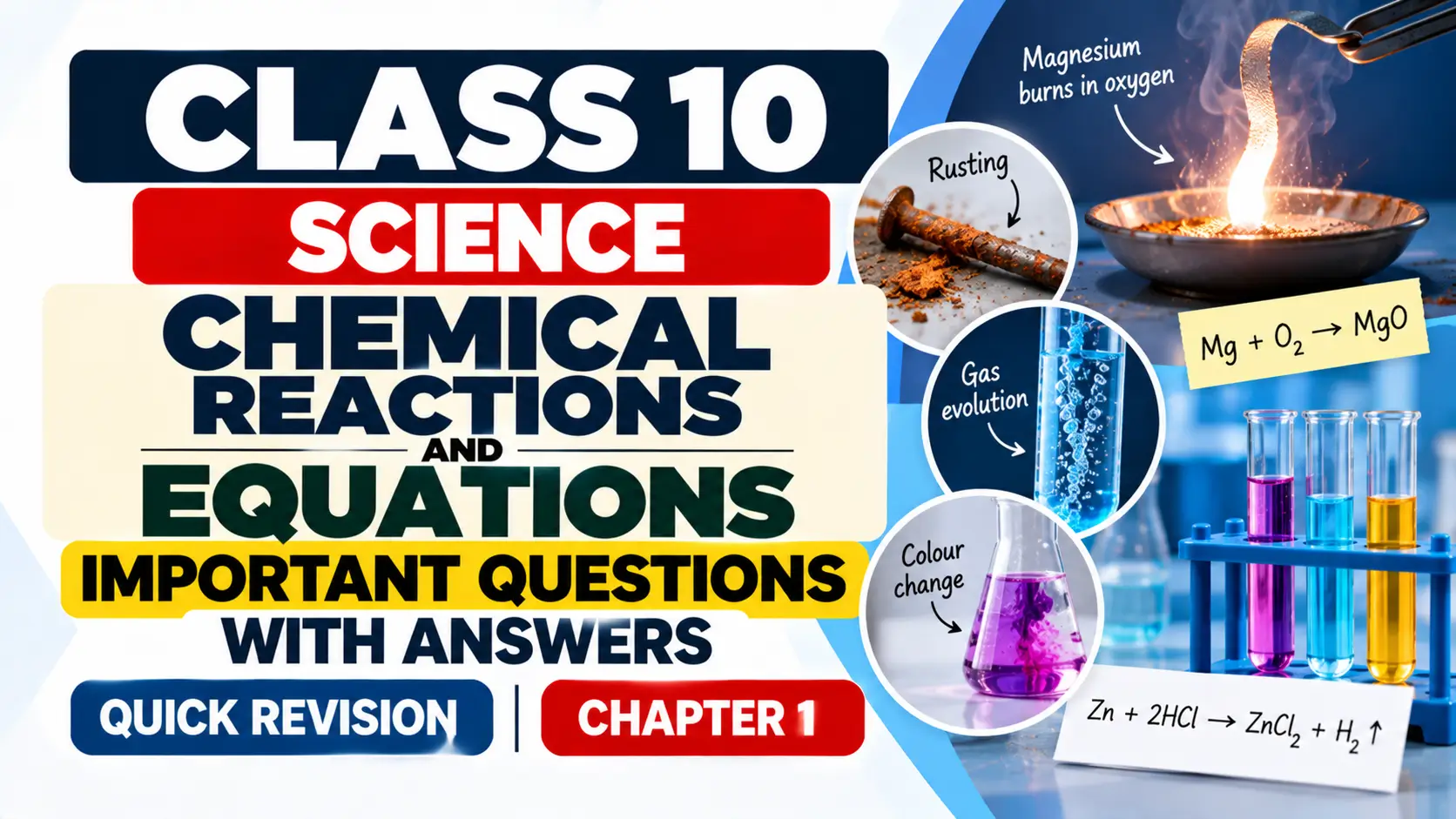
Class 10 Chemical Reactions and Equations Important Questions with Answers
is designed to help students revise one of the most important chapters
of NCERT Class 10 Science.
The chapter Chemical Reactions and Equations introduces
students to chemical reactions, reactants and products, word equations,
skeletal chemical equations and balanced chemical equations.
It also explains the law of conservation of mass and the importance of
balancing chemical equations.
For Board Exam preparation, students should thoroughly revise
combination reactions, decomposition reactions, displacement reactions,
double displacement reactions, precipitation reactions, oxidation,
reduction, redox reactions, exothermic reactions, endothermic reactions,
corrosion and rancidity.
This page contains important Class 10 Chemistry questions,
NCERT-based questions, chemical equations, MCQs, case-based questions,
reaction-type questions and quick revision notes to help students
prepare effectively for examinations.
THE BUSY BRAINS • BY MANSI SARASWAT
CLASS 10 CHEMICAL REACTIONS AND EQUATIONS
Important Questions with Answers
CBSE Science | Pre-Board & Board Exam Preparation
NCERT-Based • Exam-Focused • Quick Revision
1. Chemical Reactions – Important Questions
Q1. What is a chemical reaction?
Answer:
A chemical reaction is a process in which one or more substances
undergo a chemical change to form new substances with different
properties.
Q2. What are reactants?
Answer:
The substances that undergo chemical change during a chemical reaction
are called reactants.
Q3. What are products?
Answer:
The new substances formed during a chemical reaction are called products.
Q4. Mention four observations that indicate that a chemical reaction may have taken place.
Answer: 1. Change in state.
2. Change in colour.
3. Evolution of a gas.
4. Change in temperature.
Q5. Give one example of a chemical reaction from everyday life.
Answer:
Respiration, cooking of food, digestion, fermentation and rusting
are examples involving chemical changes.
Q6. What happens when a magnesium ribbon is burnt in air?
Answer:
Magnesium burns with a dazzling white flame and forms a white powder
of magnesium oxide.
2Mg(s) + O2(g) → 2MgO(s)
Q7. Why is magnesium ribbon cleaned before burning?
Answer:
Magnesium ribbon is cleaned by rubbing it with sandpaper to remove
the thin layer of magnesium oxide present on its surface so that it
can burn properly.
2. Chemical Equations
Q8. What is a word equation?
Answer:
A word equation represents a chemical reaction using the names
of the reactants and products.
Q9. Write the word equation for burning magnesium in oxygen.
Answer:
Magnesium + Oxygen → Magnesium oxide
Q10. What is a chemical equation?
Answer:
A chemical equation represents a chemical reaction using chemical
formulae and symbols.
Q11. What is a skeletal chemical equation?
Answer:
An unbalanced chemical equation representing a chemical reaction
is called a skeletal chemical equation.
Q12. Write the skeletal equation for burning magnesium in oxygen.
Mg + O2 → MgO
Q13. What does the arrow in a chemical equation indicate?
Answer:
The arrow indicates the direction of the chemical reaction from
reactants towards products.
Q14. Where are reactants written in a chemical equation?
Answer:
Reactants are written on the left-hand side of the arrow.
Q15. Where are products written?
Answer:
Products are written on the right-hand side of the arrow.
3. Balanced Chemical Equations
Q16. What is a balanced chemical equation?
Answer:
A chemical equation in which the number of atoms of each element
is the same on both sides of the equation is called a balanced
chemical equation.
Q17. Why should chemical equations be balanced?
Answer:
Chemical equations are balanced to satisfy the law of conservation
of mass. The number of atoms of each element must remain the same
before and after the reaction.
Q18. What law is used while balancing chemical equations?
Answer:
The law of conservation of mass.
Q19. Can the formula of a compound be changed while balancing an equation?
Answer:
No. The chemical formulae must not be changed. Only suitable
coefficients are placed before the formulae.
Q20. Balance the equation: H2 + O2 → H2O.
2H2 + O2 → 2H2O
Q21. Balance: Fe + H2O → Fe3O4 + H2.
3Fe + 4H2O → Fe3O4 + 4H2
Q22. What method of balancing chemical equations is explained in NCERT?
Answer:
The hit-and-trial method is explained. Suitable whole-number
coefficients are tried until the number of atoms of every element
becomes equal on both sides.
Q23. Why should the smallest whole-number coefficients be used?
Answer:
They represent the simplest whole-number ratio of the substances
participating in the chemical reaction.
4. State Symbols and Reaction Conditions
Q24. What does (s) represent in a chemical equation?
Answer:
(s) represents the solid state.
Q25. What does (l) represent?
Answer:
(l) represents the liquid state.
Q26. What does (g) represent?
Answer:
(g) represents the gaseous state.
Q27. What does (aq) represent?
Answer:
(aq) indicates that a substance is present as an aqueous solution,
that is, dissolved in water.
Q28. Why are physical states sometimes written in chemical equations?
Answer:
They provide additional information about the physical state of
reactants and products and make the equation more informative.
Q29. How can reaction conditions be represented in an equation?
Answer:
Conditions such as temperature, pressure, catalyst or sunlight may
be indicated above or below the reaction arrow.
5. Combination Reaction
Q30. What is a combination reaction?
Answer:
A reaction in which two or more substances combine to form a
single product is called a combination reaction.
CaO(s) + H2O(l) → Ca(OH)2(aq) + Heat
Q31. Identify the type of reaction: CaO + H2O → Ca(OH)2.
Answer:
Combination reaction.
Q32. What happens when calcium oxide reacts with water?
Answer:
Calcium oxide reacts vigorously with water to form calcium hydroxide
and releases a large amount of heat.
Q33. Why is the reaction between calcium oxide and water exothermic?
Answer:
Because heat is released during the reaction.
Q34. Write the reaction for burning carbon in oxygen.
C(s) + O2(g) → CO2(g)
Q35. Write the reaction for formation of water from hydrogen and oxygen.
2H2(g) + O2(g) → 2H2O(l)
Q36. Why is respiration considered an exothermic reaction?
Answer:
During respiration, glucose combines with oxygen and releases energy.
Therefore, respiration is an exothermic process.
C6H12O6 + 6O2
→ 6CO2 + 6H2O + Energy
6. Decomposition Reaction
Q37. What is a decomposition reaction?
Answer:
A reaction in which a single reactant breaks down into two or more
simpler substances is called a decomposition reaction.
Q38. Why are decomposition reactions called the opposite of combination reactions?
Answer:
In a combination reaction, two or more substances combine to form
a single product, whereas in decomposition a single substance
breaks down into two or more products.
Answer:
A decomposition reaction carried out by heating is called
thermal decomposition.
CaCO3(s)
→Heat
CaO(s) + CO2(g)
Q40. Write the thermal decomposition reaction of calcium carbonate.
CaCO3 → CaO + CO2
Q41. What happens when ferrous sulphate crystals are heated?
Answer:
Ferrous sulphate crystals lose water on heating and then decompose
to form ferric oxide, sulphur dioxide and sulphur trioxide.
2FeSO4
→Heat
Fe2O3 + SO2 + SO3
Q42. What happens when lead nitrate is heated?
Answer:
Lead nitrate decomposes on heating to form lead oxide, nitrogen
dioxide and oxygen. Brown fumes of nitrogen dioxide are observed.
2Pb(NO3)2
→Heat
2PbO + 4NO2 + O2
Q43. What is an electrolytic decomposition reaction?
Answer:
A decomposition reaction in which electricity supplies the energy
needed for decomposition is called electrolytic decomposition.
2H2O(l)
→Electricity
2H2(g) + O2(g)
Q44. Why is the volume of hydrogen collected during electrolysis of water double the volume of oxygen?
Answer:
Water contains hydrogen and oxygen in a 2:1 ratio. Therefore,
electrolysis of water produces hydrogen and oxygen in a 2:1 volume ratio.
Q45. What happens to silver chloride in sunlight?
Answer:
White silver chloride turns grey because it decomposes into silver
and chlorine in sunlight.
2AgCl(s)
→Sunlight
2Ag(s) + Cl2(g)
Q46. Give one use of the decomposition of silver halides.
Answer:
Such photochemical decomposition reactions are used in black and
white photography.
7. Displacement Reaction
Q47. What is a displacement reaction?
Answer:
A reaction in which one element displaces another element from
its compound is called a displacement reaction.
Fe + CuSO4 → FeSO4 + Cu
Q48. Why does an iron nail become brownish when placed in copper sulphate solution?
Answer:
Iron displaces copper from copper sulphate solution. Copper gets
deposited on the iron nail, giving it a brownish coating.
Q49. Why does the blue colour of copper sulphate solution fade during the iron nail experiment?
Answer:
Copper sulphate is converted into iron sulphate as iron displaces
copper from the solution.
Fe(s) + CuSO4(aq)
→ FeSO4(aq) + Cu(s)
Q50. Write one more example of a displacement reaction.
Zn + CuSO4 → ZnSO4 + Cu
Q51. Why can zinc displace copper from copper sulphate?
Answer:
Zinc is more reactive than copper and therefore displaces copper
from its compound.
Q52. What happens when lead is added to copper chloride?
Pb + CuCl2 → PbCl2 + Cu
Answer:
Lead displaces copper from copper chloride.
8. Double Displacement and Precipitation Reactions
Q53. What is a double displacement reaction?
Answer:
A reaction in which two different atoms or groups of atoms,
usually ions, are exchanged between the reactants is called a
double displacement reaction.
Na2SO4(aq) + BaCl2(aq)
→ BaSO4(s) + 2NaCl(aq)
Q54. What is a precipitation reaction?
Answer:
A reaction in which an insoluble solid is formed from solutions
is called a precipitation reaction.
Q55. What is the precipitate formed when sodium sulphate reacts with barium chloride?
Answer:
Barium sulphate, BaSO4, is formed as a white precipitate.
Q56. Write the balanced equation for the formation of barium sulphate.
Na2SO4(aq) + BaCl2(aq)
→ BaSO4(s) + 2NaCl(aq)
Q57. Why is barium sulphate called a precipitate?
Answer:
It is an insoluble solid formed when two aqueous solutions react.
Q58. Give an example of a double displacement reaction other than barium sulphate formation.
AgNO3(aq) + NaCl(aq)
→ AgCl(s) + NaNO3(aq)
9. Exothermic and Endothermic Reactions
Q59. What is an exothermic reaction?
Answer:
A reaction in which heat is released along with the products
is called an exothermic reaction.
Q60. Give two examples of exothermic reactions.
Answer: 1. Burning of natural gas.
2. Respiration.
CH4 + 2O2 → CO2 + 2H2O + Energy
Q61. What is an endothermic reaction?
Answer:
A reaction in which energy is absorbed is called an endothermic reaction.
Q62. Give examples of endothermic decomposition reactions.
Answer:
Thermal decomposition, photochemical decomposition and electrolytic
decomposition require energy in the form of heat, light or electricity.
Q63. Is the decomposition of calcium carbonate exothermic or endothermic?
Answer:
It is an endothermic decomposition reaction because heat is supplied.
Q64. Why is respiration an exothermic process?
Answer:
Glucose reacts with oxygen and energy is released. Therefore,
respiration is exothermic.
⭐ BOARD EXAM TIP:
Remember:
Exothermic → Heat/Energy is released. Endothermic → Energy is absorbed.
10. Oxidation, Reduction and Redox Reactions
Q65. What is oxidation in terms of oxygen?
Answer:
Oxidation is the gain of oxygen by a substance.
Q66. What is reduction in terms of oxygen?
Answer:
Reduction is the loss of oxygen by a substance.
Q67. What is oxidation in terms of hydrogen?
Answer:
Oxidation can also be described as loss of hydrogen.
Q68. What is reduction in terms of hydrogen?
Answer:
Reduction can also be described as gain of hydrogen.
Q69. What is a redox reaction?
Answer:
A reaction in which oxidation and reduction take place simultaneously
is called an oxidation-reduction or redox reaction.
CuO + H2
→ Cu + H2O
Q70. Identify the substance oxidised and the substance reduced in CuO + H2 → Cu + H2O.
Answer:
CuO loses oxygen and is reduced.
H2 gains oxygen and is oxidised.
Q71. What happens when copper powder is heated in air?
Answer:
Copper reacts with oxygen and a black coating of copper(II) oxide forms.
2Cu + O2
→ 2CuO
Q72. What happens when hydrogen is passed over heated copper oxide?
Answer:
The black copper oxide is reduced to brown copper and water is formed.
CuO + H2
→ Cu + H2O
Q73. Identify the oxidised and reduced substances in ZnO + C → Zn + CO.
Answer:
ZnO is reduced to Zn, while carbon is oxidised to carbon monoxide.
Q74. Identify the oxidised and reduced substances in MnO2 + 4HCl → MnCl2 + 2H2O + Cl2.
Answer:
MnO2 is reduced to MnCl2, while HCl is oxidised to chlorine.
11. Corrosion – Important Questions
Q75. What is corrosion?
Answer:
When a metal is attacked by substances around it such as moisture
or acids, it is said to corrode. This process is called corrosion.
Q76. What is rusting of iron?
Answer:
Rusting is the corrosion of iron in which iron articles develop
a reddish-brown coating after exposure to suitable environmental conditions.
Q77. Give two examples of corrosion other than rusting of iron.
Answer:
The black coating formed on silver and the green coating formed
on copper are examples of corrosion.
Q78. Why is corrosion harmful?
Answer:
Corrosion damages metal objects such as car bodies, bridges,
iron railings, ships and other structures.
Q79. Why do we apply paint on iron articles?
Answer:
Paint forms a protective layer that prevents the iron surface from
coming into contact with air and moisture, thereby reducing corrosion.
Q80. Give examples of coloured coatings formed due to corrosion.
Answer: • Iron – reddish-brown rust.
• Silver – black coating.
• Copper – green coating.
Answer:
When fats and oils are oxidised, the food becomes rancid and
its smell and taste change. This process is called rancidity.
Q82. What causes rancidity?
Answer:
Oxidation of fats and oils causes rancidity.
Q83. How can rancidity be prevented?
Answer: 1. Add antioxidants to food containing fats and oils.
2. Store food in airtight containers.
3. Chips packets may be flushed with nitrogen to slow oxidation.
Q84. Why are chips packets flushed with nitrogen?
Answer:
Nitrogen helps prevent oxidation of the fats and oils present in
the chips and therefore helps slow down rancidity.
Q85. What are antioxidants?
Answer:
Antioxidants are substances that help prevent or slow down oxidation.
13. NCERT Exercise-Based Questions with Answers
Q86. Consider the reaction: 2PbO(s) + C(s) → 2Pb(s) + CO2(g). Which statements are incorrect?
Answer:
Lead oxide is reduced and carbon is oxidised. Carbon dioxide is not
getting oxidised. The incorrect statements are the ones saying that
lead itself is getting reduced and carbon dioxide is getting oxidised.
Q87. Fe2O3 + 2Al → Al2O3 + 2Fe is an example of which type of reaction?
Answer:
It is a displacement reaction and also a redox reaction.
Q88. What happens when dilute hydrochloric acid is added to iron filings?
Answer:
Iron reacts with dilute hydrochloric acid to form iron chloride
and hydrogen gas.
Fe + 2HCl → FeCl2 + H2
Q89. What is a balanced chemical equation? Why should chemical equations be balanced?
Answer:
A balanced chemical equation has the same number of atoms of each
element on both sides. Equations are balanced to satisfy the law
of conservation of mass.
Q90. Write and balance: Hydrogen gas combines with nitrogen to form ammonia.
N2 + 3H2
→ 2NH3
Q91. Write and balance: Hydrogen sulphide burns in air to give water and sulphur dioxide.
2H2S + 3O2
→ 2H2O + 2SO2
Q92. Write and balance: Barium chloride reacts with aluminium sulphate.
3BaCl2 + Al2(SO4)3
→ 3BaSO4 + 2AlCl3
Q93. Write and balance: Potassium reacts with water.
Q126. A reaction in which one element displaces another from its compound is called:
(a) Combination
(b) Decomposition
(c) Displacement
(d) Double displacement
Answer: (c) Displacement
Q127. Which reaction is an example of double displacement?
(a) Zn + CuSO4 → ZnSO4 + Cu
(b) CaCO3 → CaO + CO2
(c) Na2SO4 + BaCl2 → BaSO4 + 2NaCl
(d) C + O2 → CO2
Answer: (c)
Q128. Which reaction is exothermic?
(a) Decomposition of calcium carbonate
(b) Respiration
(c) Electrolysis of water
(d) Photochemical decomposition
Answer: (b) Respiration
Q129. Oxidation means:
(a) Loss of oxygen
(b) Gain of oxygen
(c) Gain of hydrogen only
(d) No change
Answer: (b) Gain of oxygen
Q130. Reduction means:
(a) Gain of oxygen
(b) Loss of oxygen
(c) Gain of carbon
(d) Loss of metal
Answer: (b) Loss of oxygen
Q131. Which coating is formed on silver due to corrosion?
(a) Green
(b) Black
(c) Brown
(d) White
Answer: (b) Black
Q132. Which gas is used in chips packets to reduce rancidity?
(a) Oxygen
(b) Hydrogen
(c) Nitrogen
(d) Chlorine
Answer: (c) Nitrogen
Q133. Which of the following is NOT a sign of a chemical reaction?
(a) Change in colour
(b) Evolution of gas
(c) Change in temperature
(d) Change in size without chemical change
Answer: (d)
Q134. The black coating formed when copper is heated in air is:
(a) CuSO4
(b) CuO
(c) CuCl2
(d) CuCO3
Answer: (b) CuO
Q135. The white precipitate formed in Na2SO4 + BaCl2 is:
(a) NaCl
(b) BaSO4
(c) BaCl2
(d) Na2SO4
Answer: (b) BaSO4
Q136. Which reaction is a redox reaction?
(a) CuO + H2 → Cu + H2O
(b) NaCl → NaCl
(c) Water freezing
(d) Melting of ice
Answer: (a)
17. Case-Based Questions – Chemical Reactions and Equations
Case Study 1 – Magnesium Ribbon
A student cleans a magnesium ribbon with sandpaper and burns it in air.
It burns with a dazzling white flame and produces a white powder.
(a) Why is magnesium cleaned before burning?
Answer:
To remove the layer of magnesium oxide from its surface.
(b) Name the white powder.
Answer:
Magnesium oxide.
(c) Write the balanced equation.
2Mg + O2 → 2MgO
(d) Identify the reaction type.
Answer:
Combination reaction and oxidation.
Case Study 2 – Iron Nail and Copper Sulphate
An iron nail is placed in copper sulphate solution for some time.
The blue colour of the solution fades and a brownish coating appears
on the iron nail.
(a) Which metal is deposited on the iron nail?
Answer:
Copper.
(b) Why does iron displace copper?
Answer:
Iron is more reactive than copper.
(c) Write the equation.
Fe + CuSO4 → FeSO4 + Cu
(d) Identify the reaction.
Answer:
Displacement reaction.
Case Study 3 – Barium Sulphate Precipitate
Sodium sulphate solution is mixed with barium chloride solution.
A white insoluble substance is formed.
(a) Name the white substance.
Answer:
Barium sulphate.
(b) What is a precipitate?
Answer:
An insoluble solid formed during a reaction in solution.
(c) Write the equation.
Na2SO4 + BaCl2
→ BaSO4 + 2NaCl
(d) Identify the reaction type.
Answer:
Double displacement and precipitation reaction.
Case Study 4 – Copper and Hydrogen
Black copper oxide is heated in the presence of hydrogen.
The black coating turns brown and water is formed.
(a) Name the brown substance.
Answer:
Copper.
(b) Which substance is reduced?
Answer:
Copper oxide is reduced because it loses oxygen.
(c) Which substance is oxidised?
Answer:
Hydrogen is oxidised because it gains oxygen.
(d) Name the reaction.
Answer:
Redox reaction.
Case Study 5 – Rancidity
A packet of chips is stored for a long time. Manufacturers fill
chips packets with nitrogen gas to reduce the contact of the food
with oxygen.
(a) What is rancidity?
Answer:
Oxidation of fats and oils resulting in unpleasant smell and taste.
(b) Why is nitrogen used?
Answer:
Nitrogen helps reduce oxidation of fats and oils.
(c) Name substances that can slow oxidation in food.
Answer:
Antioxidants.
⚡ Quick Revision – Chemical Reactions and Equations
Concept
Remember
Chemical reaction
Formation of new substances due to chemical change
Reactants
Substances that undergo chemical change
Products
New substances formed
Balanced equation
Same number of atoms of each element on both sides
Combination
Two or more reactants → One product
Decomposition
One reactant → Two or more products
Displacement
One element displaces another
Double displacement
Exchange of ions/groups between reactants
Precipitation
Formation of insoluble solid
Exothermic
Energy/heat released
Endothermic
Energy absorbed
Oxidation
Gain of oxygen / loss of hydrogen
Reduction
Loss of oxygen / gain of hydrogen
Redox
Oxidation and reduction occur together
Corrosion
Attack of metals by surrounding substances
Rancidity
Oxidation of fats and oils
18. Class 10 Board Exam Checklist
Before your Class 10 Science examination, make sure you can:
✔ Define chemical reaction.
✔ Identify reactants and products.
✔ Write word equations.
✔ Convert word equations into chemical equations.
✔ Balance chemical equations using the hit-and-trial method.
✔ Use state symbols correctly.
✔ Identify reaction conditions such as heat, sunlight and electricity.
✔ Identify combination reactions.
✔ Identify decomposition reactions.
✔ Identify displacement reactions.
✔ Identify double displacement reactions.
✔ Identify precipitation reactions.
✔ Differentiate exothermic and endothermic reactions.
✔ Explain oxidation and reduction.
✔ Identify redox reactions.
✔ Explain corrosion with examples.
✔ Explain rancidity and its prevention.
✔ Practise all important NCERT chemical equations.
✔ Practise reaction-type questions.
✔ Solve NCERT exercise questions.
✔ Practise MCQs and case-based questions.
🎯 Exam Strategy for Chemical Reactions and Equations
1. Master balancing first.
Balancing chemical equations is the foundation of this chapter.
Practise coefficients rather than changing chemical formulae.
2. Learn the four major reaction types.
Remember the difference between combination, decomposition,
displacement and double displacement reactions.
3. Learn the important equations.
Practise equations involving magnesium, calcium carbonate,
iron and copper sulphate, barium sulphate, silver chloride,
copper oxide and hydrogen.
4. Do not confuse oxidation and reduction.
Use the simple rule:
Gain of oxygen = oxidation and
Loss of oxygen = reduction.
5. Revise everyday-life applications.
Corrosion and rancidity are important application-based topics.
Remember their causes and prevention methods.
📌 Ready for Your Class 10 Science Exam?
Revise these Chemical Reactions and Equations Important Questions
with Answers, practise the chemical equations and then solve
MCQs and case-based questions.
For complete preparation, revise the other
Class 10 Science Important Questions available on
The Busy Brains.
Finished revising
Chemical Reactions and Equations?
Check important questions from other Class 10 Science chapters
for quick and effective Board Exam revision.




Class 10 Science Important Questions With Answers | All Chapters | CBSE Board Exam - The Busy Brains
[…] Equations Balancing Redox Corrosion Rancidity View Chapter 1 Questions → Chapter […]